 Uri dhino ripi? Kwizi
 Hondo yemadhino
 Mujaho wemadhino
 Mitambo midiki yemadhino
 Arubhamu yemasitika
 Rondedzero dzeTOP dzemadhino
 Ndishamise!
Rairarama rini?

Raiva hombe sei?
Raiva refu zvakadii?
 kureba sekatsi dzemumba 5 kubva pamhino kusvika kumuswe🍌kureba semabhanana 14 akatevedzana🏃raigona kumhanya mamita 100 mumasekonzi 8.8 (munhu anomhanya kupfuura vose anoda 9.6)
Haolong raiva hombe sei kana richienzaniswa NEWE?
Masvomhu chete mubrowser yako. Hapana chinochengetwa kana kutumirwa kupi zvako.
Raimhanya zvakadii?


Zvinonakidza
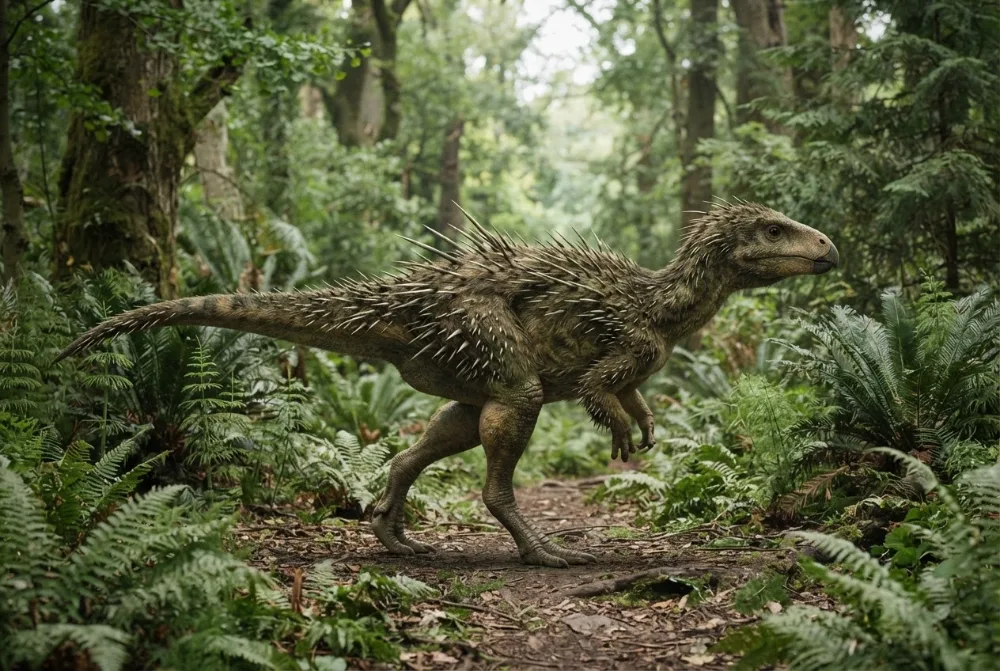
Haolong's skin had large overlapping scales on its tail and smaller bumpy scales around its neck and chest.2
The spikes on Haolong were hollow and made of keratin, the same stuff as your fingernails.2
Scientists could see the preserved nuclei of skin cells in Haolong's spikes under a microscope.2
Haolong's spikes were different from the feathers of meat-eating dinosaurs and the spines of modern lizards.12
Mibvunzo inonyanya kubvunzwa nezve Haolong
?How big was Haolong?
About 2.45 metres (8 feet) long. That is about the size of a small motorcycle.1
?Did Haolong have feathers?
No. Its skin had scales and hollow spikes made of keratin, not feathers.12
?What did Haolong eat?
It was a plant-eater, so it ate leaves and other plants.3
?When did Haolong live?
About 125 million years ago, during the Early Cretaceous period.1
?Where was Haolong found?
In Liaoning Province, northeastern China, in the Yixian Formation.1
Zvevanyanzvi vemadhino
- Zita resainzi
- Haolong
- Akaripa zita:
- Huang et al. 20264
- Boka
- Vanodya miriwo vane miromo
- Mhuri / boka
- Hadrosauroidea4
- Kurongwa kwemhuka
- Ornithischia > Ornithopoda > Iguanodontia4
- Zera rematombo
- makore mamiriyoni 126 kusvika 121 (Barremian)4
- Mapoka ematombo
- Yixian4
- Nyika
- China4
- Zvinyorwa zvemafosiri
- 1 mu The Paleobiology Database4
- Kuwanikwa
- Haolong was named in 2026 by a team of scientists led by J. Huang. The name honors the famous Chinese paleontologist Dong Zhiming.14
- Zvichiri kupokanwa
- Scientists are not sure if adult Haolong also had spikes, because the only known fossil is a juvenile.1
Kunobva chokwadi
- Haolong (en.wikipedia.org)
- Cellular-level preservation of cutaneous spikes in an Early Cretaceous iguanodontian dinosaur | Nature Ecology & Evolution (nature.com)
- A dinosaur with spikes exhibiting unprecedented properties discovered in China | CNRS (cnrs.fr)
- Haolong in The Paleobiology Database (CC BY 4.0): zera, nzvimbo, mapoka ematombo, kurongwa kwemhuka.
Chokwadi chega chega papeji ino chine nhamba inoratidza kwachakabva. Kana takakanganisa chimwe chinhu, ruregerero, tiri vanoda madhino, kwete magazini yesainzi. Tiudze pa [email protected] tichazvigadzirisa.
 Rex ane nzara! Dino Wiki ipurojekiti yababa yemwanakomana wavo anoda madhino, mahara, pasina kushambadza uye pasina zvinokutevera. Vakuru vanogona kupa Rex chekudyadya kuti vabatsire kuchengeta saiti iri pamhepo.Fudza Rex
 Iguanodon
 Tenontosaurus
 Thescelosaurus
 Zalmoxes
 Camptosaurus
 Rhabdodon
 Stegosaurus
 Archaeopteryx
 Giganotosaurus
 Microraptor
 Deinonychus
 Baryonyx