 Uri dhino ripi? Kwizi
 Hondo yemadhino
 Mujaho wemadhino
 Mitambo midiki yemadhino
 Arubhamu yemasitika
 Rondedzero dzeTOP dzemadhino
 Ndishamise!
Rairarama rini?

Raiva hombe sei?
Raiva refu zvakadii?
Raiva rakakwirira zvakadii?
fungidziro
Rairema zvakadii?
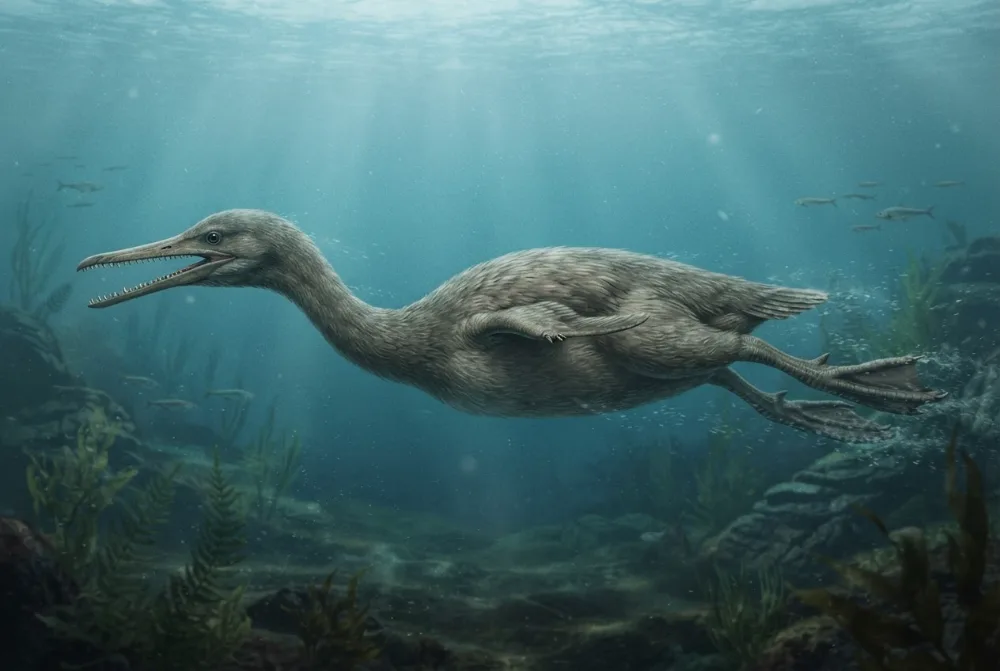
 kureba sekatsi dzemumba 4 kubva pamhino kusvika kumuswe🍌kureba semabhanana 10 akatevedzana🍌kurema semabhanana 88🏊raigona kushambira kureba kwedziva guru rekushambira (50 m) mumasekonzi 11
Hesperornis raiva hombe sei kana richienzaniswa NEWE?
Masvomhu chete mubrowser yako. Hapana chinochengetwa kana kutumirwa kupi zvako.
Raimhanya zvakadii?


Zvinonakidza
Hesperornis was one of the first birds to give up flying and become a full-time swimmer.2
Its legs were placed far back on its body, like a loon, making it clumsy on land but a powerful diver.1
The first fossils of Hesperornis were found by famous fossil hunter Othniel Charles Marsh in 1870 in Kansas.12
Several species of Hesperornis lived from about 90 to 66 million years ago, during the Late Cretaceous.5
Hesperornis fossils have been found in many places, including Canada, the United States, Russia, and Sweden.5
Mibvunzo inonyanya kubvunzwa nezve Hesperornis
?How big was Hesperornis?
About 1.5 to 2 metres (4.9 to 6.6 ft) long and weighed around 10.6 kilograms (23 lb).1
?Did Hesperornis have teeth?
Yes, it had teeth in its beak, which is rare for birds. The teeth sat in a groove, not in individual sockets.1
?Could Hesperornis fly?
No, it could not fly. Its wings were tiny and useless for flight, and its breastbone lacked a keel for flight muscles.13
?What did Hesperornis eat?
It ate fish, which it caught with its tooth-lined beak while diving in the sea.4
?When did Hesperornis live?
It lived during the Late Cretaceous period, about 83.6 to 72 million years ago, and possibly into the early Maastrichtian.1
?Where was Hesperornis found?
Fossils have been found in Kansas, Canada, Russia, Sweden, and other places, mostly in marine rocks.1
?Could Hesperornis walk on land?
It was clumsy on land. Its legs were placed far back, so it probably pushed itself along on its belly like a seal.1
Mubvisi wengano
Ngano: Some people think Hesperornis was a dinosaur.
Chokwadi: Hesperornis was a bird, not a dinosaur. Birds evolved from dinosaurs, but Hesperornis itself is classified as a bird.1
Zvevanyanzvi vemadhino
- Zita resainzi
- Hesperornis
- Akaripa zita:
- Marsh 18725
- Boka
- Shiri dzekutanga
- Mhuri / boka
- Hesperornithidae5
- Kurongwa kwemhuka
- Theropoda > Avialae5
- Zera rematombo
- makore mamiriyoni 90 kusvika 66 (Coniacian / Maastrichtian)5
- Mapoka ematombo
- Pierre Shale, Rybushka, Niobrara5
- Nyika
- Kanada, Amerika, Russia, Sweden5
- Zvinyorwa zvemafosiri
- 65 mu The Paleobiology Database5
- Rinonziwo
- Coniornis, Hargeria, Lestornis (mazita ekare zvino oonekwa semhuka imwe chete)5
- Kuwanikwa
- Othniel Charles Marsh discovered the first Hesperornis fossil in 1870 near the Smoky Hill River in Kansas. He named it Hesperornis regalis in 1872.12
- Zvichiri kupokanwa
- Scientists are still debating exactly how many species of Hesperornis existed, because many fossils are incomplete.1
Kunobva chokwadi
- Hesperornis (en.wikipedia.org)
- The Hesperornithiformes: A Review of the Diversity, Distribution, and Ecology of the Earliest Diving Birds (mdpi.com)
- Hesperornis - Scholars | Britannica Kids | Encyclopedia (kids.britannica.com)
- Hesperornis Facts, Artwork, Information - National Geographic | National Geographic (nationalgeographic.com)
- Hesperornis in The Paleobiology Database (CC BY 4.0): zera, nzvimbo, mapoka ematombo, kurongwa kwemhuka.
Chokwadi chega chega papeji ino chine nhamba inoratidza kwachakabva. Kana takakanganisa chimwe chinhu, ruregerero, tiri vanoda madhino, kwete magazini yesainzi. Tiudze pa [email protected] tichazvigadzirisa.
 Rex ane nzara! Dino Wiki ipurojekiti yababa yemwanakomana wavo anoda madhino, mahara, pasina kushambadza uye pasina zvinokutevera. Vakuru vanogona kupa Rex chekudyadya kuti vabatsire kuchengeta saiti iri pamhepo.Fudza Rex
 Archaeopteryx
 Ichthyornis
 Baptornis
 Jurapteryx
 Gobipteryx
 Martinavis
 Tyrannosaurus
 Triceratops
 Velociraptor
 Spinosaurus
 Ankylosaurus
 Parasaurolophus