 Uri dhino ripi? Kwizi
 Hondo yemadhino
 Mujaho wemadhino
 Mitambo midiki yemadhino
 Arubhamu yemasitika
 Rondedzero dzeTOP dzemadhino
 Ndishamise!
Rairarama rini?

Raiva hombe sei?
Raiva refu zvakadii?
Raiva rakakwirira zvakadii?
Ichthyornis raiva hombe sei kana richienzaniswa NEWE?
Masvomhu chete mubrowser yako. Hapana chinochengetwa kana kutumirwa kupi zvako.
Raimhanya zvakadii?


Zvinonakidza
Ichthyornis was one of the first prehistoric birds discovered with teeth, and Charles Darwin said it was important for understanding evolution.1
Its backbone bones were shaped like a fish's, which is why it got the name 'fish bird'.1
The beak of Ichthyornis was made of several separate plates, like an albatross's beak, not a single piece like most modern birds.1
Ichthyornis lived between about 93 and 83.5 million years ago, during the Late Cretaceous Period.1
Over time, Ichthyornis grew larger: older fossils have a wing bone about 58 mm long, while younger ones have a wing bone about 71.5 mm long.1
Its teeth were curved backward and set in a groove, similar to those of marine reptiles like mosasaurs.1
Ichthyornis is one of the closest extinct relatives of modern birds, helping scientists learn how today's birds evolved.1
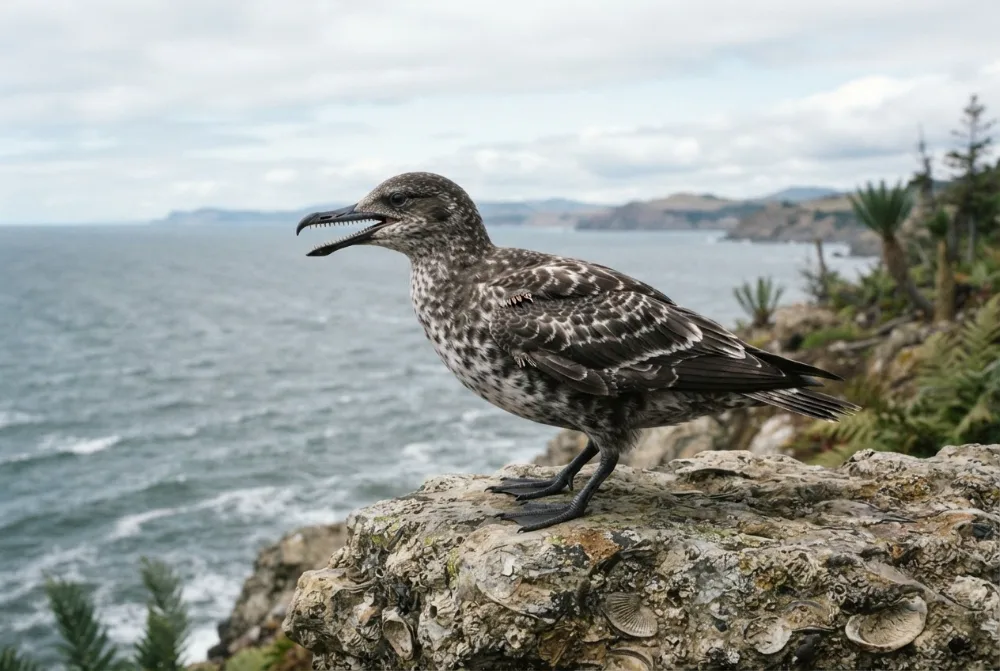
Mibvunzo inonyanya kubvunzwa nezve Ichthyornis
?How big was Ichthyornis?
About 24 centimetres (9.4 inches) long, with a skeletal wingspan of around 43 centimetres (17 inches). That is about the size of a pigeon.1
?Did Ichthyornis have teeth?
Yes, it had sharp, backward-curved teeth in the middle part of its jaws. The tips of its jaws had no teeth and were covered by a beak.1
?Could Ichthyornis fly?
Yes, it was a strong flier. Its wings and breastbone looked very modern, similar to birds that fly well today.1
?What did Ichthyornis eat?
It probably ate fish and other small sea animals, like modern gulls and terns. Its teeth helped it grab slippery prey.2
?When did Ichthyornis live?
It lived during the Late Cretaceous Period, from about 93 million to 83.5 million years ago.1
?Where did Ichthyornis live?
It lived along the coasts of the huge inland sea that covered the middle of North America. Its fossils have been found in Kansas, Texas, Alberta, and other places.1
?Is Ichthyornis a dinosaur?
Yes, birds evolved from dinosaurs, so Ichthyornis is a type of dinosaur called an avialan. But it is not a non-avian dinosaur like T. rex.1
Mubvisi wengano
Ngano: Ichthyornis is sometimes thought to be a dinosaur like T. rex.
Chokwadi: Ichthyornis is a bird, not a non-avian dinosaur. It belongs to the group Avialae, which includes modern birds and their extinct relatives.1
Zvevanyanzvi vemadhino
- Zita resainzi
- Ichthyornis
- Akaripa zita:
- Marsh 18724
- Boka
- Shiri dzekutanga
- Mhuri / boka
- Ichthyornithes4
- Kurongwa kwemhuka
- Theropoda > Avialae4
- Zera rematombo
- makore mamiriyoni 100 kusvika 72 (Cenomanian / Campanian)4
- Mapoka ematombo
- Niobrara, Mooreville Chalk, Belle Fourche4
- Nyika
- Amerika, Kanada, Uzbekistan, Mexico4
- Zvinyorwa zvemafosiri
- 33 mu The Paleobiology Database4
- Rinonziwo
- Angelinornis, Colonosaurus, Plegadornis (mazita ekare zvino oonekwa semhuka imwe chete)4
- Kuwanikwa
- Ichthyornis was named by American paleontologist Othniel Charles Marsh in 1872. At first, Marsh thought the toothed jaws belonged to a marine reptile, but later in 1873 he realized they were part of the bird.12
- Zvichiri kupokanwa
- Scientists still debate whether the species should be called Ichthyornis dispar or Ichthyornis anceps, because of naming rules.1
Kunobva chokwadi
- Ichthyornis (en.wikipedia.org)
- Ichthyornis | Cretaceous period, seabird, toothed beak (britannica.com)
- A New Specimen of the Late Cretaceous Bird, cf.Ichthyornissp., from the Cenomanian of Central Kansas, with Comments on the Size Distribution ofIchthyornisin North America (exa.ai)
- Ichthyornis in The Paleobiology Database (CC BY 4.0): zera, nzvimbo, mapoka ematombo, kurongwa kwemhuka.
Chokwadi chega chega papeji ino chine nhamba inoratidza kwachakabva. Kana takakanganisa chimwe chinhu, ruregerero, tiri vanoda madhino, kwete magazini yesainzi. Tiudze pa [email protected] tichazvigadzirisa.
 Rex ane nzara! Dino Wiki ipurojekiti yababa yemwanakomana wavo anoda madhino, mahara, pasina kushambadza uye pasina zvinokutevera. Vakuru vanogona kupa Rex chekudyadya kuti vabatsire kuchengeta saiti iri pamhepo.Fudza Rex
 Archaeopteryx
 Hesperornis
 Baptornis
 Jurapteryx
 Gobipteryx
 Martinavis
 Tyrannosaurus
 Triceratops
 Velociraptor
 Spinosaurus
 Ankylosaurus
 Parasaurolophus