 Uri dhino ripi? Kwizi
 Hondo yemadhino
 Mujaho wemadhino
 Mitambo midiki yemadhino
 Arubhamu yemasitika
 Rondedzero dzeTOP dzemadhino
 Ndishamise!
Maiaspondylus
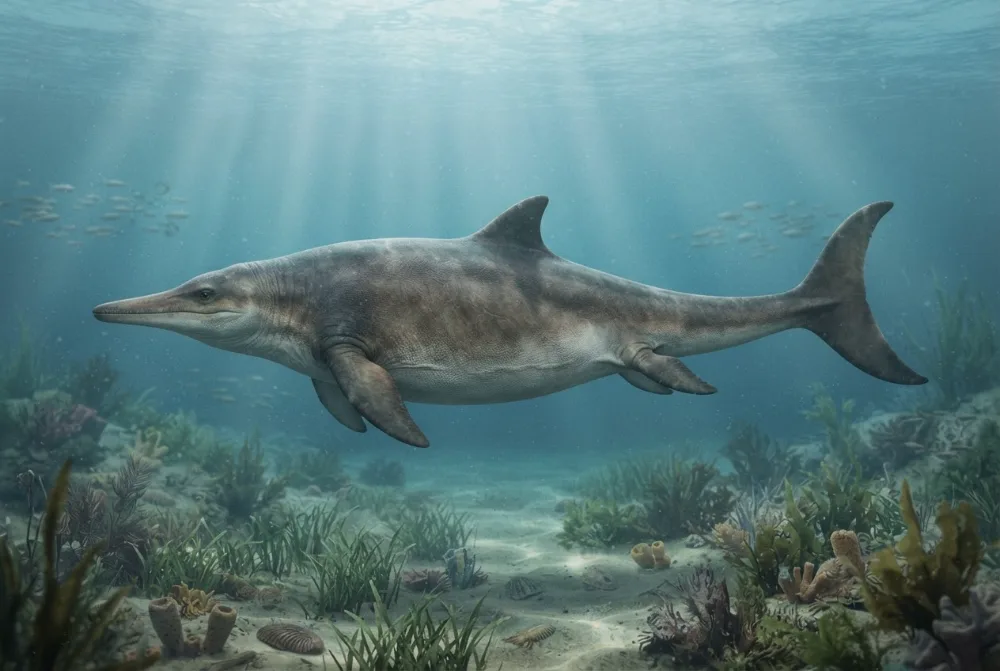
Maiaspondylus was a marine reptile that lived in the sea, not a dinosaur. It was an ichthyosaur, a fast-swimming predator with a long snout and sharp teeth. Fossils show that it gave birth to live babies, just like whales and dolphins do today.1
Rairarama rini?
Raiva hombe sei?
Raiva refu zvakadii?
 kureba seimbwa 4 kubva pamhino kusvika kumuswe🍌kureba semabhanana 22 akatevedzana🏊raigona kushambira kureba kwedziva guru rekushambira (50 m) mumasekonzi 3.8
Maiaspondylus raiva hombe sei kana richienzaniswa NEWE?
Masvomhu chete mubrowser yako. Hapana chinochengetwa kana kutumirwa kupi zvako.
Raimhanya zvakadii?


Zvinonakidza
Maiaspondylus means 'caring mother vertebra' because a fossil was found with two embryos inside an adult, showing it gave live birth.1
The embryos found inside the adult are the smallest and youngest ichthyosaur embryos ever discovered.1
Maiaspondylus lived about 110 million years ago during the Early Cretaceous period.1
Its fossils were first found in the Loon River Formation in Canada's Northwest Territories.1
Maiaspondylus had a special skull bone arrangement: the jugal and maxilla overlapped a lot, which helped scientists tell it apart from other ichthyosaurs.2
Its teeth had smooth crowns and fluted cementum (the root covering), and they curved inward toward the tongue.2
The arm bone (humerus) of Maiaspondylus had three knobs at the end for muscles, with the middle knob smaller than the outer ones.2
Mibvunzo inonyanya kubvunzwa nezve Maiaspondylus
?How big was Maiaspondylus?
No one knows for sure because no complete skeleton has been found. The known fossils include a nearly complete skeleton and vertebrae from adults, but scientists have not estimated its total length.1
?Did Maiaspondylus give live birth?
Yes. A fossil of an adult Maiaspondylus was found with two embryos inside, proving it gave birth to live babies, just like whales and dolphins.13
?Where was Maiaspondylus found?
Its fossils were first found in the Loon River Formation in Canada's Northwest Territories. Later, fossils were also found in England and Russia.1
Zvevanyanzvi vemadhino
- Zita resainzi
- Maiaspondylus
- Akaripa zita:
- Maxwell and Caldwell 20064
- Boka
- Maikitiyosauro
- Mhuri / boka
- Ophthalmosauridae4
- Kurongwa kwemhuka
- Ichthyosauria > Ichthyosauromorpha4
- Zera rematombo
- makore mamiriyoni 110 kusvika 106 (Albian)4
- Mapoka ematombo
- Loon River4
- Nyika
- Kanada4
- Zvinyorwa zvemafosiri
- 1 mu The Paleobiology Database4
- Kuwanikwa
- Maiaspondylus was named by scientists Erin Maxwell and Michael Caldwell in 2006. The fossils were found by technician Allan Lindoe, who collected and prepared them.1
- Zvichiri kupokanwa
- Scientists are still debating exactly how Maiaspondylus is related to other ichthyosaurs, especially the genus Platypterygius.1
Kunobva chokwadi
- Maiaspondylus (en.wikipedia.org)
- A NEW GENUS OF ICHTHYOSAUR FROM THE LOWER CRETACEOUS OF WESTERN CANADA (onlinelibrary.wiley.com)
- Pregnant prehistoric fossil offers clues to past | EurekAlert! (eurekalert.org)
- Maiaspondylus in The Paleobiology Database (CC BY 4.0): zera, nzvimbo, mapoka ematombo, kurongwa kwemhuka.
Chokwadi chega chega papeji ino chine nhamba inoratidza kwachakabva. Kana takakanganisa chimwe chinhu, ruregerero, tiri vanoda madhino, kwete magazini yesainzi. Tiudze pa [email protected] tichazvigadzirisa.
 Rex ane nzara! Dino Wiki ipurojekiti yababa yemwanakomana wavo anoda madhino, mahara, pasina kushambadza uye pasina zvinokutevera. Vakuru vanogona kupa Rex chekudyadya kuti vabatsire kuchengeta saiti iri pamhepo.Fudza Rex
 Ichthyosaurus
 Platypterygius
 Stenopterygius
 Khudiakovia
 Ophthalmosaurus
 Chonespondylus
 Stegosaurus
 Iguanodon
 Archaeopteryx
 Giganotosaurus
 Microraptor
 Deinonychus