 Uri dhino ripi? Kwizi
 Hondo yemadhino
 Mujaho wemadhino
 Mitambo midiki yemadhino
 Arubhamu yemasitika
 Rondedzero dzeTOP dzemadhino
 Ndishamise!
Rairarama rini?

Raiva hombe sei?
Raiva refu zvakadii?
Raiva rakakwirira zvakadii?
fungidziro
Rairema zvakadii?
 kureba seimbwa 3 kubva pamhino kusvika kumuswe🍌kureba semabhanana 17 akatevedzana🍉kurema semanwiwa 70🧸kurema sevana vekireshi 18🎒kurema sevana vechikoro 11🏃raigona kumhanya mamita 100 mumasekonzi 13 (munhu anomhanya kupfuura vose anoda 9.6)
Neimongosaurus raiva hombe sei kana richienzaniswa NEWE?
Masvomhu chete mubrowser yako. Hapana chinochengetwa kana kutumirwa kupi zvako.
Raimhanya zvakadii?


Zvinonakidza
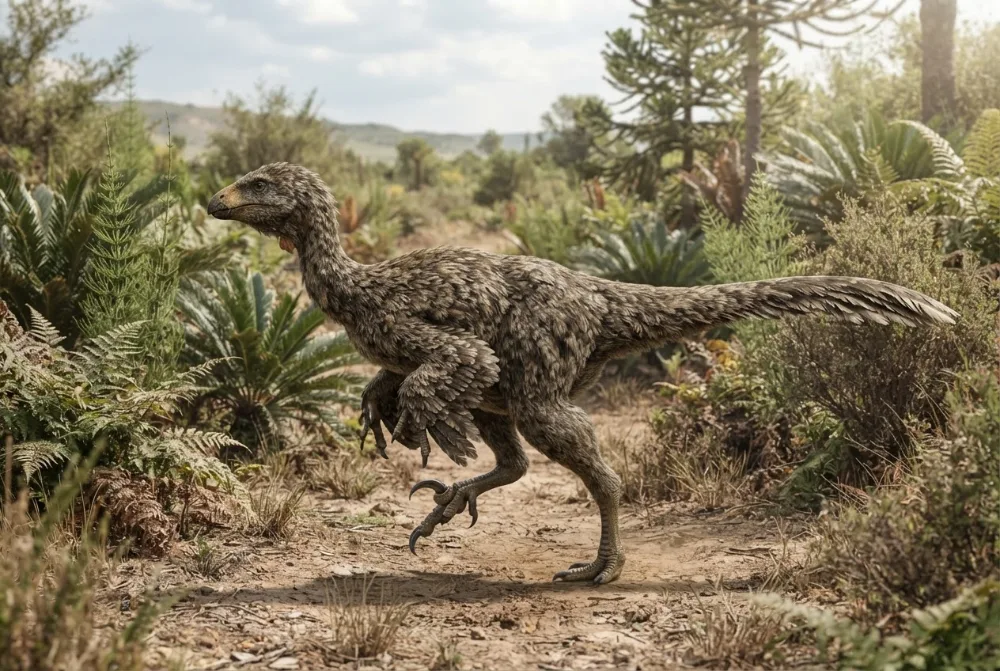
Neimongosaurus had one of the longest necks of any non-bird theropod, with about 14 neck vertebrae. That is more than most other meat-eating dinosaurs had.1
Its tail was fairly short, with only 22 tail vertebrae, which is unusual for a theropod.1
The front of its lower jaw was toothless, like a beak, and it had only a few teeth further back. This helped it eat plants.1
Its arm bones show a large bump for the biceps muscle, which may have given it strong arms for pulling branches.1
The vertebrae in its spine were hollow and filled with air spaces, a feature also seen in some advanced bird-like dinosaurs.2
Scientists think Neimongosaurus was closely related to oviraptorosaurs because of its long neck and short tail.2
Mibvunzo inonyanya kubvunzwa nezve Neimongosaurus
?How big was Neimongosaurus?
About 2 to 3 metres long. It weighed around 350 kg, which is about the weight of a small horse.1
?What did Neimongosaurus eat?
It ate plants. Its lower jaw had a toothless, beak-like front and only a few teeth with serrated edges in the back.1
?Did Neimongosaurus have feathers?
Scientists think it likely had feathers, because its relatives (therizinosaurs) are often shown with feathers, but no direct feather fossils have been found for this species.1
Zvevanyanzvi vemadhino
- Zita resainzi
- Neimongosaurus
- Akaripa zita:
- Zhang et al. 20014
- Boka
- Madhino ane minhenga anoshamisa
- Mhuri / boka
- Therizinosauridae4
- Kurongwa kwemhuka
- Theropoda > Therizinosauria4
- Zera rematombo
- makore mamiriyoni 86 kusvika 72 (Santonian / Campanian)4
- Mapoka ematombo
- Iren Dabasu, Bostobe4
- Nyika
- China, Kazakhstan4
- Zvinyorwa zvemafosiri
- 2 mu The Paleobiology Database4
- Kuwanikwa
- In 1999, a team from the Ministry of Land and Resources in Inner Mongolia found two skeletons at Sanhangobi, about 20 km southwest of Erenhot. In 2001, scientists named the new species Neimongosaurus yangi, honoring Chinese paleontologist Yang Zhongjian.1
- Zvichiri kupokanwa
- Scientists are not sure exactly where Neimongosaurus sits on the family tree. Some studies place it outside the therizinosaurid group, while others put it inside, close to Therizinosaurus.1
Kunobva chokwadi
- Neimongosaurus (en.wikipedia.org)
- A LONG-NECKED THERIZINOSAUROID DINOSAUR FROM THE UPPER CRETACEOUS IREN DABASU FORMATION OF NEI MONGOL, PEOPL E’S REPUBLIC OF CHINA (vertpala.ac.cn)
- Neimongosaurus (en.wikipedia.org)
- Neimongosaurus in The Paleobiology Database (CC BY 4.0): zera, nzvimbo, mapoka ematombo, kurongwa kwemhuka.
Chokwadi chega chega papeji ino chine nhamba inoratidza kwachakabva. Kana takakanganisa chimwe chinhu, ruregerero, tiri vanoda madhino, kwete magazini yesainzi. Tiudze pa [email protected] tichazvigadzirisa.
 Rex ane nzara! Dino Wiki ipurojekiti yababa yemwanakomana wavo anoda madhino, mahara, pasina kushambadza uye pasina zvinokutevera. Vakuru vanogona kupa Rex chekudyadya kuti vabatsire kuchengeta saiti iri pamhepo.Fudza Rex
 Therizinosaurus
 Oviraptor
 Chirostenotes
 Citipes
 Leptorhynchos
 Avimimus
 Tyrannosaurus
 Triceratops
 Velociraptor
 Spinosaurus
 Ankylosaurus
 Parasaurolophus