 Uri dhino ripi? Kwizi
 Hondo yemadhino
 Mujaho wemadhino
 Mitambo midiki yemadhino
 Arubhamu yemasitika
 Rondedzero dzeTOP dzemadhino
 Ndishamise!
Rairarama rini?

Raiva hombe sei?
Raiva refu zvakadii?
Raiva rakakwirira zvakadii?
fungidziro
Rairema zvakadii?

 kureba seimbwa 8 kubva pamhino kusvika kumuswe🍌kureba semabhanana 44 akatevedzanakurema seimbwa 200🍉kurema semanwiwa 800🎒kurema semakirasi 5 akazara evana vechikoro🐻❄️kurema semabere echando 9🏃raigona kumhanya mamita 100 mumasekonzi 13 (munhu anomhanya kupfuura vose anoda 9.6)
Pachyrhinosaurus raiva hombe sei kana richienzaniswa NEWE?
Masvomhu chete mubrowser yako. Hapana chinochengetwa kana kutumirwa kupi zvako.
Raimhanya zvakadii?


Zvinonakidza
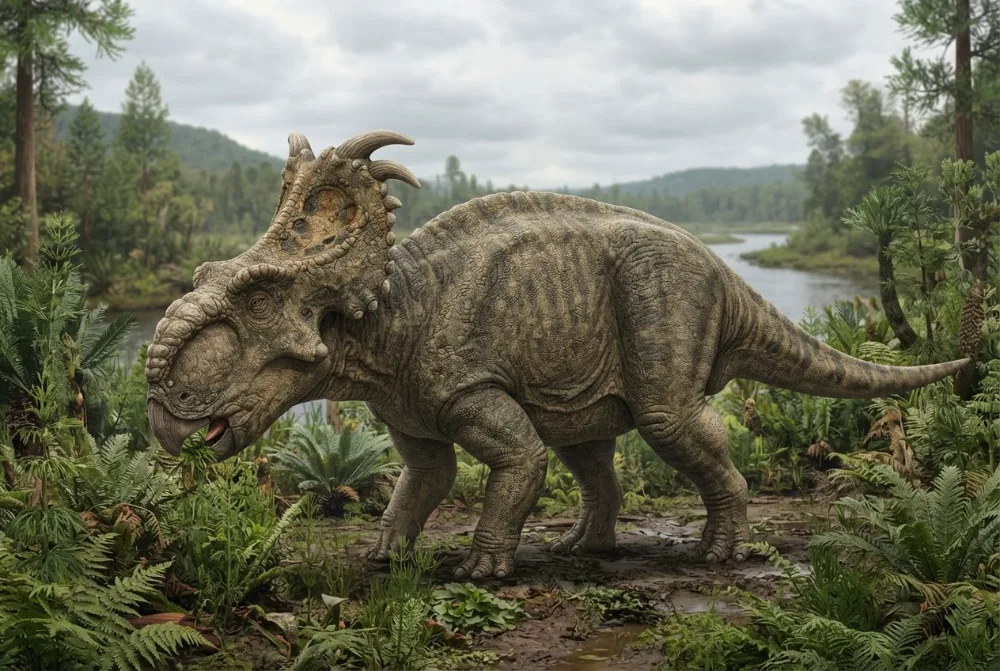
Pachyrhinosaurus had a large, flat boss on its nose and a smaller one over its eyes, instead of a nose horn.1
Three species of Pachyrhinosaurus have been found: P. canadensis, P. lakustai, and P. perotorum.1
Fossils of adults and juveniles are often found together, suggesting that Pachyrhinosaurus lived in herds and cared for its young.2
One bonebed in Alberta contained up to 100 bones per square metre, with over 3,500 bones and 14 skulls.1
The northernmost species, P. perotorum, lived in what is now Alaska about 73 million years ago.1
Pachyrhinosaurus lived during the Late Cretaceous, between about 74 and 68 million years ago.2
Mibvunzo inonyanya kubvunzwa nezve Pachyrhinosaurus
?How big was Pachyrhinosaurus?
The largest species, P. canadensis, was about 6 to 8 metres (20 to 26 feet) long and weighed 3 to 4 tonnes (3.3 to 4.4 tons). The other species were smaller, about 5 metres (16 feet) long and 2 tonnes (2.2 tons).12
?What did Pachyrhinosaurus eat?
Pachyrhinosaurus was a herbivore, meaning it ate plants. It had strong cheek teeth to cut tough, fibrous plants.12
?Did Pachyrhinosaurus have horns?
Instead of a nose horn like Triceratops, Pachyrhinosaurus had big, flat bony bumps called bosses on its snout and over its eyes. It did have a pair of horns that grew from its frill and pointed upward.12
?When did Pachyrhinosaurus live?
Pachyrhinosaurus lived during the Late Cretaceous Period, between about 74 and 68 million years ago.21
?Where was Pachyrhinosaurus found?
Fossils have been found in Alberta, Canada, and Alaska, USA. The first fossils were discovered in Alberta in 1946.21
?Did Pachyrhinosaurus live in herds?
Yes. Fossils of adults and juveniles are often found together, which suggests they lived in herds and cared for their young.21
Zvevanyanzvi vemadhino
- Zita resainzi
- Pachyrhinosaurus
- Akaripa zita:
- Sternberg 19503
- Boka
- Madhino ane nyanga
- Mhuri / boka
- Ceratopsidae3
- Kurongwa kwemhuka
- Ornithischia > Ceratopsia > Ceratopsidae3
- Zera rematombo
- makore mamiriyoni 84 kusvika 66 (Campanian / Maastrichtian)3
- Mapoka ematombo
- Horseshoe Canyon, Wapiti, St. Mary River3
- Nyika
- Kanada, Amerika3
- Zvinyorwa zvemafosiri
- 16 mu The Paleobiology Database3
- Kuwanikwa
- The first Pachyrhinosaurus fossils were found in 1946 in Alberta, Canada, by Charles M. Sternberg. He named the dinosaur Pachyrhinosaurus in 1950.12
- Zvichiri kupokanwa
- Scientists are still debating whether the differences in the shape of the bosses (some convex, some concave) are due to male and female differences or just erosion.1
Kunobva chokwadi
- Pachyrhinosaurus (en.wikipedia.org)
- Pachyrhinosaurus | Natural History Museum (nhm.ac.uk)
- Pachyrhinosaurus in The Paleobiology Database (CC BY 4.0): zera, nzvimbo, mapoka ematombo, kurongwa kwemhuka.
Chokwadi chega chega papeji ino chine nhamba inoratidza kwachakabva. Kana takakanganisa chimwe chinhu, ruregerero, tiri vanoda madhino, kwete magazini yesainzi. Tiudze pa [email protected] tichazvigadzirisa.
 Rex ane nzara! Dino Wiki ipurojekiti yababa yemwanakomana wavo anoda madhino, mahara, pasina kushambadza uye pasina zvinokutevera. Vakuru vanogona kupa Rex chekudyadya kuti vabatsire kuchengeta saiti iri pamhepo.Fudza Rex
 Triceratops
 Protoceratops
 Ojoceratops
 Tatankaceratops
 Psittacosaurus
 Centrosaurus
 Tyrannosaurus
 Velociraptor
 Spinosaurus
 Ankylosaurus
 Parasaurolophus
 Pteranodon