 Uri dhino ripi? Kwizi
 Hondo yemadhino
 Mujaho wemadhino
 Mitambo midiki yemadhino
 Arubhamu yemasitika
 Rondedzero dzeTOP dzemadhino
 Ndishamise!
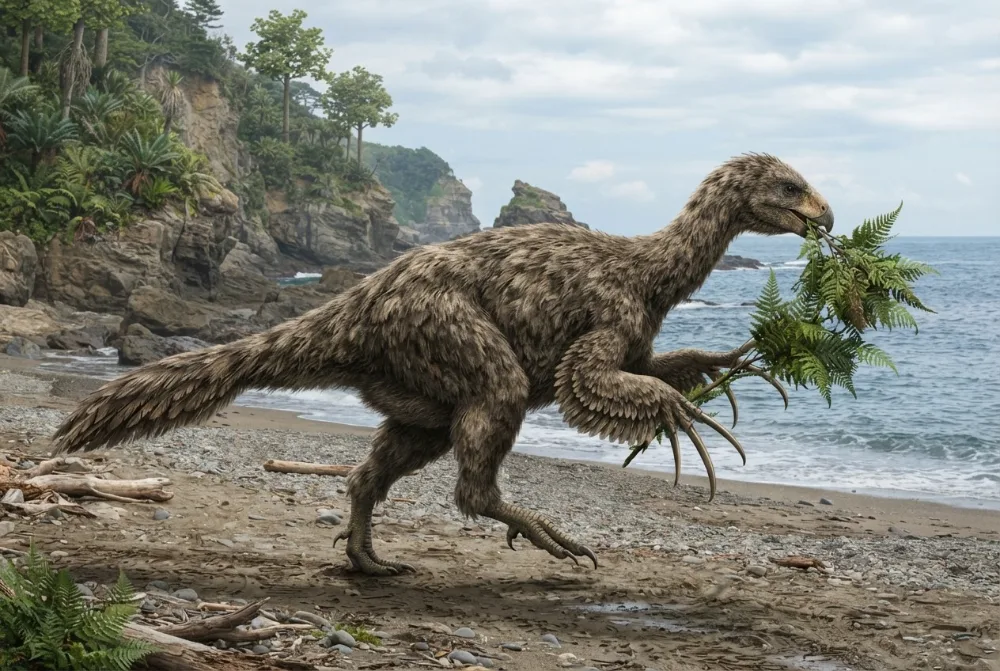
Paralitherizinosaurus
Paralitherizinosaurus was a strange, plant-eating dinosaur with long, curved claws on its hands. It lived near the coast of ancient Japan and used its claws to pull leaves and branches toward its mouth. This dinosaur was covered in feathers and looked a bit like a giant, slow-moving bird.14
Rairarama rini?
Raiva hombe sei?
Raiva refu zvakadii?
Raiva rakakwirira zvakadii?
fungidziro
Rairema zvakadii?
 kureba seimbwa 4 kubva pamhino kusvika kumuswe🍌kureba semabhanana 20 akatevedzana🍉kurema semanwiwa 56🧸kurema sevana vekireshi 15🎒kurema sevana vechikoro 9🏃raigona kumhanya mamita 100 mumasekonzi 13 (munhu anomhanya kupfuura vose anoda 9.6)
Paralitherizinosaurus raiva hombe sei kana richienzaniswa NEWE?
Masvomhu chete mubrowser yako. Hapana chinochengetwa kana kutumirwa kupi zvako.
Raimhanya zvakadii?


Zvinonakidza
Paralitherizinosaurus is the youngest therizinosaur ever found in Japan, living about 83 to 72 million years ago.1
Its fossils were discovered in a marine rock layer, meaning it lived near the coast and its body washed out to sea after death.1
Only a partial hand and a single vertebra have been found, but those bones show it had very slender, curved claws like its relative Therizinosaurus.1
The first bone of its thumb (metacarpal I) was flattened from top to bottom, a unique feature that helps scientists tell it apart from other dinosaurs.1
Its claws had weak flexor tubercles (the bump where a muscle attaches), which means it used a hook-and-pull motion to bring branches to its mouth, not to slash or stab.1
Paralitherizinosaurus is one of the few therizinosaurs found in marine sediments anywhere in the world, along with Nothronychus from North America.1
Mibvunzo inonyanya kubvunzwa nezve Paralitherizinosaurus
?What did Paralitherizinosaurus eat?
It was a plant-eater. It used its long, curved claws to hook and pull leaves and branches toward its mouth.1
?How big was Paralitherizinosaurus?
Nobody knows for sure because only a partial hand and a neck bone have been found. It was probably medium-sized, but its exact size is unknown.3
?Did Paralitherizinosaurus have feathers?
Yes, it was a feathered theropod dinosaur, related to other feathered dinosaurs like Therizinosaurus. It probably looked like a big, slow-moving bird.3
Zvevanyanzvi vemadhino
- Zita resainzi
- Paralitherizinosaurus
- Akaripa zita:
- Kobayashi et al. 20224
- Boka
- Madhino ane minhenga anoshamisa
- Mhuri / boka
- Therizinosauridae4
- Kurongwa kwemhuka
- Theropoda > Therizinosauria4
- Zera rematombo
- makore mamiriyoni 84 kusvika 72 (Campanian)4
- Mapoka ematombo
- Osoushinai4
- Nyika
- Japan4
- Zvinyorwa zvemafosiri
- 1 mu The Paleobiology Database4
- Kuwanikwa
- The first fossils of Paralitherizinosaurus were found in a concretion (a hard rock nodule) near a river in Hokkaido, Japan. Scientists Murakami and colleagues first described the bones in 2008, but it was not until 2022 that Kobayashi and his team named it as a new species.1
- Zvichiri kupokanwa
- Scientists are not sure exactly where Paralitherizinosaurus fits on the therizinosaur family tree. It might be closely related to Therizinosaurus, Suzhousaurus, and another unnamed form from the Bissekty Formation, but the relationships are still debated.1
Kunobva chokwadi
- New therizinosaurid dinosaur from the marine Osoushinai Formation (Upper Cretaceous, Japan) provides insight for function and evolution of therizinosaur claws (pmc.ncbi.nlm.nih.gov)
- Paralitherizinosaurus japonicus | Dinosaur Database by DinoAnimals.com (dinoanimals.com)
- Paralitherizinosaurus (en.wikipedia.org)
- Paralitherizinosaurus in The Paleobiology Database (CC BY 4.0): zera, nzvimbo, mapoka ematombo, kurongwa kwemhuka.
Chokwadi chega chega papeji ino chine nhamba inoratidza kwachakabva. Kana takakanganisa chimwe chinhu, ruregerero, tiri vanoda madhino, kwete magazini yesainzi. Tiudze pa [email protected] tichazvigadzirisa.
 Rex ane nzara! Dino Wiki ipurojekiti yababa yemwanakomana wavo anoda madhino, mahara, pasina kushambadza uye pasina zvinokutevera. Vakuru vanogona kupa Rex chekudyadya kuti vabatsire kuchengeta saiti iri pamhepo.Fudza Rex
 Therizinosaurus
 Oviraptor
 Chirostenotes
 Citipes
 Leptorhynchos
 Avimimus
 Tyrannosaurus
 Triceratops
 Velociraptor
 Spinosaurus
 Ankylosaurus
 Parasaurolophus