 Uri dhino ripi? Kwizi
 Hondo yemadhino
 Mujaho wemadhino
 Mitambo midiki yemadhino
 Arubhamu yemasitika
 Rondedzero dzeTOP dzemadhino
 Ndishamise!
Rairarama rini?

Raiva hombe sei?
Raiva refu zvakadii?
Raiva rakakwirira zvakadii?
fungidziro
Rairema zvakadii?

 kureba seimbwa 2.5 kubva pamhino kusvika kumuswe🍌kureba semabhanana 14 akatevedzana🍉kurema semanwiwa 6🏃raigona kumhanya mamita 100 mumasekonzi 6.2 (munhu anomhanya kupfuura vose anoda 9.6)
Pelecanimimus raiva hombe sei kana richienzaniswa NEWE?
Masvomhu chete mubrowser yako. Hapana chinochengetwa kana kutumirwa kupi zvako.
Raimhanya zvakadii?


Zvinonakidza
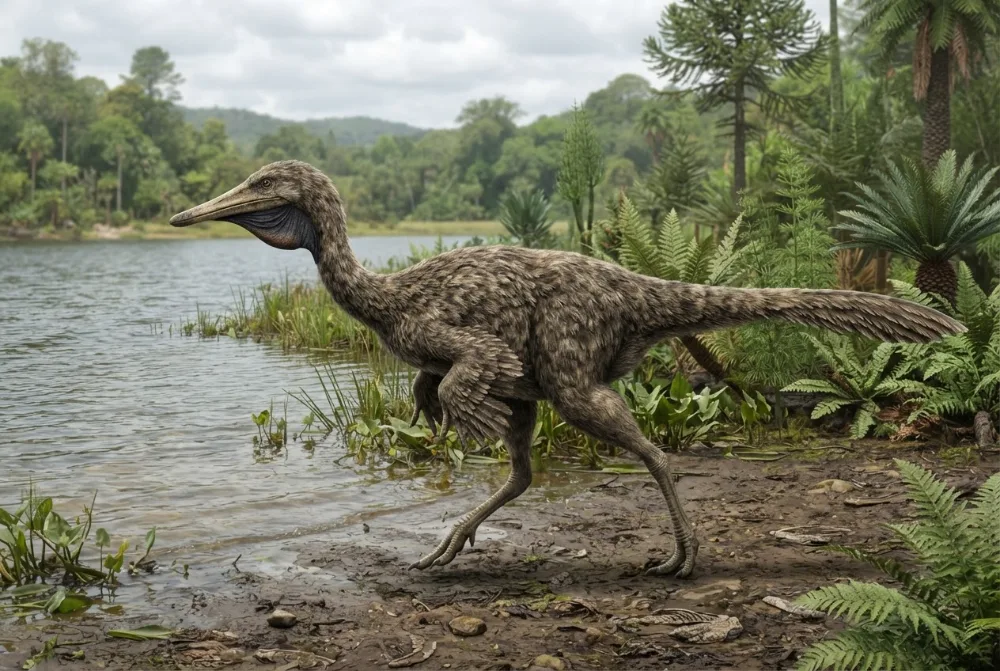
Pelecanimimus had about 220 tiny teeth in its mouth, more than any other meat-eating dinosaur.1
Its teeth were different shapes: front teeth were broad and D-shaped, while back teeth were blade-like.1
It also had a small crest on the back of its head, made of skin or keratin.1
Pelecanimimus lived about 125 million years ago during the Early Cretaceous in what is now Spain.13
Only the front half of one skeleton has been found, but it includes amazing details like skin impressions and throat bones.1
Mibvunzo inonyanya kubvunzwa nezve Pelecanimimus
?How big was Pelecanimimus?
About 1.9 to 2.5 metres long and weighed 17 to 30 kilograms. That is about as long as a large bicycle.12
?What did Pelecanimimus eat?
It was carnivorous, meaning it ate meat. It probably waded in lakes or ponds to catch fish with its claws and many teeth, storing them in its throat pouch.12
?Did Pelecanimimus have feathers?
No, the preserved skin impressions show wrinkled skin that lacked scales or feathers. Some filament-like structures were once thought to be feathers, but they are now seen as muscle fibers.1
?When did Pelecanimimus live?
It lived during the Early Cretaceous period, about 127 to 121 million years ago.2
Mubvisi wengano
Ngano: Some people think Pelecanimimus could fly because of its large chest bones.
Chokwadi: Scientists are not sure, but most think it was a ground dinosaur, not a flier.1
Zvevanyanzvi vemadhino
- Zita resainzi
- Pelecanimimus
- Akaripa zita:
- Pérez-Moreno et al. 19943
- Boka
- Madhino eostrich
- Mhuri / boka
- Ornithomimosauria3
- Kurongwa kwemhuka
- Theropoda > Ornithomimosauria3
- Zera rematombo
- makore mamiriyoni 126 kusvika 121 (Barremian)3
- Mapoka ematombo
- La Huérguina3
- Nyika
- Spain3
- Zvinyorwa zvemafosiri
- 1 mu The Paleobiology Database3
- Kuwanikwa
- Armando Díaz Romeral found the first skeleton in 1993 in Spain. Scientists named it Pelecanimimus polyodon in 1994.12
- Zvichiri kupokanwa
- Scientists still debate whether Pelecanimimus could fly or if its large chest muscles were for something else.1
Kunobva chokwadi
- Pelecanimimus (en.wikipedia.org)
- Pelecanimimus | Natural History Museum (nhm.ac.uk)
- Pelecanimimus in The Paleobiology Database (CC BY 4.0): zera, nzvimbo, mapoka ematombo, kurongwa kwemhuka.
Chokwadi chega chega papeji ino chine nhamba inoratidza kwachakabva. Kana takakanganisa chimwe chinhu, ruregerero, tiri vanoda madhino, kwete magazini yesainzi. Tiudze pa [email protected] tichazvigadzirisa.
 Rex ane nzara! Dino Wiki ipurojekiti yababa yemwanakomana wavo anoda madhino, mahara, pasina kushambadza uye pasina zvinokutevera. Vakuru vanogona kupa Rex chekudyadya kuti vabatsire kuchengeta saiti iri pamhepo.Fudza Rex
 Gallimimus
 Ornithomimus
 Struthiomimus
 Deinocheirus
 Dromiceiomimus
 Archaeornithomimus
 Stegosaurus
 Iguanodon
 Archaeopteryx
 Giganotosaurus
 Microraptor
 Deinonychus