 Uri dhino ripi? Kwizi
 Hondo yemadhino
 Mujaho wemadhino
 Mitambo midiki yemadhino
 Arubhamu yemasitika
 Rondedzero dzeTOP dzemadhino
 Ndishamise!
Pervushovisaurus
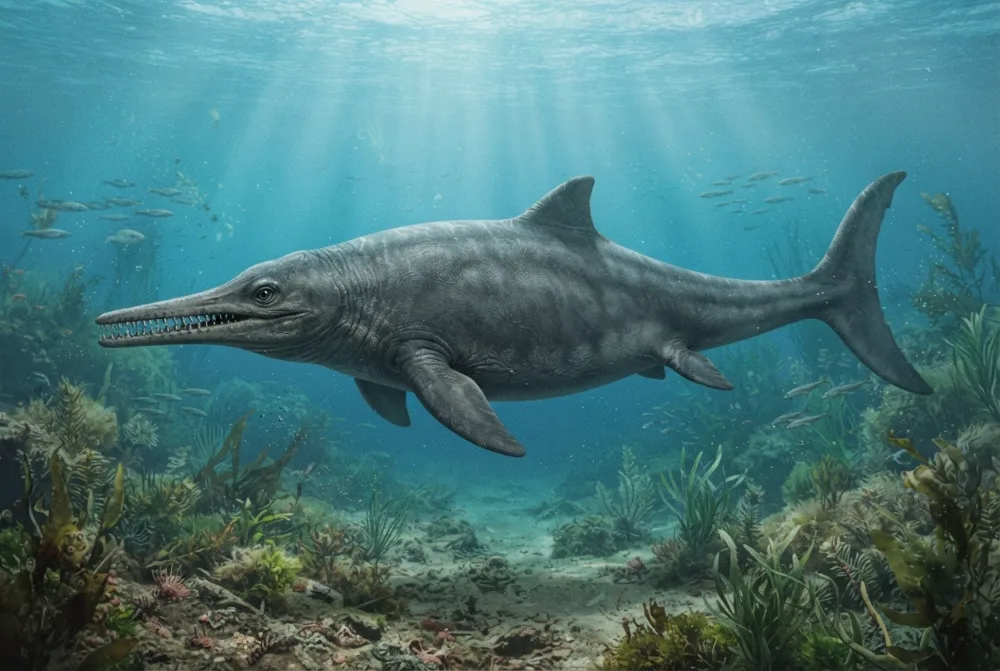
Pervushovisaurus was a fast-swimming marine reptile that looked like a dolphin with a long snout full of sharp teeth. It lived in the seas that covered Europe during the time of the dinosaurs, about 113 to 94 million years ago.31
Rairarama rini?
Raiva hombe sei?
Raiva refu zvakadii?
 kureba seimbwa 6 kubva pamhino kusvika kumuswe🍌kureba semabhanana 32 akatevedzana🏊raigona kushambira kureba kwedziva guru rekushambira (50 m) mumasekonzi 4.1
Pervushovisaurus raiva hombe sei kana richienzaniswa NEWE?
Masvomhu chete mubrowser yako. Hapana chinochengetwa kana kutumirwa kupi zvako.
Raimhanya zvakadii?


Zvinonakidza
Pervushovisaurus was first thought to be a type of Platypterygius, but scientists later decided it was different enough to be its own genus.1
This ichthyosaur had a straight snout, unlike some of its relatives that had curved jaws.1
Its teeth had square roots with sharp 90-degree angles, which is unusual for an ichthyosaur.1
One species, Pervushovisaurus campylodon, was originally named Ichthyosaurus campylodon in 1846.1
Pervushovisaurus lived during the Cretaceous period, at the same time as dinosaurs like Tyrannosaurus and Triceratops, but in the ocean.3
Fossils of Pervushovisaurus have been found in the Melovatka Formation in Russia and the La Penthiève Beds in France.1
Like other ichthyosaurs, Pervushovisaurus gave birth to live young, not laying eggs on land.2
Mibvunzo inonyanya kubvunzwa nezve Pervushovisaurus
?How big was Pervushovisaurus?
It was a medium-sized ichthyosaur, measuring about 5.8 metres (19 feet) long.1
?What did Pervushovisaurus eat?
It was a carnivore that ate fish and other sea creatures, using its long snout full of sharp teeth to catch prey.3
?Where did Pervushovisaurus live?
It lived in the seas that covered Europe during the Cretaceous period, and its fossils have been found in Russia, France, and the United Kingdom.1
?Is Pervushovisaurus a dinosaur?
No, it is not a dinosaur. It is an ichthyosaur, a marine reptile that lived in the ocean at the same time as dinosaurs.1
Zvevanyanzvi vemadhino
- Zita resainzi
- Pervushovisaurus
- Akaripa zita:
- Arkhangelsky 19983
- Boka
- Maikitiyosauro
- Mhuri / boka
- Ophthalmosauridae3
- Kurongwa kwemhuka
- Ichthyosauria > Ichthyosauromorpha3
- Zera rematombo
- makore mamiriyoni 113 kusvika 94 (Albian / Cenomanian)3
- Mapoka ematombo
- West Melbury Marly Chalk, Melovatskaya, La Penthiève Beds3
- Nyika
- France, United Kingdom, Russia, Germany3
- Zvinyorwa zvemafosiri
- 14 mu The Paleobiology Database3
- Kuwanikwa
- The genus Pervushovisaurus was named by Russian paleontologist M. S. Arkhangelsky in 1998, based on a partial skull from the Saratov region of Russia.13
- Zvichiri kupokanwa
- Scientists are still debating whether the two species Pervushovisaurus bannovkensis and Pervushovisaurus campylodon are truly distinct or if they represent the same animal.1
Kunobva chokwadi
- Pervushovisaurus (en.wikipedia.org)
- PBDB Taxon (paleobiodb.org)
- Pervushovisaurus in The Paleobiology Database (CC BY 4.0): zera, nzvimbo, mapoka ematombo, kurongwa kwemhuka.
Chokwadi chega chega papeji ino chine nhamba inoratidza kwachakabva. Kana takakanganisa chimwe chinhu, ruregerero, tiri vanoda madhino, kwete magazini yesainzi. Tiudze pa [email protected] tichazvigadzirisa.
 Rex ane nzara! Dino Wiki ipurojekiti yababa yemwanakomana wavo anoda madhino, mahara, pasina kushambadza uye pasina zvinokutevera. Vakuru vanogona kupa Rex chekudyadya kuti vabatsire kuchengeta saiti iri pamhepo.Fudza Rex
 Ichthyosaurus
 Platypterygius
 Stenopterygius
 Khudiakovia
 Ophthalmosaurus
 Chonespondylus
 Stegosaurus
 Iguanodon
 Archaeopteryx
 Giganotosaurus
 Microraptor
 Deinonychus