 Uri dhino ripi? Kwizi
 Hondo yemadhino
 Mujaho wemadhino
 Mitambo midiki yemadhino
 Arubhamu yemasitika
 Rondedzero dzeTOP dzemadhino
 Ndishamise!
Rairarama rini?

Raiva hombe sei?
Raiva refu zvakadii?
Raiva rakakwirira zvakadii?
fungidziro
Rairema zvakadii?
 kureba seimbwa 3 kubva pamhino kusvika kumuswe🍌kureba semabhanana 17 akatevedzana🍉kurema semanwiwa 24🧸kurema sevana vekireshi 6🎒kurema sevana vechikoro 4🏃raigona kumhanya mamita 100 mumasekonzi 8 (munhu anomhanya kupfuura vose anoda 9.6)
Ratchasimasaurus raiva hombe sei kana richienzaniswa NEWE?
Masvomhu chete mubrowser yako. Hapana chinochengetwa kana kutumirwa kupi zvako.
Raimhanya zvakadii?


Zvinonakidza
Ratchasimasaurus is only known from a single left lower jawbone, called a dentary, which is 198.1 millimetres (7.80 inches) long.1
Its jawbone was long and flat, a unique feature that helps scientists tell it apart from other dinosaurs.12
This dinosaur lived during the Early Cretaceous period, about 121 to 113 million years ago.4
Ratchasimasaurus had both primitive and advanced features, like a backward-slanting coronoid process and a shelf between its teeth and jaw joint.12
The fossil was found by a local farmer near a pond in Thailand, likely between 2002 and 2004.1
Its species name, suranareae, honors Thao Suranari, a 19th-century war heroine from Thailand.1
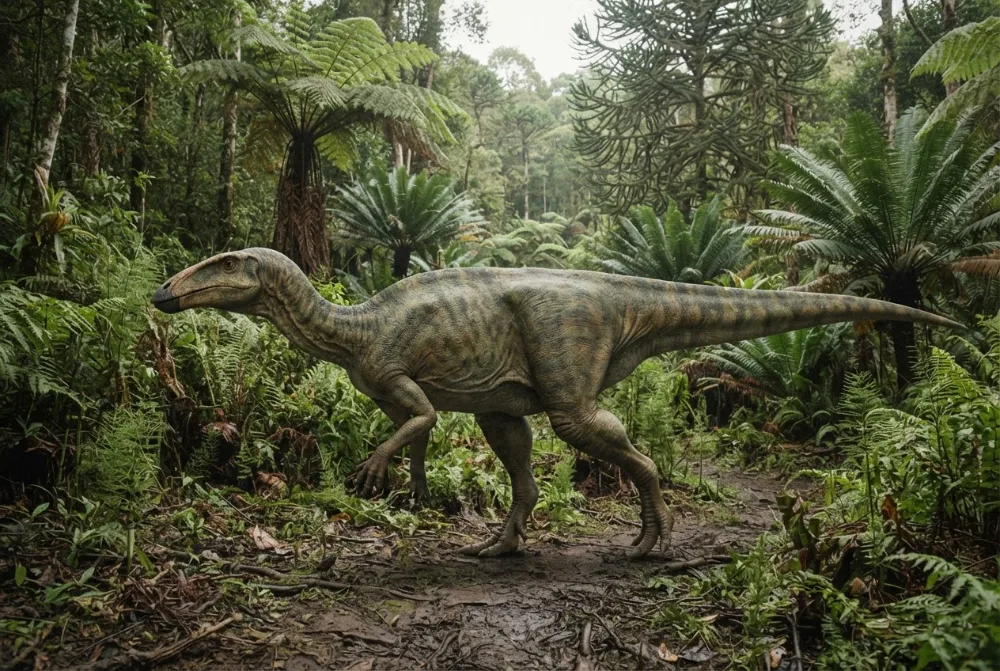
Mibvunzo inonyanya kubvunzwa nezve Ratchasimasaurus
?What did Ratchasimasaurus eat?
Ratchasimasaurus was a plant-eating dinosaur, as shown by its beaked mouth and jaw features for chewing tough plants. Its diet is listed as herbivore in the Paleobiology Database.4
?How big was Ratchasimasaurus?
The only known fossil is a jawbone, so its full size is uncertain. The dentary is 198.1 millimetres (7.80 inches) long, and the dinosaur was about the size of a small car, based on the page's intro.1
?When did Ratchasimasaurus live?
It lived during the Early Cretaceous period, about 121 to 113 million years ago (Aptian stage). This is based on the age range given in the Paleobiology Database.4
Zvevanyanzvi vemadhino
- Zita resainzi
- Ratchasimasaurus
- Akaripa zita:
- Shibata et al. 20114
- Boka
- Vanodya miriwo vane miromo
- Mhuri / boka
- Hadrosauroidea4
- Kurongwa kwemhuka
- Ornithischia > Ornithopoda > Iguanodontia4
- Zera rematombo
- makore mamiriyoni 121 kusvika 113 (Aptian)4
- Mapoka ematombo
- Khok Kruat4
- Nyika
- Thailand4
- Zvinyorwa zvemafosiri
- 1 mu The Paleobiology Database4
- Kuwanikwa
- Ratchasimasaurus was named in 2011 by Masateru Shibata, Pratueng Jintasakul, and Yoichi Azuma based on a jawbone found in the Khok Kruat Formation of Thailand.41
- Zvichiri kupokanwa
- Some scientists think Ratchasimasaurus might be a nomen dubium, meaning its fossils are too incomplete to be sure it is a distinct species.1
Kunobva chokwadi
- Ratchasimasaurus (en.wikipedia.org)
- A New Iguanodontian Dinosaur from the Lower Cretaceous Khok Kruat Formation, Nakhon Ratchasima in Northeastern Thailand (onlinelibrary.wiley.com)
- Ratchasimasaurus suranareae | Dinosaur Database by DinoAnimals.com (dinoanimals.com)
- Ratchasimasaurus in The Paleobiology Database (CC BY 4.0): zera, nzvimbo, mapoka ematombo, kurongwa kwemhuka.
Chokwadi chega chega papeji ino chine nhamba inoratidza kwachakabva. Kana takakanganisa chimwe chinhu, ruregerero, tiri vanoda madhino, kwete magazini yesainzi. Tiudze pa [email protected] tichazvigadzirisa.
 Rex ane nzara! Dino Wiki ipurojekiti yababa yemwanakomana wavo anoda madhino, mahara, pasina kushambadza uye pasina zvinokutevera. Vakuru vanogona kupa Rex chekudyadya kuti vabatsire kuchengeta saiti iri pamhepo.Fudza Rex
 Iguanodon
 Tenontosaurus
 Thescelosaurus
 Zalmoxes
 Camptosaurus
 Rhabdodon
 Stegosaurus
 Archaeopteryx
 Giganotosaurus
 Microraptor
 Deinonychus
 Baryonyx