 Uri dhino ripi? Kwizi
 Hondo yemadhino
 Mujaho wemadhino
 Mitambo midiki yemadhino
 Arubhamu yemasitika
 Rondedzero dzeTOP dzemadhino
 Ndishamise!
Shenzhousaurus
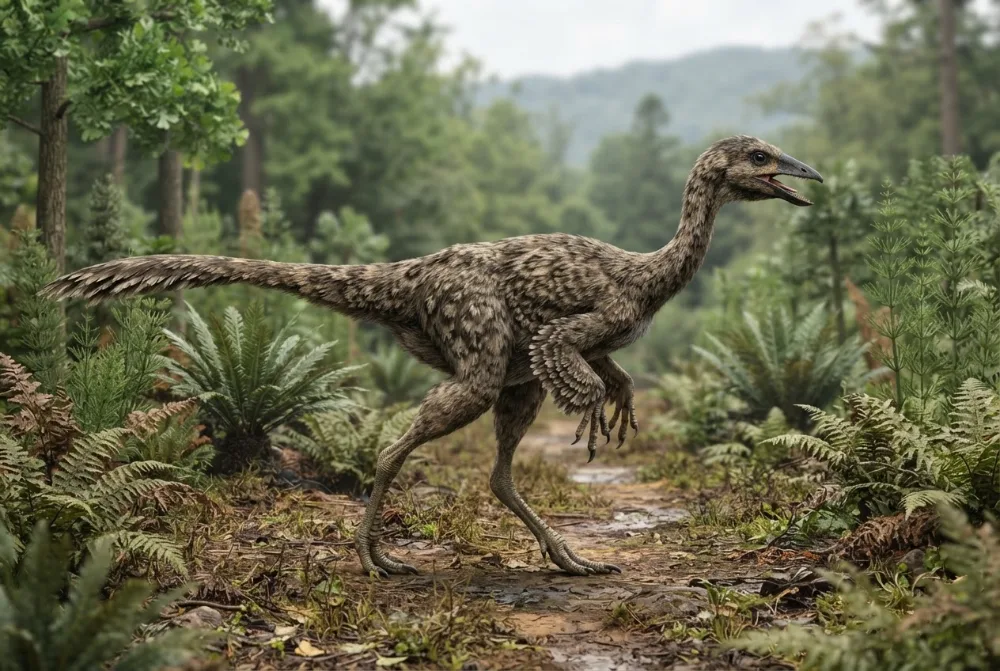
Shenzhousaurus was an early ostrich-like dinosaur that lived in what is now China. It had small teeth only at the front of its mouth, unlike later ostrich dinosaurs that had no teeth at all. This speedy dinosaur probably ate plants and small animals.12
Rairarama rini?
Raimhanya zvakadii?


Zvinonakidza
Shenzhousaurus is one of the earliest known ostrich-like dinosaurs, living about 126 million years ago during the Early Cretaceous.2
Its name comes from 'Shenzhou', an ancient name for China, and 'saurus' meaning lizard.1
Unlike later ostrich dinosaurs that had no teeth, Shenzhousaurus had small teeth only at the front of its lower jaw.1
The only known fossil of Shenzhousaurus was found in a 'death pose' with its head above its body.2
Its first finger bone (metacarpal I) was only half the length of its second finger bone, a primitive feature.2
Shenzhousaurus had a straight ischium (a hip bone), while more advanced ostrich dinosaurs had a curved one.1
Mibvunzo inonyanya kubvunzwa nezve Shenzhousaurus
?How big was Shenzhousaurus?
Scientists are not sure of its total size because the only fossil is missing parts of the legs and tail. Its skull was about 185 mm (7.3 inches) long.2
?What did Shenzhousaurus eat?
It probably ate both plants and small animals. Pebbles found in its chest area may have been gastroliths (stomach stones) to help grind up food.23
?Did Shenzhousaurus have feathers?
The fossil does not show feathers, but many close relatives of Shenzhousaurus had simple, hair-like feathers, so it might have had them too.2
?When did Shenzhousaurus live?
It lived about 126 million years ago, during the Early Cretaceous Period.2
Zvevanyanzvi vemadhino
- Zita resainzi
- Shenzhousaurus
- Akaripa zita:
- Ji et al. 20033
- Boka
- Madhino eostrich
- Mhuri / boka
- Ornithomimosauria3
- Kurongwa kwemhuka
- Theropoda > Ornithomimosauria3
- Zera rematombo
- makore mamiriyoni 126 kusvika 120 (Barremian / Aptian)3
- Mapoka ematombo
- Yixian3
- Nyika
- China3
- Zvinyorwa zvemafosiri
- 1 mu The Paleobiology Database3
- Kuwanikwa
- Shenzhousaurus was named in 2003 by a team of scientists including Qiang Ji, Mark Norell, and Peter Makovicky. The only fossil was found at the Sihetun site in Liaoning, China.32
- Zvichiri kupokanwa
- Scientists are not sure exactly what Shenzhousaurus ate, but the pebbles found in its chest may have been gastroliths for grinding food.2
Kunobva chokwadi
- An early ostrich dinosaur and implications for ornithomimosaur phylogeny (ia803404.us.archive.org)
- Shenzhousaurus (en.wikipedia.org)
- Shenzhousaurus in The Paleobiology Database (CC BY 4.0): zera, nzvimbo, mapoka ematombo, kurongwa kwemhuka.
Chokwadi chega chega papeji ino chine nhamba inoratidza kwachakabva. Kana takakanganisa chimwe chinhu, ruregerero, tiri vanoda madhino, kwete magazini yesainzi. Tiudze pa [email protected] tichazvigadzirisa.
 Rex ane nzara! Dino Wiki ipurojekiti yababa yemwanakomana wavo anoda madhino, mahara, pasina kushambadza uye pasina zvinokutevera. Vakuru vanogona kupa Rex chekudyadya kuti vabatsire kuchengeta saiti iri pamhepo.Fudza Rex
 Gallimimus
 Ornithomimus
 Struthiomimus
 Deinocheirus
 Dromiceiomimus
 Archaeornithomimus
 Stegosaurus
 Iguanodon
 Archaeopteryx
 Giganotosaurus
 Microraptor
 Deinonychus