 Uri dhino ripi? Kwizi
 Hondo yemadhino
 Mujaho wemadhino
 Mitambo midiki yemadhino
 Arubhamu yemasitika
 Rondedzero dzeTOP dzemadhino
 Ndishamise!
Simbirskiasaurus
Simbirskiasaurus was a fast-swimming marine reptile that lived in the Early Cretaceous seas. It had a long snout and sharp teeth for catching fish and squid. This ichthyosaur was not a dinosaur, but a reptile that breathed air like a dolphin.31
Rairarama rini?
Raiva hombe sei?
Raiva refu zvakadii?
 kureba seimbwa 5 kubva pamhino kusvika kumuswe🍌kureba semabhanana 28 akatevedzana🏊raigona kushambira kureba kwedziva guru rekushambira (50 m) mumasekonzi 3.9
Simbirskiasaurus raiva hombe sei kana richienzaniswa NEWE?
Masvomhu chete mubrowser yako. Hapana chinochengetwa kana kutumirwa kupi zvako.
Raimhanya zvakadii?


Zvinonakidza
Simbirskiasaurus had a divided nostril opening, with a bony pillar separating it into two parts. This is a rare feature among ichthyosaurs.1
Its skull bones show deep interlocking joints between the prefrontal and lacrimal bones, similar to the much older ichthyosaur Temnodontosaurus.1
The only known fossil is a partial skull and backbone, found in clay from the Simbirskites Clay formation.13
Scientists once thought Simbirskiasaurus was a doubtful name, but a 2014 study confirmed it is a valid genus of platypterygiine ichthyosaur.2
It lived about 130 million years ago, during the early Barremian stage of the Early Cretaceous.1
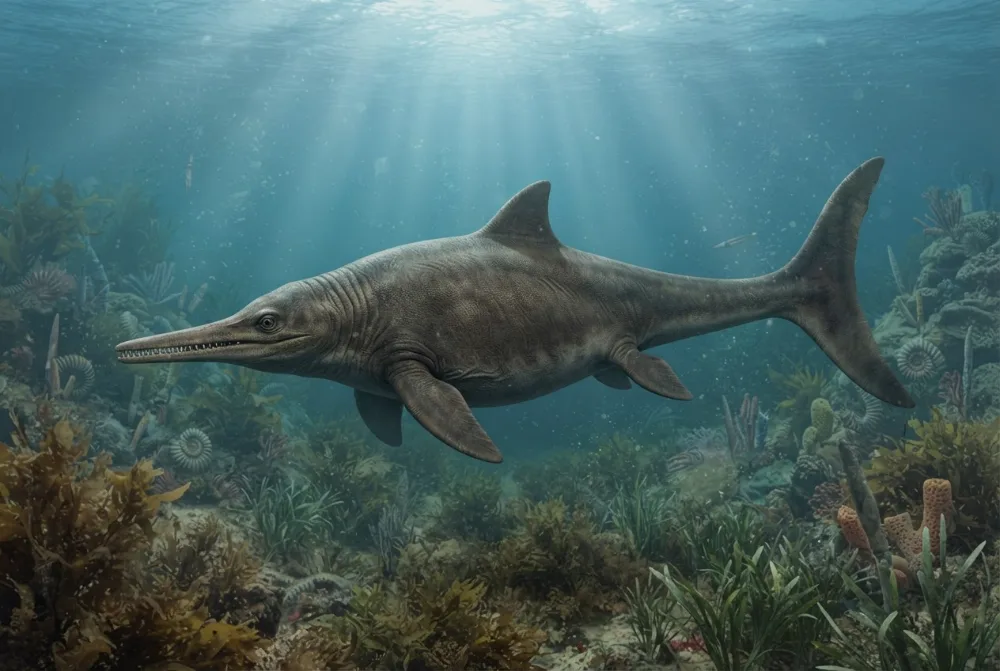
Mubvisi wengano
Ngano: Simbirskiasaurus is a dinosaur.
Chokwadi: Simbirskiasaurus is an ichthyosaur, a marine reptile that lived in the ocean and was not a dinosaur.1
Zvevanyanzvi vemadhino
- Zita resainzi
- Simbirskiasaurus
- Akaripa zita:
- Otschev and Efimov 19853
- Boka
- Maikitiyosauro
- Mhuri / boka
- Ophthalmosauridae3
- Kurongwa kwemhuka
- Ichthyosauria > Ichthyosauromorpha3
- Zera rematombo
- makore mamiriyoni 126 kusvika 121 (Barremian)3
- Mapoka ematombo
- Simbirskites Clay3
- Nyika
- Russia3
- Zvinyorwa zvemafosiri
- 1 mu The Paleobiology Database3
- Kuwanikwa
- Simbirskiasaurus was named by Russian paleontologists V. G. Otschev and V. M. Efimov in 1985, based on a fragmentary skull and backbone found near the Volga River in Russia.31
- Zvichiri kupokanwa
- Scientists are not sure about the exact size of Simbirskiasaurus because only a partial skull and backbone have been found.1
Kunobva chokwadi
- Simbirskiasaurus (en.wikipedia.org)
- Simbirskiasaurus and Pervushovisaurus reassessed: implications for the taxonomy and cranial osteology of Cretaceous platypterygiine ichthyosaurs - Fischer - 2014 - Zoological Journal of the Linnean Society - Wiley Online Library (onlinelibrary.wiley.com)
- Simbirskiasaurus in The Paleobiology Database (CC BY 4.0): zera, nzvimbo, mapoka ematombo, kurongwa kwemhuka.
Chokwadi chega chega papeji ino chine nhamba inoratidza kwachakabva. Kana takakanganisa chimwe chinhu, ruregerero, tiri vanoda madhino, kwete magazini yesainzi. Tiudze pa [email protected] tichazvigadzirisa.
 Rex ane nzara! Dino Wiki ipurojekiti yababa yemwanakomana wavo anoda madhino, mahara, pasina kushambadza uye pasina zvinokutevera. Vakuru vanogona kupa Rex chekudyadya kuti vabatsire kuchengeta saiti iri pamhepo.Fudza Rex
 Ichthyosaurus
 Platypterygius
 Stenopterygius
 Khudiakovia
 Ophthalmosaurus
 Chonespondylus
 Stegosaurus
 Iguanodon
 Archaeopteryx
 Giganotosaurus
 Microraptor
 Deinonychus