 Uri dhino ripi? Kwizi
 Hondo yemadhino
 Mujaho wemadhino
 Mitambo midiki yemadhino
 Arubhamu yemasitika
 Rondedzero dzeTOP dzemadhino
 Ndishamise!
Terminocavus
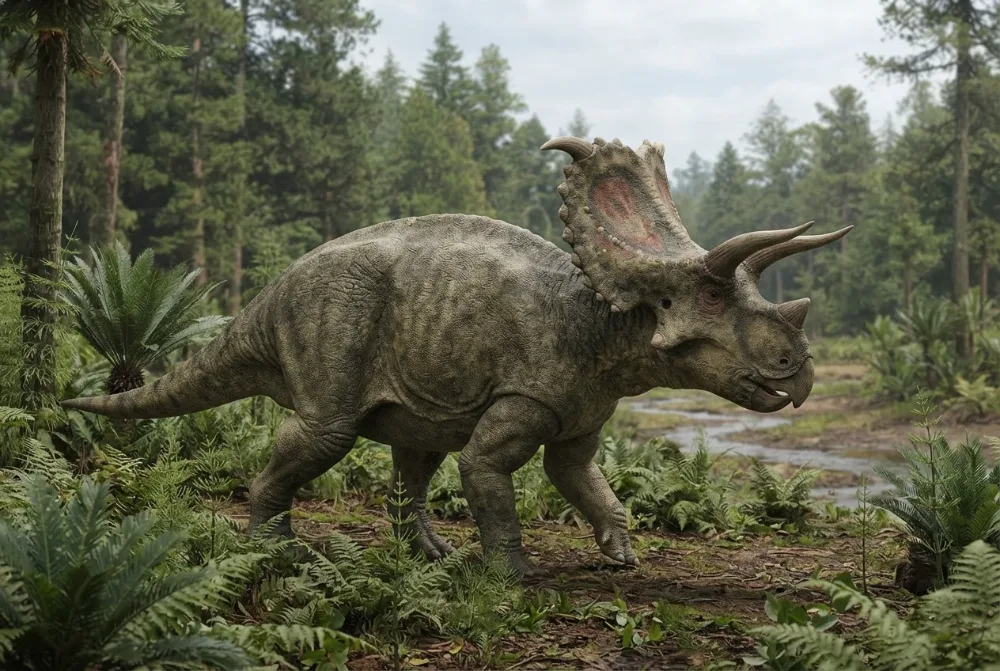
Terminocavus was a horned dinosaur that lived in New Mexico about 75 million years ago. Its frill had a very narrow notch, unlike its relatives. It looked a bit like a smaller cousin of Triceratops.31
Rairarama rini?
Raimhanya zvakadii?


Zvinonakidza
Only one partial skeleton of Terminocavus has been found, including a heart-shaped frill and parts of the skull.1
The name Terminocavus means 'last stop for the cavity' because the notch in its frill was almost closed.1
The fossil was discovered by Paul Sealey in 1997 in New Mexico.1
Terminocavus is closely related to Pentaceratops and Anchiceratops.1
The frill of Terminocavus was flat and plate-like, not made of narrow bars like earlier relatives.1
Scientists think Terminocavus might be a step in an evolutionary line where the frill notch slowly closed over millions of years.1
Mibvunzo inonyanya kubvunzwa nezve Terminocavus
?How big was Terminocavus?
It was about the size of a smaller cousin of Triceratops. Its known remains are slightly smaller than those of Pentaceratops and Utahceratops, so it was a medium-sized ceratopsian.2
?What did Terminocavus eat?
It was a plant-eater, like other ceratopsian dinosaurs. It used its beak to clip leaves and stems.2
Zvevanyanzvi vemadhino
- Zita resainzi
- Terminocavus
- Akaripa zita:
- Fowler and Freedman Fowler 20203
- Boka
- Madhino ane nyanga
- Mhuri / boka
- Ceratopsidae3
- Kurongwa kwemhuka
- Ornithischia > Ceratopsia > Ceratopsidae3
- Zera rematombo
- makore mamiriyoni 84 kusvika 72 (Campanian)3
- Mapoka ematombo
- Kirtland3
- Nyika
- Amerika3
- Zvinyorwa zvemafosiri
- 1 mu The Paleobiology Database3
- Kuwanikwa
- Terminocavus was named in 2020 by scientists Fowler and Freedman Fowler. The only known fossil, a partial skull, was found by Paul Sealey in the Kirtland Formation of New Mexico in 1997.31
- Zvichiri kupokanwa
- Scientists debate whether Terminocavus is a separate species or part of a slow, ongoing change from Pentaceratops to Anchiceratops.1
Kunobva chokwadi
- Transitional evolutionary forms in chasmosaurine ceratopsid dinosaurs: evidence from the Campanian of New Mexico (pmc.ncbi.nlm.nih.gov)
- Terminocavus (en.wikipedia.org)
- Terminocavus in The Paleobiology Database (CC BY 4.0): zera, nzvimbo, mapoka ematombo, kurongwa kwemhuka.
Chokwadi chega chega papeji ino chine nhamba inoratidza kwachakabva. Kana takakanganisa chimwe chinhu, ruregerero, tiri vanoda madhino, kwete magazini yesainzi. Tiudze pa [email protected] tichazvigadzirisa.
 Rex ane nzara! Dino Wiki ipurojekiti yababa yemwanakomana wavo anoda madhino, mahara, pasina kushambadza uye pasina zvinokutevera. Vakuru vanogona kupa Rex chekudyadya kuti vabatsire kuchengeta saiti iri pamhepo.Fudza Rex
 Triceratops
 Protoceratops
 Ojoceratops
 Tatankaceratops
 Psittacosaurus
 Centrosaurus
 Tyrannosaurus
 Velociraptor
 Spinosaurus
 Ankylosaurus
 Parasaurolophus
 Pteranodon