 Uri dhino ripi? Kwizi
 Hondo yemadhino
 Mujaho wemadhino
 Mitambo midiki yemadhino
 Arubhamu yemasitika
 Rondedzero dzeTOP dzemadhino
 Ndishamise!
Rairarama rini?

Raiva hombe sei?
Raiva refu zvakadii?
Raiva rakakwirira zvakadii?
fungidziro
Rairema zvakadii?
 kureba sekatsi dzemumba 2 kubva pamhino kusvika kumuswe🍌kureba semabhanana 6 akatevedzanakurema kunenge sekatsi yemumba🍌kurema semabhanana 50🪑diki zvekugona kufamba pasi pechigaro🏃raigona kumhanya mamita 100 mumasekonzi 15 (munhu anomhanya kupfuura vose anoda 9.6)
Xuanhuaceratops raiva hombe sei kana richienzaniswa NEWE?
Masvomhu chete mubrowser yako. Hapana chinochengetwa kana kutumirwa kupi zvako.
Raimhanya zvakadii?


Zvinonakidza
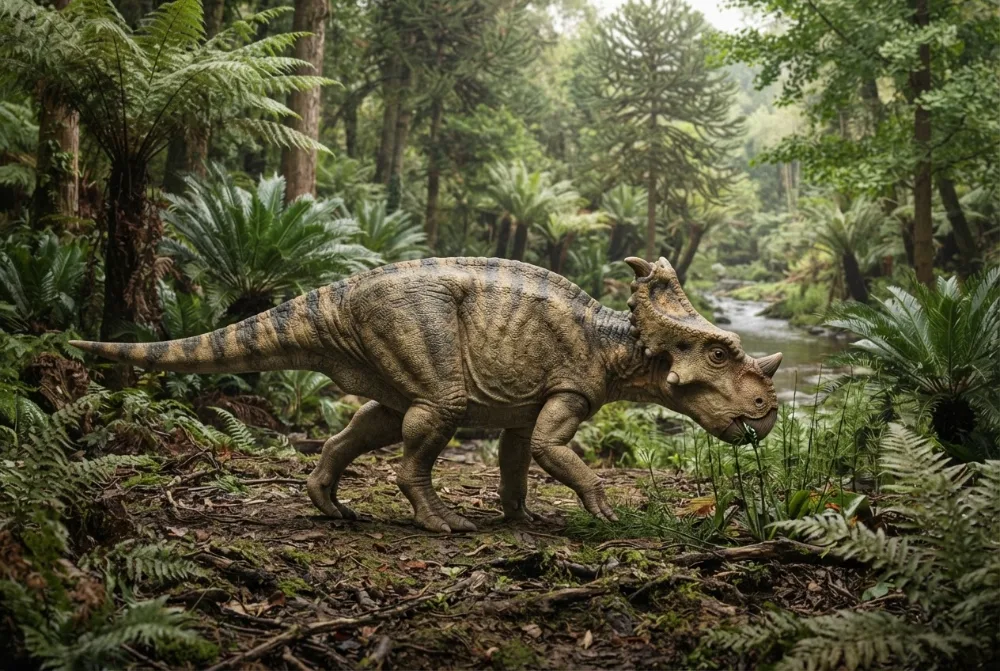
Xuanhuaceratops is one of the earliest known horned dinosaurs, living about 150 million years ago in the Late Jurassic.1
It was very small, only about 1 metre (3.3 feet) long and weighed as much as a large cat, around 6 kilograms (13 pounds).1
The first fossil was discovered in the 1970s by a man named Nie Rongzhen near Yanjiagou, China.1
Xuanhuaceratops had a unique feature: a single tooth in the premaxilla (the front part of the upper jaw).1
Its upper arm bones were very slender, only 4 centimetres (1.6 inches) long, suggesting it could walk on two legs when needed.1
Mibvunzo inonyanya kubvunzwa nezve Xuanhuaceratops
?What did Xuanhuaceratops eat?
It was an herbivore, meaning it ate plants. It used its beak to nibble on plants.13
?How big was Xuanhuaceratops?
About 1 metre (3.3 feet) long and weighed around 6 kilograms (13 pounds), about the size of a large dog.1
?When did Xuanhuaceratops live?
It lived during the Late Jurassic Period, about 150 to 145 million years ago.1
Zvevanyanzvi vemadhino
- Zita resainzi
- Xuanhuaceratops
- Akaripa zita:
- Zhao et al. 20063
- Boka
- Madhino ane nyanga
- Mhuri / boka
- Chaoyangsauridae3
- Kurongwa kwemhuka
- Ornithischia > Ceratopsia3
- Zera rematombo
- makore mamiriyoni 152 kusvika 133 (Kimmeridgian / Valanginian)3
- Mapoka ematombo
- Tuchengzi3
- Nyika
- China3
- Zvinyorwa zvemafosiri
- 1 mu The Paleobiology Database3
- Kuwanikwa
- The first fragmentary skeleton was found in the 1970s by Nie Rongzhen near Yanjiagou, China. It was named Xuanhuaceratops niei in 2006 by Zhao Xijin, Cheng Zhengwu, Xu Xing, and Peter J. Makovicky.1
- Zvichiri kupokanwa
- Scientists are not sure exactly how Xuanhuaceratops is related to other early ceratopsians because its fossils are incomplete.2
Kunobva chokwadi
- Xuanhuaceratops (en.wikipedia.org)
- A New Taxon of Basal Ceratopsian from China and the Early Evolution of Ceratopsia | PLOS One (journals.plos.org)
- Xuanhuaceratops in The Paleobiology Database (CC BY 4.0): zera, nzvimbo, mapoka ematombo, kurongwa kwemhuka.
Chokwadi chega chega papeji ino chine nhamba inoratidza kwachakabva. Kana takakanganisa chimwe chinhu, ruregerero, tiri vanoda madhino, kwete magazini yesainzi. Tiudze pa [email protected] tichazvigadzirisa.
 Rex ane nzara! Dino Wiki ipurojekiti yababa yemwanakomana wavo anoda madhino, mahara, pasina kushambadza uye pasina zvinokutevera. Vakuru vanogona kupa Rex chekudyadya kuti vabatsire kuchengeta saiti iri pamhepo.Fudza Rex
 Triceratops
 Protoceratops
 Ojoceratops
 Tatankaceratops
 Psittacosaurus
 Centrosaurus
 Stegosaurus
 Iguanodon
 Archaeopteryx
 Giganotosaurus
 Microraptor
 Deinonychus