 Kwisi: O dinosaure efe?
 Ntwa ya didinosaure
 Peiso ya didinosaure
 Dipapadi tse nyane tsa didinosaure
 Albamo ya ditikara
 Manane a TOP a didinosaure
 Nkgethele!
Bagualia
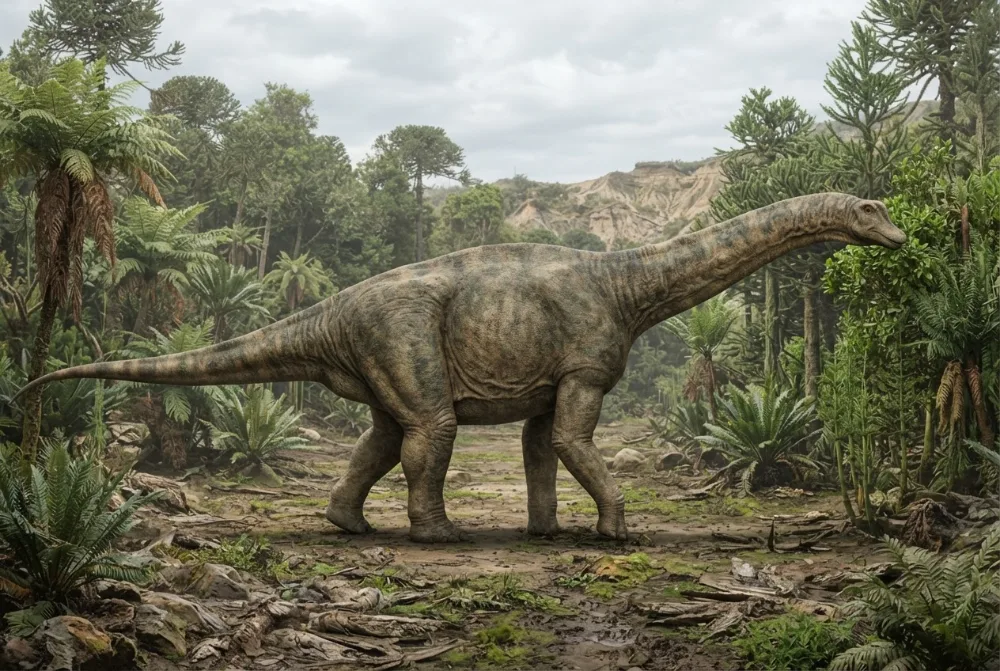
Bagualia was an early long-necked dinosaur that lived about 180 million years ago. It is one of the oldest known true sauropods, the group that later included giants like Brachiosaurus. Bagualia had a deep skull and big spoon-shaped teeth for eating tough plants.21
E phetse neng?
E ne e le kgolo hakae?
E ne e le telele hakae?
E ne e phahame hakae?
kakanyo
E ne e le boima hakae?
 telele jwaloka dikoloi tse 2.5 tse pakilweng ka mola🍌telele jwaloka dibanana tse 67 di behilwe ka mola
 boima jwaloka ditlou tse 1.5🍉boima jwaloka mahapu a 2000🎒boima jwaloka ditlelase tse feletseng tse 12 tsa bana ba sekolo🐻❄️boima jwaloka dibere tse tshweu tse 22🏃e ne e ka matha dimitara tse 100 ka metsotswana e 24 (motho ya lebelo ka ho fetisisa o hloka 9,6)
Bagualia e ne e le kgolo hakae ha e bapiswa le WENA?
Ke dipalo feela ho browser ya hao. Ha ho letho le bolokwang kapa le romelwang kae kapa kae.
E ne e le lebelo hakae?


Dintlha tse monate
Bagualia lived during a time of major climate change, when a huge volcanic event warmed the Earth and many other plant-eating dinosaurs died out.2
The holotype specimen includes the back half of a skull and the first seven neck bones, all still connected together.2
Scientists found remains of at least three Bagualia individuals at the same site, all about the same size.2
Bagualia had a short, deep snout and large nostrils that were set far back on its skull, like later sauropods.2
Dipotso tse botswang haholo ka Bagualia
?How big was Bagualia?
Scientists estimate Bagualia weighed over 10 tonnes, making it one of the first truly giant sauropods. Its exact length is not known, but it had a long neck and a large body.5
?What did Bagualia eat?
Bagualia ate tough plants like conifers. Its spoon-shaped teeth had very thick enamel, about seven times thicker than other plant-eaters, to help shear leaves.1
?When did Bagualia live?
Bagualia lived about 179 million years ago, during the Early Jurassic period. That makes it one of the oldest known true sauropods.15
?Where was Bagualia found?
Bagualia fossils were found in Bagual Canyon in Chubut, Argentina. The remains were discovered in 2007 and 2009 by scientists from the Museo Paleontológico Egidio Feruglio.1
Bakeng sa ditsebi tsa didinosaure
- Lebitso la saense
- Bagualia
- E rehilwe ke
- Pol et al. 20206
- Sehlopha
- Melala e melelele
- Lelapa / leloko
- Eusauropoda6
- Tlhophiso
- Sauropodomorpha > Sauropoda6
- Dilemo tsa mafika
- dilemo tse dimilione tse 183 ho isa ho 180 (Toarcian)6
- Dibopeho tsa mafika
- Cañadón Asfalto6
- Dinaha
- Argentina6
- Direkoto tsa difosili
- 1 ho The Paleobiology Database6
- Ho sibollwa
- Bagualia was named in 2020 by Diego Pol and colleagues. The fossils were found in the Cañadón Asfalto Formation in Chubut, Argentina, at a site called Bagual Canyon.12
- E sa ntse e phehwa kgang
- Scientists are still debating exactly how Bagualia is related to other early sauropods and how quickly the group evolved after the Toarcian warming event.2
Moo dintlha di tswang teng
- Bagualia (en.wikipedia.org)
- Extinction of herbivorous dinosaurs linked to Early Jurassic global warming event (royalsocietypublishing.org)
- PBDB Taxon (paleobiodb.org)
- Nuevos hallazgos sobre Bagualia alba, un dinosaurio saurópodo qu (iipg.conicet.gov.ar)
- Axial skeleton of Bagualia (palaeo-electronica.org)
- Bagualia in The Paleobiology Database (CC BY 4.0): dilemo, dibaka, dibopeho tsa mafika, tlhophiso.
Ntlha e nngwe le e nngwe leqepheng lena e na le nomoro e supang mohlodi wa yona. Haeba re fositse ho hong, re kopa tshwarelo, re balatedi ba didinosaure, ha re koranta ya saense. Re bolelle ho [email protected] mme re tla e lokisa.
 Rex o lapile! Dino Wiki ke projeke ya ntate bakeng sa mora wa hae ya ratang didinosaure, ke mahala, ha ho dipapatso, ha ho disebedi. Batho ba baholo ba ka fepa Rex seneke ho thusa hore e dule e le inthaneteng.Fepa Rex
 Brachiosaurus
 Diplodocus
 Brontosaurus
 Argentinosaurus
 Camarasaurus
 Morosaurus
 Dilophosaurus
 Stenopterygius
 Dorygnathus
 Scutellosaurus
 Sinosaurus
 Temnodontosaurus