 Kwisi: O dinosaure efe?
 Ntwa ya didinosaure
 Peiso ya didinosaure
 Dipapadi tse nyane tsa didinosaure
 Albamo ya ditikara
 Manane a TOP a didinosaure
 Nkgethele!
Temnodontosaurus
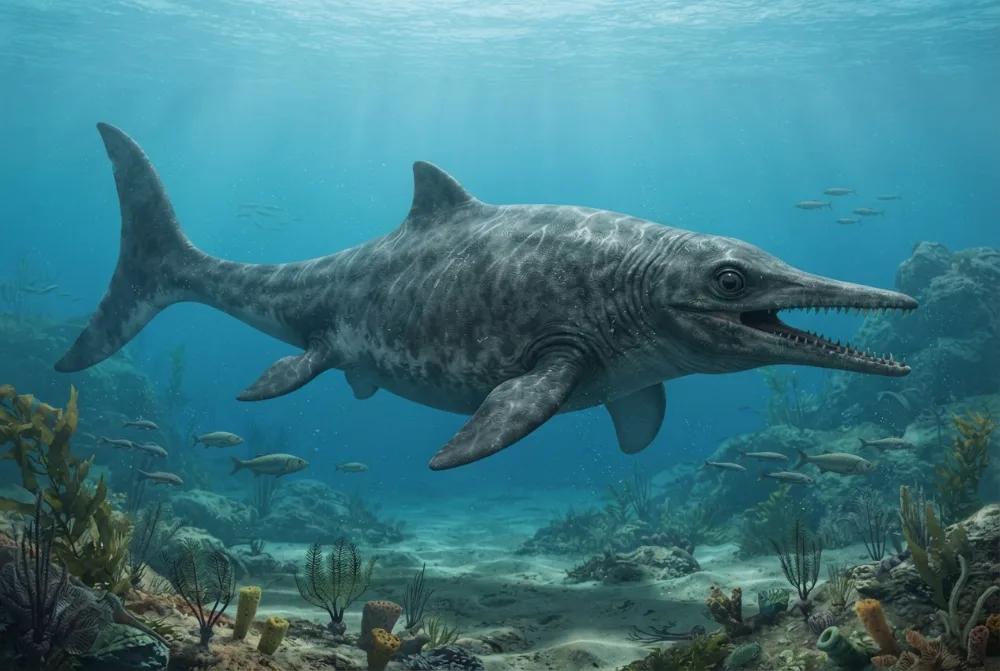
Temnodontosaurus was a giant marine reptile that swam in the Jurassic seas. It was one of the biggest ichthyosaurs, with huge eyes and sharp teeth. It hunted fish, squid, and even other ichthyosaurs.1
E phetse neng?
E ne e le kgolo hakae?
E ne e le telele hakae?
 telele jwaloka dikoloi tse 2 tse pakilweng ka mola🍌telele jwaloka dibanana tse 50 di behilwe ka mola🏊e ne e ka sesa bolelele ba letamo le leholo la ho sesa (50 m) ka metsotswana e 4.9
Temnodontosaurus e ne e le kgolo hakae ha e bapiswa le WENA?
Ke dipalo feela ho browser ya hao. Ha ho letho le bolokwang kapa le romelwang kae kapa kae.
E ne e le lebelo hakae?


Dintlha tse monate
Temnodontosaurus had the largest eyes of any known animal, measuring over 25 cm (9.8 in) across, as big as a dinner plate.1
One fossil of Temnodontosaurus trigonodon had the remains of three baby Stenopterygius ichthyosaurs in its stomach, along with many squid hooks.1
The first Temnodontosaurus fossil was found by famous fossil hunter Mary Anning in Dorset, England, around 1810.1
Temnodontosaurus lived during the Early Jurassic, from about 201 to 176 million years ago.5
It was a fast swimmer with flippers and a tail fin, and may have been an ambush predator.1
Some scientists think Temnodontosaurus might not be a single natural group, because different species may not be closely related.2
Dipotso tse botswang haholo ka Temnodontosaurus
?How big was Temnodontosaurus?
Temnodontosaurus was generally about 9 metres (30 feet) long, but some specimens may have been over 10 metres. It was one of the largest ichthyosaurs, though not as big as some Triassic forms.13
?Did Temnodontosaurus have the largest eyes of any animal?
Yes, Temnodontosaurus had eye sockets over 25 cm (9.8 inches) wide, possibly the largest eyes of any known vertebrate, rivaling those of giant squid. This helped it see in dim light.14
?What did Temnodontosaurus eat?
Temnodontosaurus was an apex predator that ate bony fish, cephalopods (like squid), and even other ichthyosaurs. One fossil had three baby Stenopterygius in its stomach.1
?Could Temnodontosaurus swim fast?
Yes, Temnodontosaurus was a fast swimmer with flippers and a tail fin. Its wing-like flippers may have helped it swim stealthily to sneak up on prey.14
?Is Temnodontosaurus a dinosaur?
No, Temnodontosaurus is an ichthyosaur, a marine reptile, not a dinosaur. Ichthyosaurs lived in the seas during the time of dinosaurs.1
?When did Temnodontosaurus live?
Temnodontosaurus lived during the Early Jurassic, about 201 to 176 million years ago. It swam in the seas of what is now Europe and possibly Chile.1
Bakeng sa ditsebi tsa didinosaure
- Lebitso la saense
- Temnodontosaurus
- E rehilwe ke
- Lydekker 18895
- Sehlopha
- Diikhthiosaure
- Lelapa / leloko
- Neoichthyosauria5
- Tlhophiso
- Ichthyosauria > Ichthyosauromorpha5
- Dilemo tsa mafika
- dilemo tse dimilione tse 201 ho isa ho 175 (Hettangian / Toarcian)5
- Dibopeho tsa mafika
- Alum Shale, Charmouth Mudstone, Luxembourg Sandstone5
- Dinaha
- United Kingdom, Fora, Jeremane, Luxembourg, Belgium5
- Direkoto tsa difosili
- 16 ho The Paleobiology Database5
- Ho sibollwa
- The first Temnodontosaurus fossil was a skull and partial skeleton found by Joseph and Mary Anning in Dorset, England, around 1810. It was described by Sir Everard Home between 1814 and 1819, making it the first ichthyosaur ever scientifically described. The genus was named by Richard Lydekker in 1889.1
- E sa ntse e phehwa kgang
- Scientists are still debating whether Temnodontosaurus is a natural group, because different species might not be closely related to each other.2
Moo dintlha di tswang teng
- Temnodontosaurus (en.wikipedia.org)
- Anatomy and phylogenetic relationships of Temnodontosaurus zetlandicus (Reptilia: Ichthyosauria) | Zoological Journal of the Linnean Society | Oxford Academic (academic.oup.com)
- Giant ichthyosaurs evolved stealthy flippers to sneak up on prey | Natural History Museum (nhm.ac.uk)
- Adaptations for stealth in the wing-like flippers of a large ichthyosaur | Nature (preview-www.nature.com)
- Temnodontosaurus in The Paleobiology Database (CC BY 4.0): dilemo, dibaka, dibopeho tsa mafika, tlhophiso.
Ntlha e nngwe le e nngwe leqepheng lena e na le nomoro e supang mohlodi wa yona. Haeba re fositse ho hong, re kopa tshwarelo, re balatedi ba didinosaure, ha re koranta ya saense. Re bolelle ho [email protected] mme re tla e lokisa.
 Rex o lapile! Dino Wiki ke projeke ya ntate bakeng sa mora wa hae ya ratang didinosaure, ke mahala, ha ho dipapatso, ha ho disebedi. Batho ba baholo ba ka fepa Rex seneke ho thusa hore e dule e le inthaneteng.Fepa Rex
 Ichthyosaurus
 Platypterygius
 Stenopterygius
 Khudiakovia
 Ophthalmosaurus
 Chonespondylus
 Dilophosaurus
 Dorygnathus
 Lufengosaurus
 Scutellosaurus
 Yunnanosaurus
 Sinosaurus