 Kwisi: O dinosaure efe?
 Ntwa ya didinosaure
 Peiso ya didinosaure
 Dipapadi tse nyane tsa didinosaure
 Albamo ya ditikara
 Manane a TOP a didinosaure
 Nkgethele!
Bohaiornis
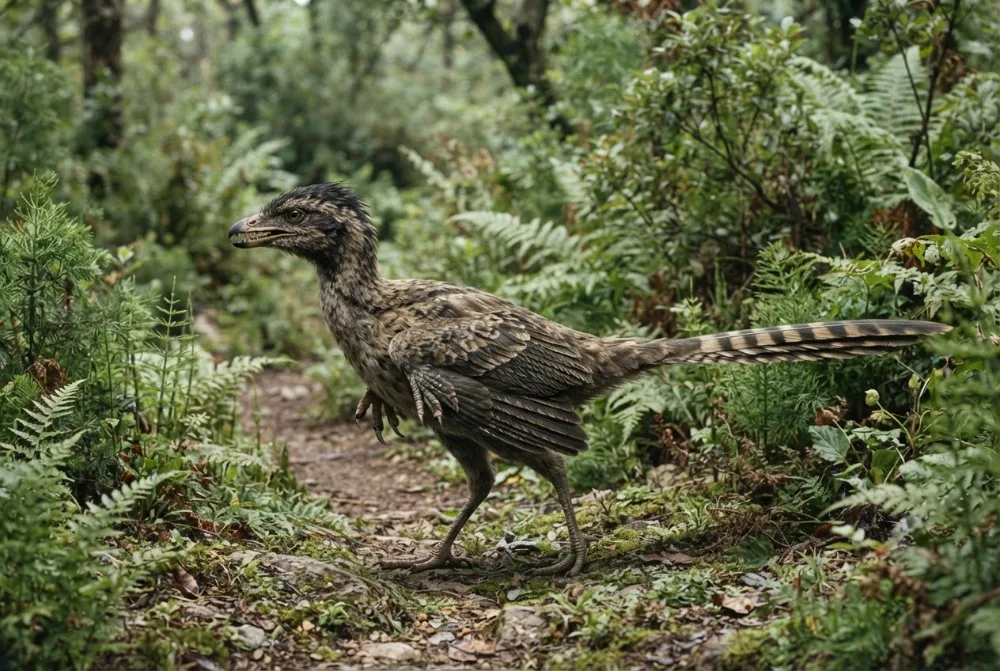
Bohaiornis was a feathered dinosaur that lived about 120 million years ago in what is now China. It was a bird-like predator with sharp teeth and long tail feathers. Scientists found a nearly complete skeleton that shows it was a fast, ground-dwelling hunter.15
E phetse neng?
E ne e le kgolo hakae?
E ne e le boima hakae?
Bohaiornis e ne e le kgolo hakae ha e bapiswa le WENA?
Ke dipalo feela ho browser ya hao. Ha ho letho le bolokwang kapa le romelwang kae kapa kae.
E ne e le lebelo hakae?


Dintlha tse monate
Bohaiornis had two long, ribbon-like feathers on its tail, not a fan of short feathers like many other birds.1
It was much larger than its close relative Eoenantiornis, which lived a bit earlier.1
The first skeleton found was almost complete, with all its bones still connected.2
Scientists once thought it had stones in its belly to help grind food, but those turned out to be mineral lumps that formed after death.1
Bohaiornis had a broad snout, which is unusual for early birds that ate meat.1
It lived during the Early Cretaceous, about 120 million years ago.1
Dipotso tse botswang haholo ka Bohaiornis
?How big was Bohaiornis?
Scientists do not give an exact size, but it was much larger than its close relative Eoenantiornis, and a second, even larger specimen has been found.14
?What did Bohaiornis eat?
It was probably a meat-eater, maybe a raptorial predator. Scientists once thought it had stomach stones to help grind food, but those turned out to be mineral lumps that formed after death.14
?Did Bohaiornis have feathers?
Yes. The first skeleton found had two long, ribbon-like feathers attached to its tail.1
?When did Bohaiornis live?
It lived during the Early Cretaceous, about 120 million years ago, in what is now China.1
Mosenyi wa ditshomo
Tshomo: People might think Bohaiornis ate plants because it had stones in its stomach.
Nnete: The stones were actually mineral concretions that formed after the animal died, and Bohaiornis was a meat-eater.1
Bakeng sa ditsebi tsa didinosaure
- Lebitso la saense
- Bohaiornis
- E rehilwe ke
- Hu et al. 20115
- Sehlopha
- Dinonyana tsa pele
- Lelapa / leloko
- Bohaiornithidae5
- Tlhophiso
- Theropoda > Avialae5
- Dilemo tsa mafika
- dilemo tse dimilione tse 121 ho isa ho 113 (Aptian)5
- Dibopeho tsa mafika
- Jiufotang5
- Dinaha
- Tjhaena5
- Direkoto tsa difosili
- 2 ho The Paleobiology Database5
- Ho sibollwa
- Bohaiornis was named by Dongyu Hu, Li Li, Lianhaim Hou, and Xing Xu in 2011. They described a nearly complete skeleton from the Yixian Formation in China.21
- E sa ntse e phehwa kgang
- Scientists still debate what exactly Bohaiornis ate, because its stomach contents are not clear.1
Moo dintlha di tswang teng
- Bohaiornis (en.wikipedia.org)
- A new enantiornithine bird from the Lower Cretaceous of western L...: Ingenta Connect (ingentaconnect.com)
- Synthetic analysis of trophic diversity and evolution in Enantiornithes with new insights from Bohaiornithidae (pmc.ncbi.nlm.nih.gov)
- A new specimen of large-bodied basal Enantiornithine Bohaiornis from the Early Cretaceous of China and the inference of feeding ecology in Mesozoic birds | Journal of Paleontology | Cambridge Core (cambridge.org)
- Bohaiornis in The Paleobiology Database (CC BY 4.0): dilemo, dibaka, dibopeho tsa mafika, tlhophiso.
Ntlha e nngwe le e nngwe leqepheng lena e na le nomoro e supang mohlodi wa yona. Haeba re fositse ho hong, re kopa tshwarelo, re balatedi ba didinosaure, ha re koranta ya saense. Re bolelle ho [email protected] mme re tla e lokisa.
 Rex o lapile! Dino Wiki ke projeke ya ntate bakeng sa mora wa hae ya ratang didinosaure, ke mahala, ha ho dipapatso, ha ho disebedi. Batho ba baholo ba ka fepa Rex seneke ho thusa hore e dule e le inthaneteng.Fepa Rex
 Archaeopteryx
 Hesperornis
 Ichthyornis
 Baptornis
 Jurapteryx
 Gobipteryx
 Stegosaurus
 Iguanodon
 Giganotosaurus
 Microraptor
 Deinonychus
 Baryonyx