 Kwisi: O dinosaure efe?
 Ntwa ya didinosaure
 Peiso ya didinosaure
 Dipapadi tse nyane tsa didinosaure
 Albamo ya ditikara
 Manane a TOP a didinosaure
 Nkgethele!
E phetse neng?

E ne e le kgolo hakae?
E ne e le telele hakae?
E ne e phahame hakae?
Ichthyornis e ne e le kgolo hakae ha e bapiswa le WENA?
Ke dipalo feela ho browser ya hao. Ha ho letho le bolokwang kapa le romelwang kae kapa kae.
E ne e le lebelo hakae?


Dintlha tse monate
Ichthyornis was one of the first prehistoric birds discovered with teeth, and Charles Darwin said it was important for understanding evolution.1
Its backbone bones were shaped like a fish's, which is why it got the name 'fish bird'.1
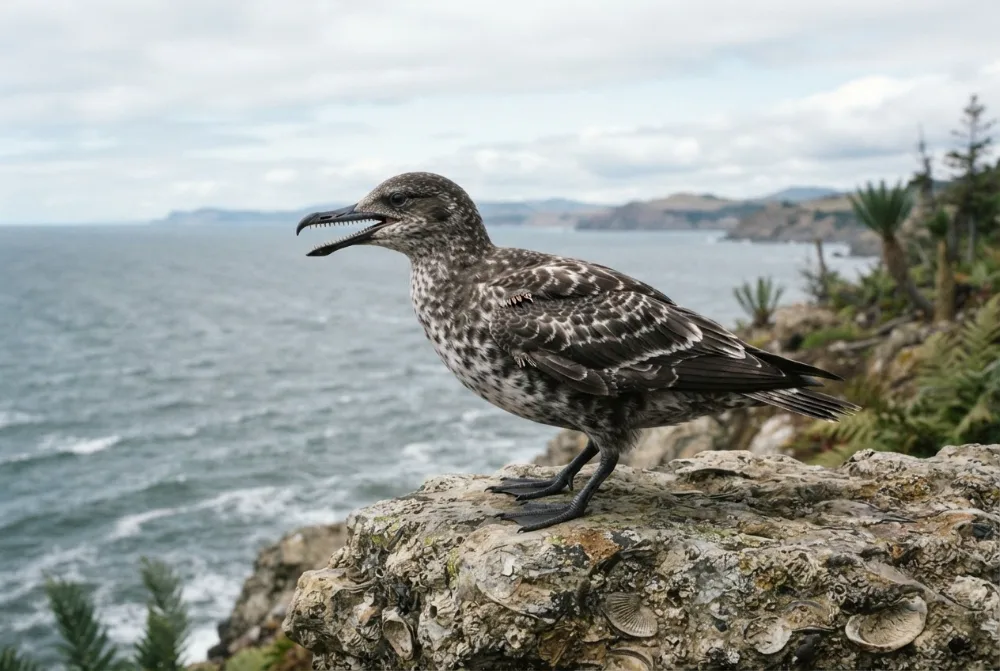
The beak of Ichthyornis was made of several separate plates, like an albatross's beak, not a single piece like most modern birds.1
Ichthyornis lived between about 93 and 83.5 million years ago, during the Late Cretaceous Period.1
Over time, Ichthyornis grew larger: older fossils have a wing bone about 58 mm long, while younger ones have a wing bone about 71.5 mm long.1
Its teeth were curved backward and set in a groove, similar to those of marine reptiles like mosasaurs.1
Ichthyornis is one of the closest extinct relatives of modern birds, helping scientists learn how today's birds evolved.1
Dipotso tse botswang haholo ka Ichthyornis
?How big was Ichthyornis?
About 24 centimetres (9.4 inches) long, with a skeletal wingspan of around 43 centimetres (17 inches). That is about the size of a pigeon.1
?Did Ichthyornis have teeth?
Yes, it had sharp, backward-curved teeth in the middle part of its jaws. The tips of its jaws had no teeth and were covered by a beak.1
?Could Ichthyornis fly?
Yes, it was a strong flier. Its wings and breastbone looked very modern, similar to birds that fly well today.1
?What did Ichthyornis eat?
It probably ate fish and other small sea animals, like modern gulls and terns. Its teeth helped it grab slippery prey.2
?When did Ichthyornis live?
It lived during the Late Cretaceous Period, from about 93 million to 83.5 million years ago.1
?Where did Ichthyornis live?
It lived along the coasts of the huge inland sea that covered the middle of North America. Its fossils have been found in Kansas, Texas, Alberta, and other places.1
?Is Ichthyornis a dinosaur?
Yes, birds evolved from dinosaurs, so Ichthyornis is a type of dinosaur called an avialan. But it is not a non-avian dinosaur like T. rex.1
Mosenyi wa ditshomo
Tshomo: Ichthyornis is sometimes thought to be a dinosaur like T. rex.
Nnete: Ichthyornis is a bird, not a non-avian dinosaur. It belongs to the group Avialae, which includes modern birds and their extinct relatives.1
Bakeng sa ditsebi tsa didinosaure
- Lebitso la saense
- Ichthyornis
- E rehilwe ke
- Marsh 18724
- Sehlopha
- Dinonyana tsa pele
- Lelapa / leloko
- Ichthyornithes4
- Tlhophiso
- Theropoda > Avialae4
- Dilemo tsa mafika
- dilemo tse dimilione tse 100 ho isa ho 72 (Cenomanian / Campanian)4
- Dibopeho tsa mafika
- Niobrara, Mooreville Chalk, Belle Fourche4
- Dinaha
- Amerika, Kanada, Uzbekistan, Meksiko4
- Direkoto tsa difosili
- 33 ho The Paleobiology Database4
- E boetse e tsejwa e le
- Angelinornis, Colonosaurus, Plegadornis (mabitso a kgale jwale a balwa e le phoofolo e le nngwe)4
- Ho sibollwa
- Ichthyornis was named by American paleontologist Othniel Charles Marsh in 1872. At first, Marsh thought the toothed jaws belonged to a marine reptile, but later in 1873 he realized they were part of the bird.12
- E sa ntse e phehwa kgang
- Scientists still debate whether the species should be called Ichthyornis dispar or Ichthyornis anceps, because of naming rules.1
Moo dintlha di tswang teng
- Ichthyornis (en.wikipedia.org)
- Ichthyornis | Cretaceous period, seabird, toothed beak (britannica.com)
- A New Specimen of the Late Cretaceous Bird, cf.Ichthyornissp., from the Cenomanian of Central Kansas, with Comments on the Size Distribution ofIchthyornisin North America (exa.ai)
- Ichthyornis in The Paleobiology Database (CC BY 4.0): dilemo, dibaka, dibopeho tsa mafika, tlhophiso.
Ntlha e nngwe le e nngwe leqepheng lena e na le nomoro e supang mohlodi wa yona. Haeba re fositse ho hong, re kopa tshwarelo, re balatedi ba didinosaure, ha re koranta ya saense. Re bolelle ho [email protected] mme re tla e lokisa.
 Rex o lapile! Dino Wiki ke projeke ya ntate bakeng sa mora wa hae ya ratang didinosaure, ke mahala, ha ho dipapatso, ha ho disebedi. Batho ba baholo ba ka fepa Rex seneke ho thusa hore e dule e le inthaneteng.Fepa Rex
 Archaeopteryx
 Hesperornis
 Baptornis
 Jurapteryx
 Gobipteryx
 Martinavis
 Tyrannosaurus
 Triceratops
 Velociraptor
 Spinosaurus
 Ankylosaurus
 Parasaurolophus