 Kwisi: O dinosaure efe?
 Ntwa ya didinosaure
 Peiso ya didinosaure
 Dipapadi tse nyane tsa didinosaure
 Albamo ya ditikara
 Manane a TOP a didinosaure
 Nkgethele!
E phetse neng?

E ne e le kgolo hakae?
E ne e le telele hakae?
E ne e phahame hakae?
kakanyo
E ne e le boima hakae?
 telele jwaloka dikatse tsa lapeng tse 2 ho tloha nkong ho isa mohatleng🍌telele jwaloka dibanana tse 6 di behilwe ka molae batla e le boima jwaloka katse ya lapeng🍌boima jwaloka dibanana tse 42🏊e ne e ka sesa bolelele ba letamo le leholo la ho sesa (50 m) ka metsotswana e 16
Baptornis e ne e le kgolo hakae ha e bapiswa le WENA?
Ke dipalo feela ho browser ya hao. Ha ho letho le bolokwang kapa le romelwang kae kapa kae.
E ne e le lebelo hakae?


Dintlha tse monate
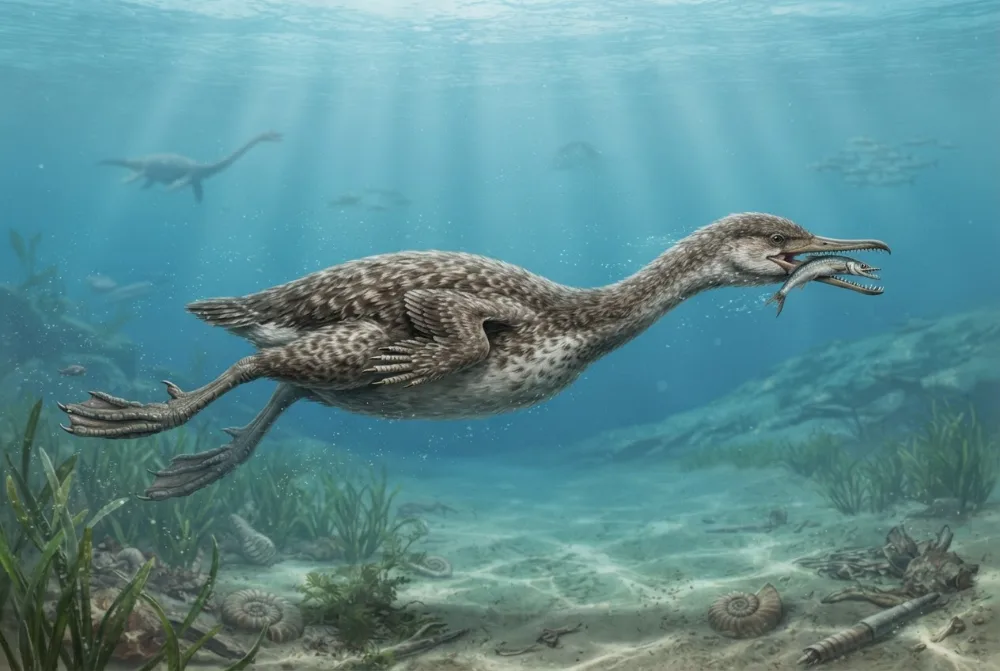
Baptornis had teeth in its beak, which is rare for birds. Most modern birds have no teeth.1
It was a strong swimmer and diver, but on land it was clumsy. It probably pushed itself along on its belly or did small hops.1
Fossils of young Baptornis have been found in Canada and Alaska, suggesting these birds migrated north to breed in summer, like some penguins do today.1
Baptornis lived about 87 to 80 million years ago, when a shallow sea covered much of central North America.1
One Baptornis fossil was found with tiny round coprolites (fossil poop) inside. The poop contained remains of a small sabre-toothed herring.1
Baptornis was one of the first Mesozoic birds discovered, along with Archaeopteryx. It was named by famous fossil hunter Othniel Charles Marsh in 1877.1
A second, much larger species of Baptornis was once named (Baptornis varneri), but later scientists moved it to a different genus called Brodavis.1
Dipotso tse botswang haholo ka Baptornis
?How big was Baptornis?
About the size of a loon, which is roughly 0.7 to 1 metre long. It was a medium-sized bird among its relatives.12
?Could Baptornis fly?
No, Baptornis was flightless. It was a strong swimmer and diver instead.1
?What did Baptornis eat?
It ate fish, especially small sabre-toothed herring called Enchodus. It caught them with its beak and swallowed them whole or in pieces.1
?Did Baptornis have teeth?
Yes, Baptornis had teeth in its beak, which is unusual for birds. Most modern birds have no teeth.1
Bakeng sa ditsebi tsa didinosaure
- Lebitso la saense
- Baptornis
- E rehilwe ke
- Marsh 18773
- Sehlopha
- Dinonyana tsa pele
- Lelapa / leloko
- Baptornithidae3
- Tlhophiso
- Theropoda > Avialae3
- Dilemo tsa mafika
- dilemo tse dimilione tse 90 ho isa ho 72 (Coniacian / Campanian)3
- Dibopeho tsa mafika
- Dinosaur Park, Niobrara, Judith River3
- Dinaha
- Kanada, Amerika, Sweden3
- Direkoto tsa difosili
- 10 ho The Paleobiology Database3
- E boetse e tsejwa e le
- Parascaniornis (mabitso a kgale jwale a balwa e le phoofolo e le nngwe)3
- Ho sibollwa
- Othniel Charles Marsh discovered the first fossils of Baptornis in Kansas in the 1870s. He named it in 1877.1
- E sa ntse e phehwa kgang
- Scientists are not sure if a fossil from Sweden called Parascaniornis stensioi is actually a second species of Baptornis or just the same species.1
Moo dintlha di tswang teng
- Baptornis (en.wikipedia.org)
- The Skeleton of Baptornis advenus (Aves: Hesperornithiformes) (exa.ai)
- Baptornis in The Paleobiology Database (CC BY 4.0): dilemo, dibaka, dibopeho tsa mafika, tlhophiso.
Ntlha e nngwe le e nngwe leqepheng lena e na le nomoro e supang mohlodi wa yona. Haeba re fositse ho hong, re kopa tshwarelo, re balatedi ba didinosaure, ha re koranta ya saense. Re bolelle ho [email protected] mme re tla e lokisa.
 Rex o lapile! Dino Wiki ke projeke ya ntate bakeng sa mora wa hae ya ratang didinosaure, ke mahala, ha ho dipapatso, ha ho disebedi. Batho ba baholo ba ka fepa Rex seneke ho thusa hore e dule e le inthaneteng.Fepa Rex
 Archaeopteryx
 Hesperornis
 Ichthyornis
 Jurapteryx
 Gobipteryx
 Martinavis
 Tyrannosaurus
 Triceratops
 Velociraptor
 Spinosaurus
 Ankylosaurus
 Parasaurolophus