 Kwisi: O dinosaure efe?
 Ntwa ya didinosaure
 Peiso ya didinosaure
 Dipapadi tse nyane tsa didinosaure
 Albamo ya ditikara
 Manane a TOP a didinosaure
 Nkgethele!
E phetse neng?

E ne e le kgolo hakae?
E ne e le telele hakae?
E ne e phahame hakae?
kakanyo
E ne e le boima hakae?
 telele jwaloka dikatse tsa lapeng tse 4 ho tloha nkong ho isa mohatleng🍌telele jwaloka dibanana tse 10 di behilwe ka mola🍌boima jwaloka dibanana tse 88🏊e ne e ka sesa bolelele ba letamo le leholo la ho sesa (50 m) ka metsotswana e 11
Hesperornis e ne e le kgolo hakae ha e bapiswa le WENA?
Ke dipalo feela ho browser ya hao. Ha ho letho le bolokwang kapa le romelwang kae kapa kae.
E ne e le lebelo hakae?


Dintlha tse monate
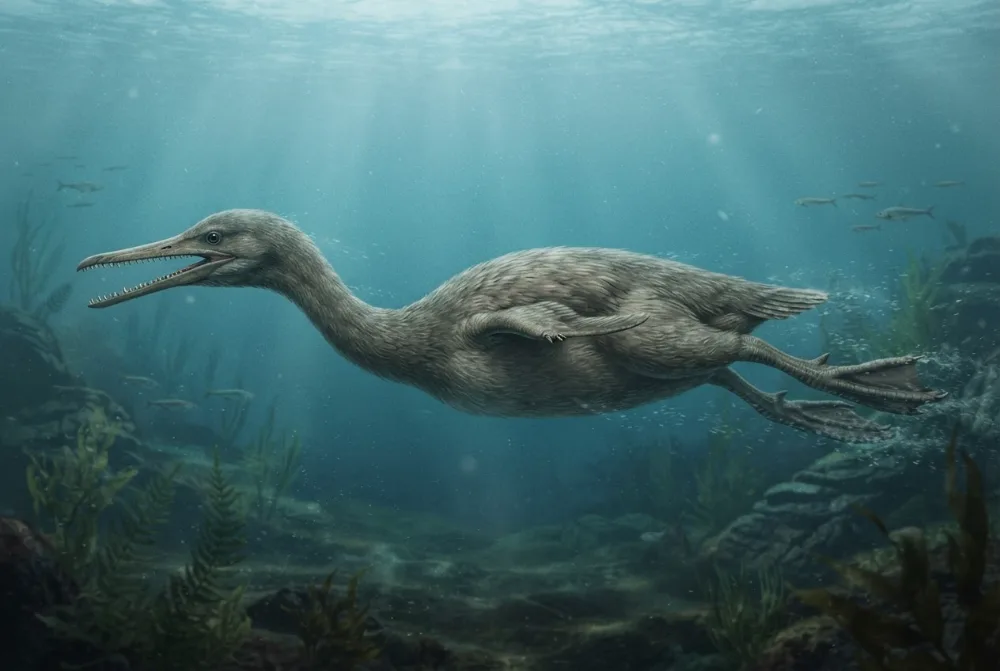
Hesperornis was one of the first birds to give up flying and become a full-time swimmer.2
Its legs were placed far back on its body, like a loon, making it clumsy on land but a powerful diver.1
The first fossils of Hesperornis were found by famous fossil hunter Othniel Charles Marsh in 1870 in Kansas.12
Several species of Hesperornis lived from about 90 to 66 million years ago, during the Late Cretaceous.5
Hesperornis fossils have been found in many places, including Canada, the United States, Russia, and Sweden.5
Dipotso tse botswang haholo ka Hesperornis
?How big was Hesperornis?
About 1.5 to 2 metres (4.9 to 6.6 ft) long and weighed around 10.6 kilograms (23 lb).1
?Did Hesperornis have teeth?
Yes, it had teeth in its beak, which is rare for birds. The teeth sat in a groove, not in individual sockets.1
?Could Hesperornis fly?
No, it could not fly. Its wings were tiny and useless for flight, and its breastbone lacked a keel for flight muscles.13
?What did Hesperornis eat?
It ate fish, which it caught with its tooth-lined beak while diving in the sea.4
?When did Hesperornis live?
It lived during the Late Cretaceous period, about 83.6 to 72 million years ago, and possibly into the early Maastrichtian.1
?Where was Hesperornis found?
Fossils have been found in Kansas, Canada, Russia, Sweden, and other places, mostly in marine rocks.1
?Could Hesperornis walk on land?
It was clumsy on land. Its legs were placed far back, so it probably pushed itself along on its belly like a seal.1
Mosenyi wa ditshomo
Tshomo: Some people think Hesperornis was a dinosaur.
Nnete: Hesperornis was a bird, not a dinosaur. Birds evolved from dinosaurs, but Hesperornis itself is classified as a bird.1
Bakeng sa ditsebi tsa didinosaure
- Lebitso la saense
- Hesperornis
- E rehilwe ke
- Marsh 18725
- Sehlopha
- Dinonyana tsa pele
- Lelapa / leloko
- Hesperornithidae5
- Tlhophiso
- Theropoda > Avialae5
- Dilemo tsa mafika
- dilemo tse dimilione tse 90 ho isa ho 66 (Coniacian / Maastrichtian)5
- Dibopeho tsa mafika
- Pierre Shale, Rybushka, Niobrara5
- Dinaha
- Kanada, Amerika, Russia, Sweden5
- Direkoto tsa difosili
- 65 ho The Paleobiology Database5
- E boetse e tsejwa e le
- Coniornis, Hargeria, Lestornis (mabitso a kgale jwale a balwa e le phoofolo e le nngwe)5
- Ho sibollwa
- Othniel Charles Marsh discovered the first Hesperornis fossil in 1870 near the Smoky Hill River in Kansas. He named it Hesperornis regalis in 1872.12
- E sa ntse e phehwa kgang
- Scientists are still debating exactly how many species of Hesperornis existed, because many fossils are incomplete.1
Moo dintlha di tswang teng
- Hesperornis (en.wikipedia.org)
- The Hesperornithiformes: A Review of the Diversity, Distribution, and Ecology of the Earliest Diving Birds (mdpi.com)
- Hesperornis - Scholars | Britannica Kids | Encyclopedia (kids.britannica.com)
- Hesperornis Facts, Artwork, Information - National Geographic | National Geographic (nationalgeographic.com)
- Hesperornis in The Paleobiology Database (CC BY 4.0): dilemo, dibaka, dibopeho tsa mafika, tlhophiso.
Ntlha e nngwe le e nngwe leqepheng lena e na le nomoro e supang mohlodi wa yona. Haeba re fositse ho hong, re kopa tshwarelo, re balatedi ba didinosaure, ha re koranta ya saense. Re bolelle ho [email protected] mme re tla e lokisa.
 Rex o lapile! Dino Wiki ke projeke ya ntate bakeng sa mora wa hae ya ratang didinosaure, ke mahala, ha ho dipapatso, ha ho disebedi. Batho ba baholo ba ka fepa Rex seneke ho thusa hore e dule e le inthaneteng.Fepa Rex
 Archaeopteryx
 Ichthyornis
 Baptornis
 Jurapteryx
 Gobipteryx
 Martinavis
 Tyrannosaurus
 Triceratops
 Velociraptor
 Spinosaurus
 Ankylosaurus
 Parasaurolophus