 Kwisi: O dinosaure efe?
 Ntwa ya didinosaure
 Peiso ya didinosaure
 Dipapadi tse nyane tsa didinosaure
 Albamo ya ditikara
 Manane a TOP a didinosaure
 Nkgethele!
Ceratocaudia
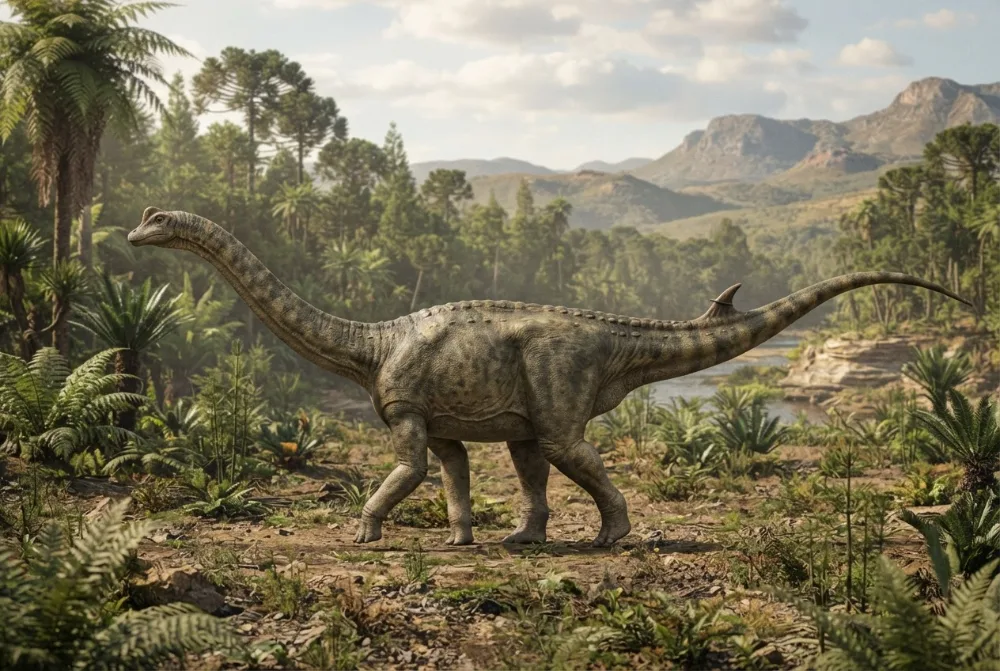
Ceratocaudia was a small, plant-eating sauropod dinosaur that lived in what is now India during the Jurassic Period. It had a horn-like crest on its tail bones, and scientists think it might have used its tail to scare away predators.1
E phetse neng?
E ne e le kgolo hakae?
E ne e le telele hakae?
E ne e phahame hakae?
kakanyo
 telele jwaloka dintja tse 7 ho tloha nkong ho isa mohatleng🍌telele jwaloka dibanana tse 39 di behilwe ka mola🏃e ne e ka matha dimitara tse 100 ka metsotswana e 12 (motho ya lebelo ka ho fetisisa o hloka 9,6)
Ceratocaudia e ne e le kgolo hakae ha e bapiswa le WENA?
Ke dipalo feela ho browser ya hao. Ha ho letho le bolokwang kapa le romelwang kae kapa kae.
E ne e le lebelo hakae?


Dintlha tse monate
Ceratocaudia is one of the smallest known macronarian sauropods, measuring only about 7 metres (23 feet) long.1
The horn-like crest on its tail vertebrae gave the dinosaur its name, meaning 'horned tail'.1
Scientists think Ceratocaudia might have been a dwarf species because the only known skeleton is from an old individual but is still very small.13
The holotype skeleton includes neck bones, tail bones, an ulna, thighbones, shinbones, and even finger and toe bones.1
Ceratocaudia lived in an estuary environment alongside petrified wood, clams, and a much larger sauropod that was about 20 metres long.1
Dipotso tse botswang haholo ka Ceratocaudia
?How big was Ceratocaudia?
Ceratocaudia was about 7 metres (23 feet) long, making it one of the smallest known macronarian sauropods.1
?Did Ceratocaudia have a horn on its tail?
Yes, it had a horn-like crest on its tail bones, which is why its name means 'horned tail'.1
?What did Ceratocaudia eat?
Ceratocaudia was a plant-eater, or herbivore.4
?When did Ceratocaudia live?
Ceratocaudia lived during the Jurassic Period, from about 201 to 168 million years ago.4
?Where was Ceratocaudia found?
Its fossils were found in Gujarat, India, in rocks that were once a low-energy estuary.1
?Could Ceratocaudia use its tail to fight?
Scientists think it could swing its tail as a mild deterrent to scare away predators.1
Bakeng sa ditsebi tsa didinosaure
- Lebitso la saense
- Ceratocaudia
- E rehilwe ke
- Natarajan et al. 20264
- Sehlopha
- Melala e melelele
- Lelapa / leloko
- Macronaria4
- Tlhophiso
- Sauropodomorpha > Sauropoda > Macronaria4
- Dilemo tsa mafika
- dilemo tse dimilione tse 201 ho isa ho 168 (Hettangian / Bajocian)4
- Dibopeho tsa mafika
- Kaladongar4
- Dinaha
- India4
- Direkoto tsa difosili
- 1 ho The Paleobiology Database4
- Ho sibollwa
- Ceratocaudia antiqua was named by Abhishek Natarajan and colleagues in 2026 based on a partial skeleton found in the Kaladongar Formation of Gujarat, India.12
- E sa ntse e phehwa kgang
- Scientists are not sure if Ceratocaudia was a true dwarf species or just a small adult, and they debate its exact place on the sauropod family tree.13
Moo dintlha di tswang teng
- Ceratocaudia (en.wikipedia.org)
- PBDB Taxon (paleobiodb.org)
- A new diminutive Jurassic neosauropod from the Kaladongar Formation (Khadir Uplift) of the Kachchh Basin, western India (exa.ai)
- Ceratocaudia in The Paleobiology Database (CC BY 4.0): dilemo, dibaka, dibopeho tsa mafika, tlhophiso.
Ntlha e nngwe le e nngwe leqepheng lena e na le nomoro e supang mohlodi wa yona. Haeba re fositse ho hong, re kopa tshwarelo, re balatedi ba didinosaure, ha re koranta ya saense. Re bolelle ho [email protected] mme re tla e lokisa.
 Rex o lapile! Dino Wiki ke projeke ya ntate bakeng sa mora wa hae ya ratang didinosaure, ke mahala, ha ho dipapatso, ha ho disebedi. Batho ba baholo ba ka fepa Rex seneke ho thusa hore e dule e le inthaneteng.Fepa Rex
 Brachiosaurus
 Diplodocus
 Brontosaurus
 Argentinosaurus
 Camarasaurus
 Morosaurus
 Dilophosaurus
 Stenopterygius
 Dorygnathus
 Scutellosaurus
 Sinosaurus
 Temnodontosaurus