 Kwisi: O dinosaure efe?
 Ntwa ya didinosaure
 Peiso ya didinosaure
 Dipapadi tse nyane tsa didinosaure
 Albamo ya ditikara
 Manane a TOP a didinosaure
 Nkgethele!
Chinshakiangosaurus
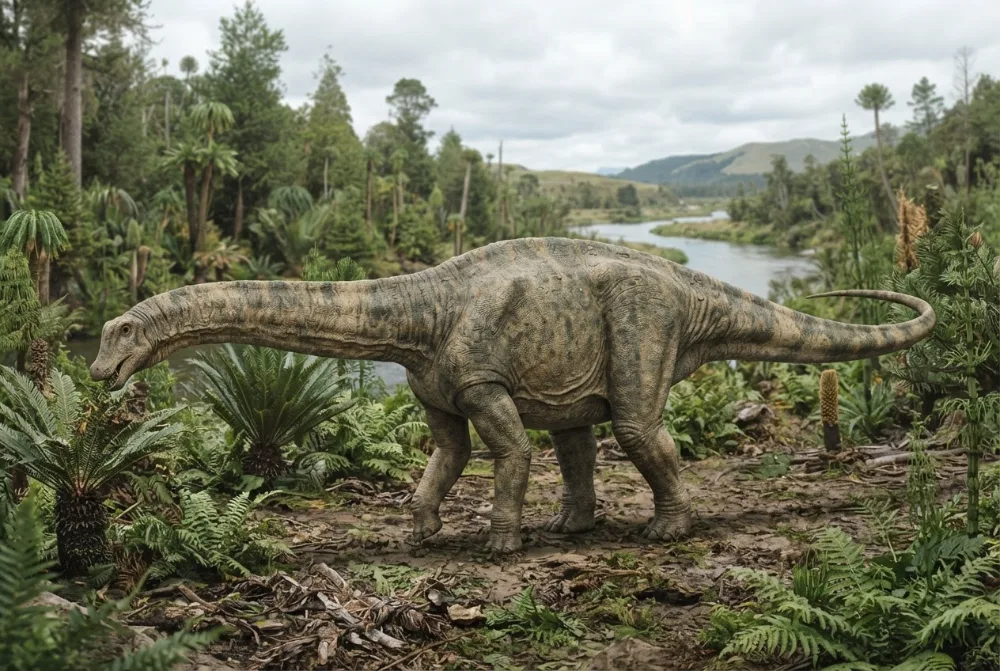
Chinshakiangosaurus was a huge, long-necked plant-eater that lived in China during the Early Jurassic. It is one of the earliest sauropods, the group that includes giants like Brachiosaurus and Diplodocus.1
E phetse neng?
E ne e le kgolo hakae?
E ne e le telele hakae?
E ne e phahame hakae?
kakanyo
 telele jwaloka dikoloi tse 3 tse pakilweng ka mola🍌telele jwaloka dibanana tse 72 di behilwe ka mola🏃e ne e ka matha dimitara tse 100 ka metsotswana e 20 (motho ya lebelo ka ho fetisisa o hloka 9,6)
Chinshakiangosaurus e ne e le kgolo hakae ha e bapiswa le WENA?
Ke dipalo feela ho browser ya hao. Ha ho letho le bolokwang kapa le romelwang kae kapa kae.
E ne e le lebelo hakae?


Dintlha tse monate
Chinshakiangosaurus is one of the few early sauropods with preserved skull bones, which helps scientists understand how sauropods evolved.1
Its lower jaw was curved into a U-shape, like later sauropods, but unlike the V-shaped jaws of earlier prosauropods.1
Scientists think Chinshakiangosaurus may have had fleshy cheeks, a feature that helped it hold food while chewing.12
The only known fossil includes a left lower jaw, neck and back vertebrae, shoulder blades, hip bones, and hind legs.1
The name was first used in 1975 but was not properly described until 1992, so for many years it was just a name without a description.1
Chinshakiangosaurus lived about 200 million years ago, during the Hettangian stage of the Early Jurassic.3
Dipotso tse botswang haholo ka Chinshakiangosaurus
?How big was Chinshakiangosaurus?
About 12 to 13 meters long. That is roughly the length of a large city bus.12
?What did Chinshakiangosaurus eat?
It was an herbivore (plant-eater). Its broad U-shaped snout and blunt teeth helped it eat large amounts of leaves and other plants.1
?Did Chinshakiangosaurus have feathers?
There is no evidence that Chinshakiangosaurus had feathers. Sauropods like this one are not known to have feathers.1
Bakeng sa ditsebi tsa didinosaure
- Lebitso la saense
- Chinshakiangosaurus
- E rehilwe ke
- Yeh 19753
- Sehlopha
- Melala e melelele
- Lelapa / leloko
- Sauropoda3
- Tlhophiso
- Sauropodomorpha > Sauropoda3
- Dilemo tsa mafika
- dilemo tse dimilione tse 201 ho isa ho 200 (Hettangian)3
- Dibopeho tsa mafika
- Fengjiahe3
- Dinaha
- Tjhaena3
- Direkoto tsa difosili
- 1 ho The Paleobiology Database3
- Ho sibollwa
- The fossils were found in 1970 by Zhao Xijin and his team in Yongren County, Yunnan, China. The name was first used by Yeh in 1975, but the official description was published by Dong Zhiming in 1992.1
- E sa ntse e phehwa kgang
- Scientists are not sure exactly how Chinshakiangosaurus is related to other early sauropods, because most of its skeleton has not been studied in detail yet.1
Moo dintlha di tswang teng
- Chinshakiangosaurus (en.wikipedia.org)
- A re-evaluation of Chinshakiangosaurus chunghoensis Ye ... (ivpp.cas.cn)
- Chinshakiangosaurus in The Paleobiology Database (CC BY 4.0): dilemo, dibaka, dibopeho tsa mafika, tlhophiso.
Ntlha e nngwe le e nngwe leqepheng lena e na le nomoro e supang mohlodi wa yona. Haeba re fositse ho hong, re kopa tshwarelo, re balatedi ba didinosaure, ha re koranta ya saense. Re bolelle ho [email protected] mme re tla e lokisa.
 Rex o lapile! Dino Wiki ke projeke ya ntate bakeng sa mora wa hae ya ratang didinosaure, ke mahala, ha ho dipapatso, ha ho disebedi. Batho ba baholo ba ka fepa Rex seneke ho thusa hore e dule e le inthaneteng.Fepa Rex
 Brachiosaurus
 Diplodocus
 Brontosaurus
 Argentinosaurus
 Camarasaurus
 Morosaurus
 Dilophosaurus
 Stenopterygius
 Dorygnathus
 Scutellosaurus
 Sinosaurus
 Temnodontosaurus