 Kwisi: O dinosaure efe?
 Ntwa ya didinosaure
 Peiso ya didinosaure
 Dipapadi tse nyane tsa didinosaure
 Albamo ya ditikara
 Manane a TOP a didinosaure
 Nkgethele!
Dunhuangia
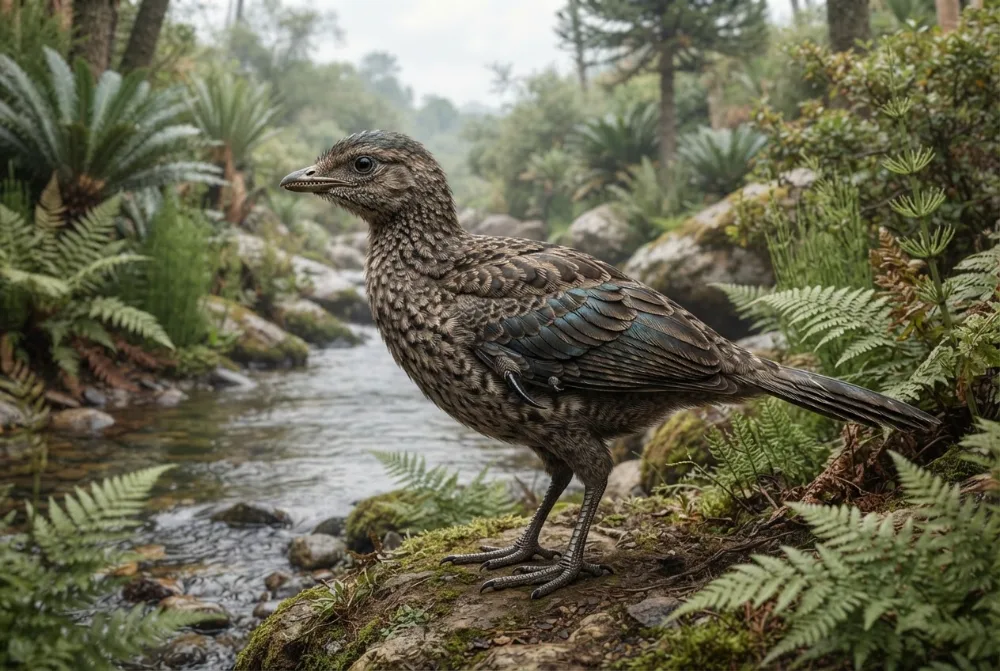
Dunhuangia was a bird that lived during the Early Cretaceous, about 121 to 113 million years ago. It was a medium-sized enantiornithine bird, a group that was very common during the time of dinosaurs. Dunhuangia had special bones in its chest that made it different from other birds.21
E phetse neng?
E ne e le lebelo hakae?


Dintlha tse monate
Dunhuangia is only the second enantiornithine bird species ever named from the Changma Basin in China.1
Its fossil includes parts of the forelimbs, shoulder girdle, and breastbone, but the skull is missing.3
The end of its breastbone had a deep notch with two side projections, a feature that helps scientists tell it apart from other enantiornithine birds.1
Dunhuangia lived alongside many other animals, including fish, salamanders, turtles, and other birds like Gansus.1
The Changma Basin where Dunhuangia was found is one of the few places where more advanced ornithuromorph birds outnumbered enantiornithines like Dunhuangia.1
Scientists think Dunhuangia was a ground-dwelling bird that could fly actively.2
Bakeng sa ditsebi tsa didinosaure
- Lebitso la saense
- Dunhuangia
- E rehilwe ke
- Wang et al. 20154
- Sehlopha
- Dinonyana tsa pele
- Lelapa / leloko
- Enantiornithes4
- Tlhophiso
- Theropoda > Avialae4
- Dilemo tsa mafika
- dilemo tse dimilione tse 121 ho isa ho 113 (Aptian)4
- Dibopeho tsa mafika
- Xiagou4
- Dinaha
- Tjhaena4
- Direkoto tsa difosili
- 1 ho The Paleobiology Database4
- Ho sibollwa
- Dunhuangia was named and described in 2015 by Wang Min, Li Daqing, Jingmai Kathleen O'Connor, Zhou Zhonghe, and You Hailu. The species name cuii honors Cui Guihai, who prepared many bird fossils from the Changma Basin.31
- E sa ntse e phehwa kgang
- Scientists are still debating whether the Changma avifauna represents a transitional stage in the dominance of ornithuromorph birds over enantiornithines like Dunhuangia.1
Moo dintlha di tswang teng
- Second species of enantiornithine bird from the Lower Cretaceous Changma Basin, northwestern China with implications for the taxonomic diversity of the Changma avifauna (sciencedirect.com)
- PBDB Taxon (paleobiodb.org)
- Dunhuangia (en.wikipedia.org)
- Dunhuangia in The Paleobiology Database (CC BY 4.0): dilemo, dibaka, dibopeho tsa mafika, tlhophiso.
Ntlha e nngwe le e nngwe leqepheng lena e na le nomoro e supang mohlodi wa yona. Haeba re fositse ho hong, re kopa tshwarelo, re balatedi ba didinosaure, ha re koranta ya saense. Re bolelle ho [email protected] mme re tla e lokisa.
 Rex o lapile! Dino Wiki ke projeke ya ntate bakeng sa mora wa hae ya ratang didinosaure, ke mahala, ha ho dipapatso, ha ho disebedi. Batho ba baholo ba ka fepa Rex seneke ho thusa hore e dule e le inthaneteng.Fepa Rex
 Archaeopteryx
 Hesperornis
 Ichthyornis
 Baptornis
 Jurapteryx
 Gobipteryx
 Stegosaurus
 Iguanodon
 Giganotosaurus
 Microraptor
 Deinonychus
 Baryonyx