 Kwisi: O dinosaure efe?
 Ntwa ya didinosaure
 Peiso ya didinosaure
 Dipapadi tse nyane tsa didinosaure
 Albamo ya ditikara
 Manane a TOP a didinosaure
 Nkgethele!
Epidexipteryx
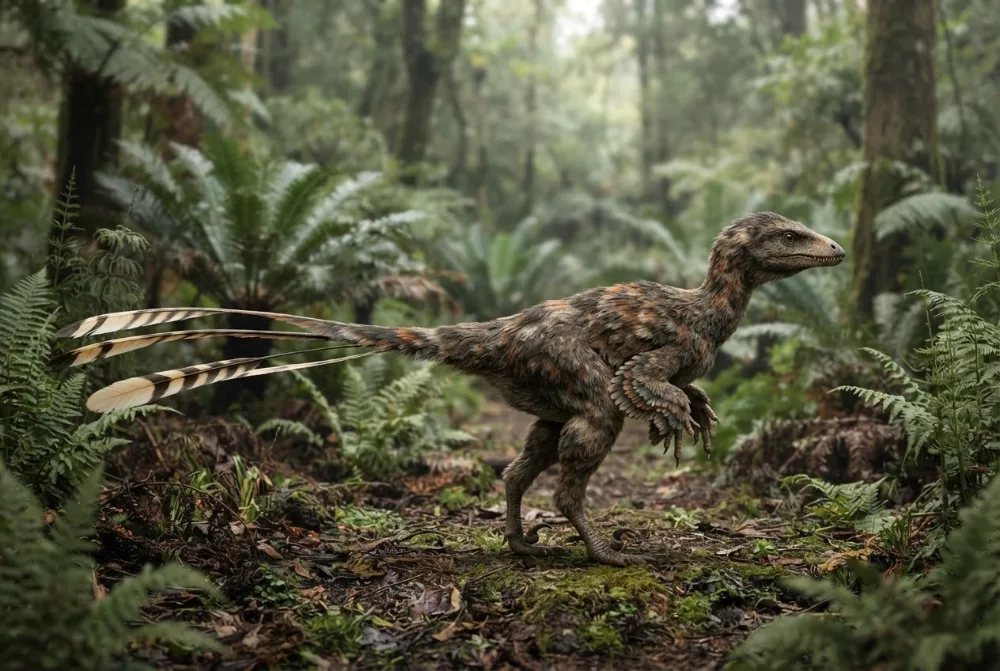
Epidexipteryx was a tiny, pigeon-sized dinosaur that lived in the Jurassic period. It had four long, ribbon-like feathers on its tail that it probably used to show off, not to fly. This little dinosaur was a meat-eater and is one of the oldest known dinosaurs with display feathers.1
E phetse neng?
E ne e le kgolo hakae?
E ne e le telele hakae?
E ne e phahame hakae?
kakanyo
E ne e le boima hakae?
Epidexipteryx e ne e le kgolo hakae ha e bapiswa le WENA?
Ke dipalo feela ho browser ya hao. Ha ho letho le bolokwang kapa le romelwang kae kapa kae.
E ne e le lebelo hakae?


Dintlha tse monate
Epidexipteryx had four long, ribbon-like feathers on its tail that were probably used for display, not for flying.1
It weighed only about 164 grams, which is less than a can of soda.1
Its front teeth were much larger than its back teeth, and they stuck out forward, similar to the dinosaur Masiakasaurus.1
Epidexipteryx lived about 165 to 161 million years ago, during the Middle to Late Jurassic.6
The only known fossil is a nearly complete skeleton of a young individual, found in Inner Mongolia, China.1
It had a short tail compared to its close relative Epidendrosaurus, with only 16 tail bones instead of more than 40.1
Epidexipteryx could not fly because it lacked the long flight feathers on its arms that birds use.1
Dipotso tse botswang haholo ka Epidexipteryx
?How big was Epidexipteryx?
It was tiny, about 25 to 30 cm long, not counting the tail feathers. That is about the size of a pigeon.3
?Did Epidexipteryx have feathers?
Yes, it had four long, ribbon-like feathers on its tail and a covering of simpler body feathers. The tail feathers were probably used for display, not for flying.34
?Could Epidexipteryx fly?
No, it could not fly. It lacked the long flight feathers on its arms that birds use, though it may have had a membrane wing for gliding.35
?What did Epidexipteryx eat?
It was a meat-eater. It may have used its long claws to rummage through trees for grubs, like an aye-aye.3
?When did Epidexipteryx live?
It lived during the Middle to Late Jurassic, about 165 to 154 million years ago, in what is now Inner Mongolia, China.3
Bakeng sa ditsebi tsa didinosaure
- Lebitso la saense
- Epidexipteryx
- E rehilwe ke
- Zhang et al. 20086
- Sehlopha
- Didinosaure tse jang nama
- Lelapa / leloko
- Paraves6
- Tlhophiso
- Theropoda6
- Dilemo tsa mafika
- dilemo tse dimilione tse 165 ho isa ho 162 (Callovian)6
- Dibopeho tsa mafika
- Tiaojishan6
- Dinaha
- Tjhaena6
- Direkoto tsa difosili
- 1 ho The Paleobiology Database6
- Ho sibollwa
- Epidexipteryx was named in 2008 by scientists Fucheng Zhang, Zhonghe Zhou, Xing Xu, Xiaolin Wang, and Corwin Sullivan. The name honors the late paleontologist Yaoming Hu. The fossil was found in the Daohugou area of Inner Mongolia, China.1
- E sa ntse e phehwa kgang
- Scientists are not sure exactly how old the rocks where Epidexipteryx was found are. They could be from the Middle Jurassic or the Late Jurassic, between 152 and 168 million years old.1
Moo dintlha di tswang teng
- LETTERS (ivpp.cas.cn)
- Epidexipteryx Zhang et al. 2008 - Encyclopedia of Life (eol.org)
- Epidexipteryx (en.wikipedia.org)
- Access : A bizarre Jurassic maniraptoran from China with elongate ribbon-like feathers : Nature (web.archive.org)
- nature.com (nature.com)
- Epidexipteryx in The Paleobiology Database (CC BY 4.0): dilemo, dibaka, dibopeho tsa mafika, tlhophiso.
Ntlha e nngwe le e nngwe leqepheng lena e na le nomoro e supang mohlodi wa yona. Haeba re fositse ho hong, re kopa tshwarelo, re balatedi ba didinosaure, ha re koranta ya saense. Re bolelle ho [email protected] mme re tla e lokisa.
 Rex o lapile! Dino Wiki ke projeke ya ntate bakeng sa mora wa hae ya ratang didinosaure, ke mahala, ha ho dipapatso, ha ho disebedi. Batho ba baholo ba ka fepa Rex seneke ho thusa hore e dule e le inthaneteng.Fepa Rex
 Allosaurus
 Carnotaurus
 Dilophosaurus
 Giganotosaurus
 Compsognathus
 Paronychodon
 Ichthyosaurus
 Khudiakovia
 Ophthalmosaurus
 Pterodactylus
 Peloneustes
 Rhamphocephalus