 Kwisi: O dinosaure efe?
 Ntwa ya didinosaure
 Peiso ya didinosaure
 Dipapadi tse nyane tsa didinosaure
 Albamo ya ditikara
 Manane a TOP a didinosaure
 Nkgethele!
Eustreptospondylus
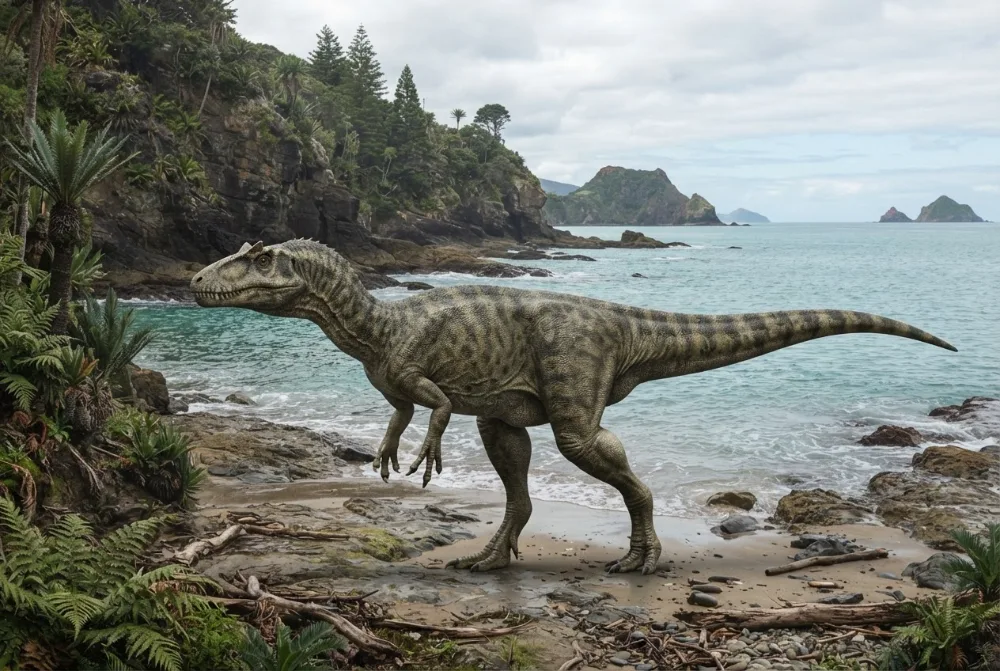
Eustreptospondylus was a meat-eating dinosaur that lived on islands in the Jurassic sea. It was about as long as a small car and probably hunted small animals or ate dead ones washed up on the beach.1
E phetse neng?
E ne e le kgolo hakae?
E ne e le telele hakae?
E ne e phahame hakae?
E ne e le boima hakae?
 telele jwaloka dintja tse 6 ho tloha nkong ho isa mohatleng🍌telele jwaloka dibanana tse 33 di behilwe ka mola🍉boima jwaloka mahapu a 100🧸boima jwaloka bana ba kereshe ba 26🎒boima jwaloka bana ba sekolo ba 16🏃e ne e ka matha dimitara tse 100 ka metsotswana e 8 (motho ya lebelo ka ho fetisisa o hloka 9,6)
Eustreptospondylus e ne e le kgolo hakae ha e bapiswa le WENA?
Ke dipalo feela ho browser ya hao. Ha ho letho le bolokwang kapa le romelwang kae kapa kae.
E ne e le lebelo hakae?


Dintlha tse monate
The first skeleton found was the most complete large meat-eating dinosaur skeleton known at the time, and it is still the most complete large Jurassic European theropod.1
It lived on islands, because Europe was a group of islands back then. Some scientists think it could swim short distances between islands, like a Komodo dragon.1
Its skull had a pointed snout and a large horizontal nostril. It did not have a horn on its face.1
Grooves in its jaw joints let it open its mouth extra wide when it lowered its lower jaws.1
No teeth were found with the skeleton, but the size of the tooth sockets shows that the third tooth in the lower jaw was extra big.1
The known fossil was found in a marine layer, which means it ended up in the sea. That is why some scientists think it could swim, but others think it just washed out to sea after dying.1
Dipotso tse botswang haholo ka Eustreptospondylus
?How big was Eustreptospondylus?
The known skeleton was from a subadult about 4.63 metres (15.2 ft) long and weighed about 218 kilograms (481 lb). A full-grown adult may have reached around 6 metres (20 ft) and weighed 0.5 tonnes.1
?What did Eustreptospondylus eat?
It was a carnivore that ate smaller dinosaurs and pterosaurs, and may have scavenged dead fish, marine reptiles, and other dinosaurs.1
?Could Eustreptospondylus swim?
Some scientists think it could swim short distances between islands, like a Komodo dragon, because its fossil was found on what was an island. Others think it just washed out to sea after dying.1
?When did Eustreptospondylus live?
It lived during the Middle to Late Jurassic period, about 166 to 154 million years ago.1
?Where was Eustreptospondylus found?
Its fossils were found in southern England, near Oxford, in a marine clay layer.1
?Is Eustreptospondylus a dinosaur?
Yes, it is a theropod dinosaur, a meat-eating dinosaur that walked on two legs.1
Mosenyi wa ditshomo
Tshomo: Eustreptospondylus was a slow, clumsy scavenger that only ate dead animals.
Nnete: It was a meat-eater that probably hunted small animals and also scavenged. Its body shows it was an active predator, and it may have foraged on shorelines.1
Bakeng sa ditsebi tsa didinosaure
- Lebitso la saense
- Eustreptospondylus
- E rehilwe ke
- Walker 19643
- Sehlopha
- Didinosaure tse jang nama
- Lelapa / leloko
- Megalosauridae3
- Tlhophiso
- Theropoda3
- Dilemo tsa mafika
- dilemo tse dimilione tse 165 ho isa ho 162 (Callovian)3
- Dibopeho tsa mafika
- Oxford Clay3
- Dinaha
- United Kingdom3
- Direkoto tsa difosili
- 1 ho The Paleobiology Database3
- Ho sibollwa
- Workers found the skeleton in 1870 at Summertown Brick Pit near Oxford, England. It was described in 1871 by John Phillips, but it got its own name, Eustreptospondylus oxoniensis, from Alick Walker in 1964.1
- E sa ntse e phehwa kgang
- Scientists still debate whether Eustreptospondylus could swim between islands or if its body just washed out to sea after death.1
Moo dintlha di tswang teng
- Eustreptospondylus (en.wikipedia.org)
- enchantedlearning.com (enchantedlearning.com)
- Eustreptospondylus in The Paleobiology Database (CC BY 4.0): dilemo, dibaka, dibopeho tsa mafika, tlhophiso.
Ntlha e nngwe le e nngwe leqepheng lena e na le nomoro e supang mohlodi wa yona. Haeba re fositse ho hong, re kopa tshwarelo, re balatedi ba didinosaure, ha re koranta ya saense. Re bolelle ho [email protected] mme re tla e lokisa.
 Rex o lapile! Dino Wiki ke projeke ya ntate bakeng sa mora wa hae ya ratang didinosaure, ke mahala, ha ho dipapatso, ha ho disebedi. Batho ba baholo ba ka fepa Rex seneke ho thusa hore e dule e le inthaneteng.Fepa Rex
 Allosaurus
 Carnotaurus
 Dilophosaurus
 Giganotosaurus
 Compsognathus
 Paronychodon
 Ichthyosaurus
 Khudiakovia
 Ophthalmosaurus
 Pterodactylus
 Peloneustes
 Rhamphocephalus