 Kwisi: O dinosaure efe?
 Ntwa ya didinosaure
 Peiso ya didinosaure
 Dipapadi tse nyane tsa didinosaure
 Albamo ya ditikara
 Manane a TOP a didinosaure
 Nkgethele!
Houornis
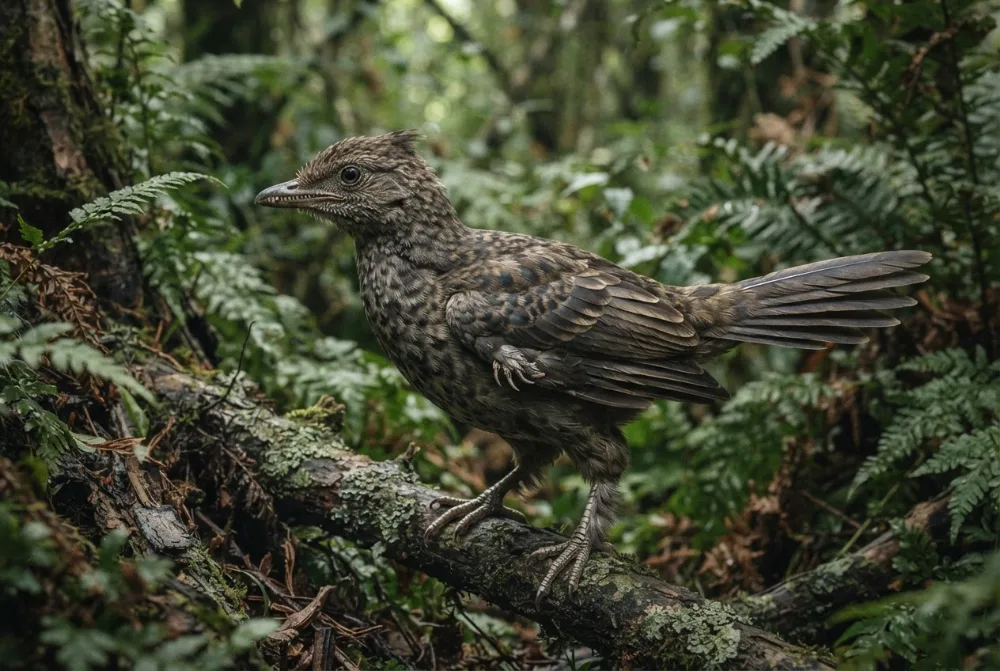
Houornis was a tiny, toothy bird that lived in China about 120 million years ago. It had perching feet and a surprisingly long tail made of fused bones. This little bird was an enantiornithean, a group of early birds that went extinct with the dinosaurs.1
E phetse neng?
E ne e le lebelo hakae?


Dintlha tse monate
Houornis is known from only one main fossil, which is not preserved as bones but as impressions left in the rock.1
Its tail was originally thought to be long and bony like Archaeopteryx, but scientists later realized it had a long pygostyle, a fused tail bone.1
The upper arm bone of Houornis is less than 30 millimeters (1.2 inches) long, making it a very small bird.1
Houornis was once classified as a species of Cathayornis, but in 2015 it was given its own genus because of unique features like its large pygostyle.1
Some scientists have considered Houornis a doubtful species because the fossil is poorly preserved, but a 2015 study found it was distinct enough to keep.1
Mosenyi wa ditshomo
Tshomo: Houornis had a long, bony tail like a dinosaur.
Nnete: Houornis actually had a short tail with a long pygostyle (fused tail vertebrae), not a long bony tail. The original mistake came from misidentifying hip bones as tail vertebrae.1
Bakeng sa ditsebi tsa didinosaure
- Lebitso la saense
- Houornis
- E rehilwe ke
- Wang and Liu 20152
- Sehlopha
- Dinonyana tsa pele
- Lelapa / leloko
- Enantiornithes2
- Tlhophiso
- Theropoda > Avialae2
- Dilemo tsa mafika
- dilemo tse dimilione tse 121 ho isa ho 113 (Aptian)2
- Dibopeho tsa mafika
- Jiufotang2
- Dinaha
- Tjhaena2
- Direkoto tsa difosili
- 1 ho The Paleobiology Database2
- Ho sibollwa
- The only known fossil of Houornis was found in 1993 by Zhou Zhonghe near Boluochi, China. It was first named Cathayornis caudatus by Hou Lianhu in 1997, and then renamed Houornis by Wang and Liu in 2015.1
- E sa ntse e phehwa kgang
- Scientists are not sure exactly how Houornis is related to other enantiornithean birds, because its fossil is too incomplete for a detailed family tree analysis.1
Moo dintlha di tswang teng
- Houornis (en.wikipedia.org)
- Houornis in The Paleobiology Database (CC BY 4.0): dilemo, dibaka, dibopeho tsa mafika, tlhophiso.
Ntlha e nngwe le e nngwe leqepheng lena e na le nomoro e supang mohlodi wa yona. Haeba re fositse ho hong, re kopa tshwarelo, re balatedi ba didinosaure, ha re koranta ya saense. Re bolelle ho [email protected] mme re tla e lokisa.
 Rex o lapile! Dino Wiki ke projeke ya ntate bakeng sa mora wa hae ya ratang didinosaure, ke mahala, ha ho dipapatso, ha ho disebedi. Batho ba baholo ba ka fepa Rex seneke ho thusa hore e dule e le inthaneteng.Fepa Rex
 Archaeopteryx
 Hesperornis
 Ichthyornis
 Baptornis
 Jurapteryx
 Gobipteryx
 Stegosaurus
 Iguanodon
 Giganotosaurus
 Microraptor
 Deinonychus
 Baryonyx