 Kwisi: O dinosaure efe?
 Ntwa ya didinosaure
 Peiso ya didinosaure
 Dipapadi tse nyane tsa didinosaure
 Albamo ya ditikara
 Manane a TOP a didinosaure
 Nkgethele!
Longipteryx
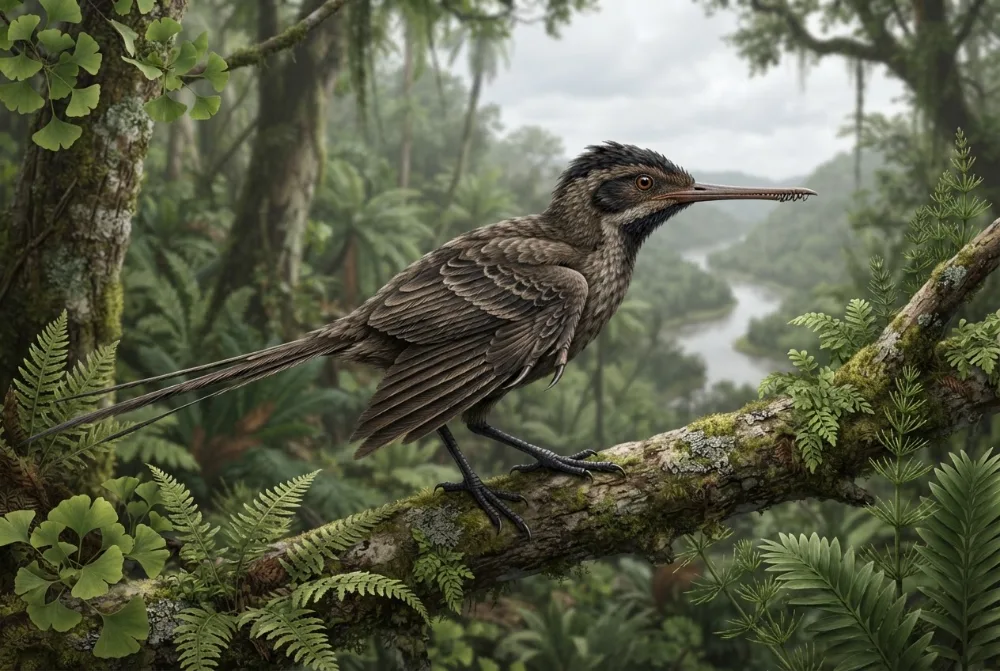
Longipteryx was a tiny bird that lived about 120 million years ago in what is now China. It had long, strong wings and a very long snout with hooked teeth at the tip. This little bird was a great flyer and could perch on branches like modern birds.12
E phetse neng?
E ne e le kgolo hakae?
Mapheo a yona a ne a pharaletse hakae?
E ne e le boima hakae?
Longipteryx e ne e le kgolo hakae ha e bapiswa le WENA?
Ke dipalo feela ho browser ya hao. Ha ho letho le bolokwang kapa le romelwang kae kapa kae.
E ne e le lebelo hakae?


Dintlha tse monate
Longipteryx had a very long snout that was longer than the rest of its head, with a few hooked teeth at the tip.1
Its wings were much longer than its legs, with the upper arm bone (humerus) being 1.56 times the length of the thigh bone (femur).1
Unlike most other early birds, Longipteryx had uncinate processes on its ribs, which helped strengthen its ribcage and improve breathing.12
Its feet were built for perching, with all four toe bones (metatarsals) ending at nearly the same level, just like modern perching birds.2
Scientists once thought Longipteryx ate fish or insects, but in 2024 a study found it actually ate seeds and fruits.1
Longipteryx had a big breastbone with a well-developed keel, which gave it powerful flight muscles.2
Dipotso tse botswang haholo ka Longipteryx
?How big was Longipteryx?
Longipteryx was very small, with a wingspan of about 46.3 cm (1.52 ft) and a body mass of about 193 g (6.8 oz).1
?What did Longipteryx eat?
Longipteryx ate fish. A 2024 study found fish remains in its stomach, showing it was a piscivore.13
?Did Longipteryx have feathers?
Yes, Longipteryx had feathers. The holotype preserves body feathers, wing coverts and down, but no long tail feathers.1
?Could Longipteryx fly?
Yes, Longipteryx was a good flyer. It had long, strong wings and a well-developed breastbone with a keel for powerful flight muscles.1
Mosenyi wa ditshomo
Tshomo: Longipteryx was a fish-eater because of its long snout and teeth.
Nnete: Scientists now know from fossil evidence that Longipteryx ate seeds and fruits, not fish.1
Bakeng sa ditsebi tsa didinosaure
- Lebitso la saense
- Longipteryx
- E rehilwe ke
- Zhang et al. 20004
- Sehlopha
- Dinonyana tsa pele
- Lelapa / leloko
- Longipterygidae4
- Tlhophiso
- Theropoda > Avialae4
- Dilemo tsa mafika
- dilemo tse dimilione tse 121 ho isa ho 113 (Aptian)4
- Dibopeho tsa mafika
- Jiufotang4
- Dinaha
- Tjhaena4
- Direkoto tsa difosili
- 3 ho The Paleobiology Database4
- Ho sibollwa
- Longipteryx was named in 2000 by Zhang Fucheng and colleagues from a nearly complete skeleton found in the Jiufotang Formation in Chaoyang, China.42
- E sa ntse e phehwa kgang
- Scientists are not sure whether Longipteryx used its long snout and teeth to catch prey or for some other purpose.1
Moo dintlha di tswang teng
- Longipteryx (en.wikipedia.org)
- Early diversification of birds: Evidence from a new opposite bird (ivpp.cas.cn)
- Direct evidence of frugivory in the Mesozoic bird Longipteryx contradicts morphological proxies for diet (cell.com)
- Longipteryx in The Paleobiology Database (CC BY 4.0): dilemo, dibaka, dibopeho tsa mafika, tlhophiso.
Ntlha e nngwe le e nngwe leqepheng lena e na le nomoro e supang mohlodi wa yona. Haeba re fositse ho hong, re kopa tshwarelo, re balatedi ba didinosaure, ha re koranta ya saense. Re bolelle ho [email protected] mme re tla e lokisa.
 Rex o lapile! Dino Wiki ke projeke ya ntate bakeng sa mora wa hae ya ratang didinosaure, ke mahala, ha ho dipapatso, ha ho disebedi. Batho ba baholo ba ka fepa Rex seneke ho thusa hore e dule e le inthaneteng.Fepa Rex
 Archaeopteryx
 Hesperornis
 Ichthyornis
 Baptornis
 Jurapteryx
 Gobipteryx
 Stegosaurus
 Iguanodon
 Giganotosaurus
 Microraptor
 Deinonychus
 Baryonyx