 Kwisi: O dinosaure efe?
 Ntwa ya didinosaure
 Peiso ya didinosaure
 Dipapadi tse nyane tsa didinosaure
 Albamo ya ditikara
 Manane a TOP a didinosaure
 Nkgethele!
E phetse neng?

E ne e le kgolo hakae?
E ne e le telele hakae?
E ne e phahame hakae?
kakanyo
E ne e le boima hakae?
 telele jwaloka dintja tse 3 ho tloha nkong ho isa mohatleng🍌telele jwaloka dibanana tse 17 di behilwe ka mola🍉boima jwaloka mahapu a 70🧸boima jwaloka bana ba kereshe ba 18🎒boima jwaloka bana ba sekolo ba 11🏃e ne e ka matha dimitara tse 100 ka metsotswana e 13 (motho ya lebelo ka ho fetisisa o hloka 9,6)
Neimongosaurus e ne e le kgolo hakae ha e bapiswa le WENA?
Ke dipalo feela ho browser ya hao. Ha ho letho le bolokwang kapa le romelwang kae kapa kae.
E ne e le lebelo hakae?


Dintlha tse monate
Neimongosaurus had one of the longest necks of any non-bird theropod, with about 14 neck vertebrae. That is more than most other meat-eating dinosaurs had.1
Its tail was fairly short, with only 22 tail vertebrae, which is unusual for a theropod.1
The front of its lower jaw was toothless, like a beak, and it had only a few teeth further back. This helped it eat plants.1
Its arm bones show a large bump for the biceps muscle, which may have given it strong arms for pulling branches.1
The vertebrae in its spine were hollow and filled with air spaces, a feature also seen in some advanced bird-like dinosaurs.2
Scientists think Neimongosaurus was closely related to oviraptorosaurs because of its long neck and short tail.2
Dipotso tse botswang haholo ka Neimongosaurus
?How big was Neimongosaurus?
About 2 to 3 metres long. It weighed around 350 kg, which is about the weight of a small horse.1
?What did Neimongosaurus eat?
It ate plants. Its lower jaw had a toothless, beak-like front and only a few teeth with serrated edges in the back.1
?Did Neimongosaurus have feathers?
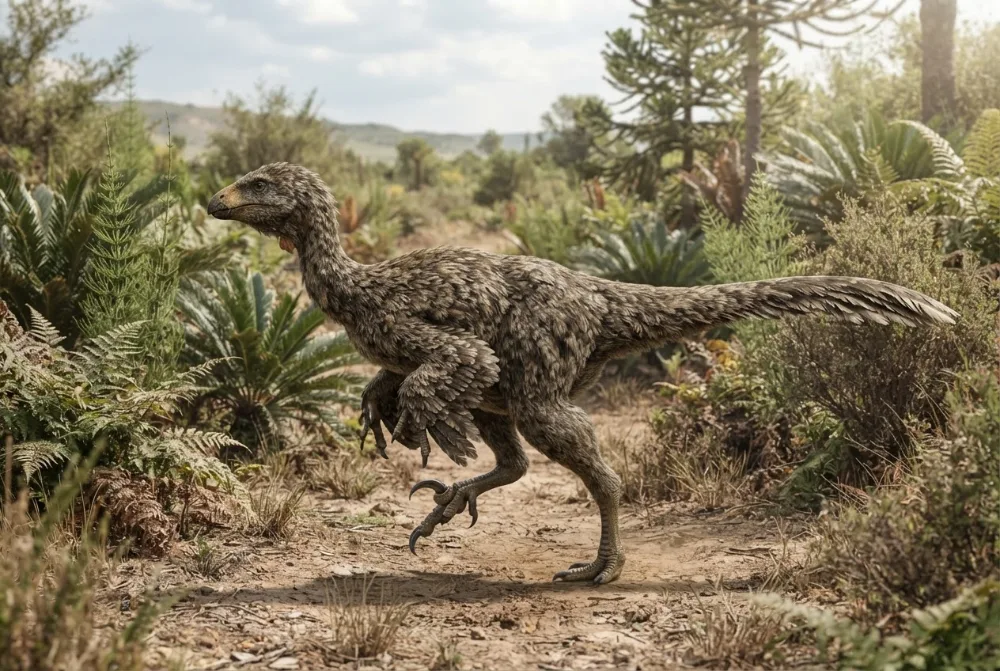
Scientists think it likely had feathers, because its relatives (therizinosaurs) are often shown with feathers, but no direct feather fossils have been found for this species.1
Bakeng sa ditsebi tsa didinosaure
- Lebitso la saense
- Neimongosaurus
- E rehilwe ke
- Zhang et al. 20014
- Sehlopha
- Didinosaure tse makatsang tse nang le mafofa
- Lelapa / leloko
- Therizinosauridae4
- Tlhophiso
- Theropoda > Therizinosauria4
- Dilemo tsa mafika
- dilemo tse dimilione tse 86 ho isa ho 72 (Santonian / Campanian)4
- Dibopeho tsa mafika
- Iren Dabasu, Bostobe4
- Dinaha
- Tjhaena, Kazakhstan4
- Direkoto tsa difosili
- 2 ho The Paleobiology Database4
- Ho sibollwa
- In 1999, a team from the Ministry of Land and Resources in Inner Mongolia found two skeletons at Sanhangobi, about 20 km southwest of Erenhot. In 2001, scientists named the new species Neimongosaurus yangi, honoring Chinese paleontologist Yang Zhongjian.1
- E sa ntse e phehwa kgang
- Scientists are not sure exactly where Neimongosaurus sits on the family tree. Some studies place it outside the therizinosaurid group, while others put it inside, close to Therizinosaurus.1
Moo dintlha di tswang teng
- Neimongosaurus (en.wikipedia.org)
- A LONG-NECKED THERIZINOSAUROID DINOSAUR FROM THE UPPER CRETACEOUS IREN DABASU FORMATION OF NEI MONGOL, PEOPL E’S REPUBLIC OF CHINA (vertpala.ac.cn)
- Neimongosaurus (en.wikipedia.org)
- Neimongosaurus in The Paleobiology Database (CC BY 4.0): dilemo, dibaka, dibopeho tsa mafika, tlhophiso.
Ntlha e nngwe le e nngwe leqepheng lena e na le nomoro e supang mohlodi wa yona. Haeba re fositse ho hong, re kopa tshwarelo, re balatedi ba didinosaure, ha re koranta ya saense. Re bolelle ho [email protected] mme re tla e lokisa.
 Rex o lapile! Dino Wiki ke projeke ya ntate bakeng sa mora wa hae ya ratang didinosaure, ke mahala, ha ho dipapatso, ha ho disebedi. Batho ba baholo ba ka fepa Rex seneke ho thusa hore e dule e le inthaneteng.Fepa Rex
Tse ding tsa sehlopha se le seng: Didinosaure tse makatsang tse nang le mafofa
 TherizinosaurusDidinosaure tse makatsang tse nang le mafofa
 OviraptorDidinosaure tse makatsang tse nang le mafofa
 ChirostenotesDidinosaure tse makatsang tse nang le mafofa
 CitipesDidinosaure tse makatsang tse nang le mafofa
 LeptorhynchosDidinosaure tse makatsang tse nang le mafofa
 AvimimusDidinosaure tse makatsang tse nang le mafofa
 Tyrannosaurus
 Triceratops
 Velociraptor
 Spinosaurus
 Ankylosaurus
 Parasaurolophus