 Kwisi: O dinosaure efe?
 Ntwa ya didinosaure
 Peiso ya didinosaure
 Dipapadi tse nyane tsa didinosaure
 Albamo ya ditikara
 Manane a TOP a didinosaure
 Nkgethele!
Piscivoravis
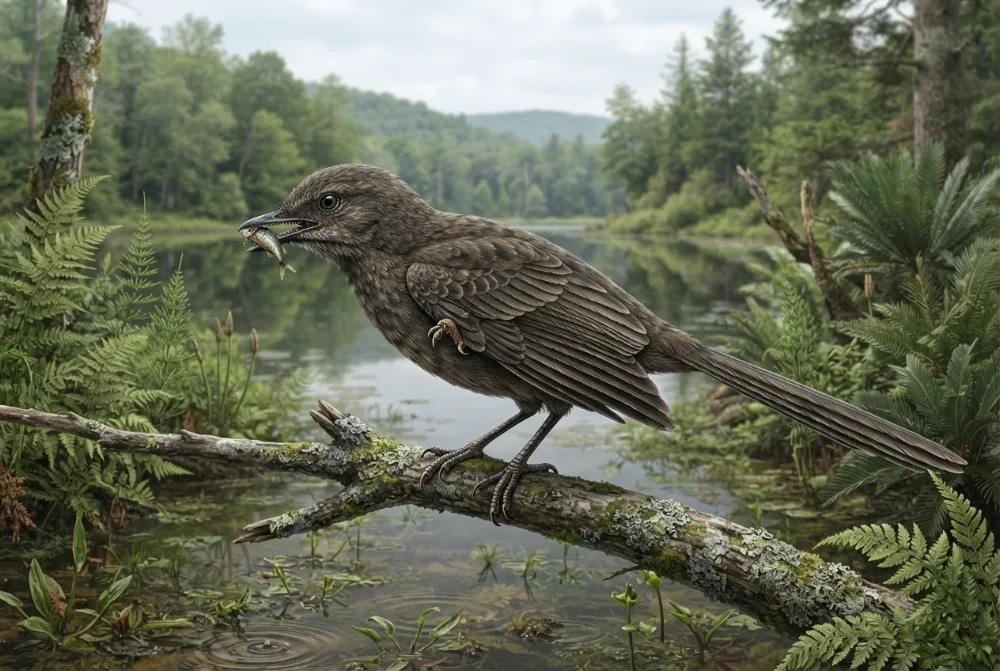
Piscivoravis was an ancient bird that lived in China about 120 million years ago. It loved to eat fish, and we know this because fish bones were found inside its fossilized stomach and near its beak. This bird could probably fly and lived near lakes.1
E phetse neng?
E ne e le lebelo hakae?


Dintlha tse monate
Piscivoravis is one of only two early birds from the Jehol Biota that we know for sure ate fish. The other is Yanornis.1
The fossil of Piscivoravis shows fish bones in two places: a small cluster near the beak and a larger cluster in the belly. Scientists think the small cluster might be a pellet that the bird was about to cough up.1
This bird had a broad breastbone that was wider than it was long, which is unusual for early birds.1
Piscivoravis had large, strongly curved claws on its hands, which might have helped it catch fish.1
The name Piscivoravis comes from Latin and means 'fish-eating bird'.1
Piscivoravis lived during the Early Cretaceous period, about 120 million years ago, in what is now northeastern China.1
Bakeng sa ditsebi tsa didinosaure
- Lebitso la saense
- Piscivoravis
- E rehilwe ke
- Zhou et al. 20132
- Sehlopha
- Dinonyana tsa pele
- Lelapa / leloko
- Ornithuromorpha2
- Tlhophiso
- Theropoda > Avialae2
- Dilemo tsa mafika
- dilemo tse dimilione tse 121 ho isa ho 113 (Aptian)2
- Dibopeho tsa mafika
- Jiufotang2
- Dinaha
- Tjhaena2
- Direkoto tsa difosili
- 1 ho The Paleobiology Database2
- Ho sibollwa
- Piscivoravis was named by Zhou and colleagues in 2013 based on a nearly complete skeleton found near Xiaotaizi village in Liaoning, China. The species name 'lii' honors Li Yutong, who prepared many important bird fossils.1
- E sa ntse e phehwa kgang
- Scientists are not sure if Piscivoravis changed its diet with the seasons, like some other early birds may have done. Only one fossil has been found so far.1
Moo dintlha di tswang teng
- A new piscivorous ornithuromorph from the Jehol Biota (ivpp.cas.cn)
- Piscivoravis in The Paleobiology Database (CC BY 4.0): dilemo, dibaka, dibopeho tsa mafika, tlhophiso.
Ntlha e nngwe le e nngwe leqepheng lena e na le nomoro e supang mohlodi wa yona. Haeba re fositse ho hong, re kopa tshwarelo, re balatedi ba didinosaure, ha re koranta ya saense. Re bolelle ho [email protected] mme re tla e lokisa.
 Rex o lapile! Dino Wiki ke projeke ya ntate bakeng sa mora wa hae ya ratang didinosaure, ke mahala, ha ho dipapatso, ha ho disebedi. Batho ba baholo ba ka fepa Rex seneke ho thusa hore e dule e le inthaneteng.Fepa Rex
 Archaeopteryx
 Hesperornis
 Ichthyornis
 Baptornis
 Jurapteryx
 Gobipteryx
 Stegosaurus
 Iguanodon
 Giganotosaurus
 Microraptor
 Deinonychus
 Baryonyx