 Kwisi: O dinosaure efe?
 Ntwa ya didinosaure
 Peiso ya didinosaure
 Dipapadi tse nyane tsa didinosaure
 Albamo ya ditikara
 Manane a TOP a didinosaure
 Nkgethele!
Pterorhynchus
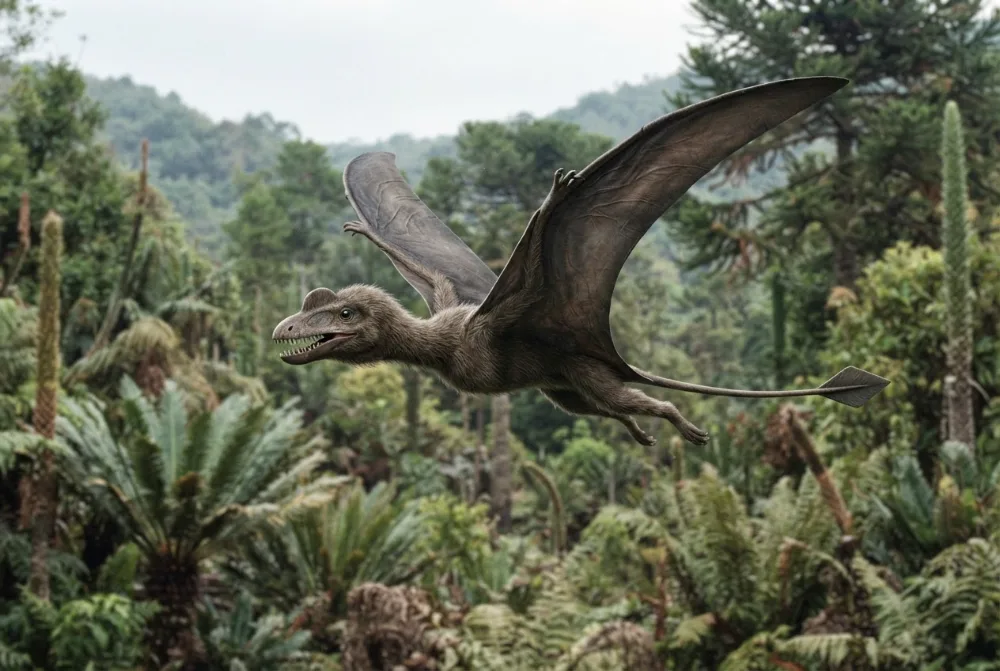
Pterorhynchus was a flying reptile that lived about 164 million years ago, during the Jurassic Period. It had a big crest on its head and a long tail, and it flew over ancient China.14
E phetse neng?
E ne e le kgolo hakae?
Mapheo a yona a ne a pharaletse hakae?
 telele jwaloka dikatse tsa lapeng tse 1.5 ho tloha nkong ho isa mohatleng⚽e ne e ka fofa ho tshela lebala lohle la bolo ya maoto ka metsotswana e 11
Pterorhynchus e ne e le kgolo hakae ha e bapiswa le WENA?
Ke dipalo feela ho browser ya hao. Ha ho letho le bolokwang kapa le romelwang kae kapa kae.
E ne e le lebelo hakae?


Dintlha tse monate
Pterorhynchus had a head crest made of both bone and soft tissue, which was unusual for long-tailed pterosaurs.12
Its body was covered in hair-like structures called pycnofibers, which may have helped keep it warm.1
The tail of Pterorhynchus was about as long as its wing, and it had a diamond-shaped flap at the end.12
The head crest was so large that scientists think it helped the animal steer while flying, like a rudder.2
The only known fossil is a nearly complete skeleton with preserved skin and other soft parts.1
The crest may have had a camouflage pattern, based on vertical stripes seen at its base.1
Dipotso tse botswang haholo ka Pterorhynchus
?How big was Pterorhynchus?
Pterorhynchus had a wingspan of about 85 centimetres (33 inches) and a skull about 11.8 centimetres (4.6 inches) long.13
?What did Pterorhynchus eat?
Its robust teeth suggest it ate small animals, possibly including fish and insects, though the exact diet is not known for sure.3
?Did Pterorhynchus have feathers?
Pterorhynchus had hair-like pycnofibers covering its body, not feathers. Some scientists think these might be related to dinosaur feathers, but this is debated.1
?Why did Pterorhynchus have a crest?
The crest likely helped with steering during flight, acting like a rudder, and may have had a camouflage pattern.1
Mosenyi wa ditshomo
Tshomo: Pterorhynchus was a dinosaur.
Nnete: Pterorhynchus was a pterosaur, a flying reptile that is not a dinosaur.1
Bakeng sa ditsebi tsa didinosaure
- Lebitso la saense
- Pterorhynchus
- E rehilwe ke
- Czerkas and Ji 20024
- Sehlopha
- Dihahabi tse fofang
- Lelapa / leloko
- Rhamphorhynchidae4
- Tlhophiso
- Pterosauria > Rhamphorhynchidae4
- Dilemo tsa mafika
- dilemo tse dimilione tse 165 ho isa ho 162 (Callovian)4
- Dibopeho tsa mafika
- Tiaojishan4
- Dinaha
- Tjhaena4
- Direkoto tsa difosili
- 1 ho The Paleobiology Database4
- Ho sibollwa
- Pterorhynchus was named in 2002 by Stephen Czerkas and Ji Qiang, based on a fossil found in the Daohugou Beds of China.1
- E sa ntse e phehwa kgang
- Scientists debate whether the hair-like fibers on Pterorhynchus are related to feathers or evolved separately.12
Moo dintlha di tswang teng
- Pterorhynchus (en.wikipedia.org)
- papers for web abriged 7-10-05 SCB-2.pmd (dinosaur-museum.org)
- Pterorhynchus (prehistoric-wildlife.com)
- Pterorhynchus in The Paleobiology Database (CC BY 4.0): dilemo, dibaka, dibopeho tsa mafika, tlhophiso.
Ntlha e nngwe le e nngwe leqepheng lena e na le nomoro e supang mohlodi wa yona. Haeba re fositse ho hong, re kopa tshwarelo, re balatedi ba didinosaure, ha re koranta ya saense. Re bolelle ho [email protected] mme re tla e lokisa.
 Rex o lapile! Dino Wiki ke projeke ya ntate bakeng sa mora wa hae ya ratang didinosaure, ke mahala, ha ho dipapatso, ha ho disebedi. Batho ba baholo ba ka fepa Rex seneke ho thusa hore e dule e le inthaneteng.Fepa Rex
 Pteranodon
 Quetzalcoatlus
 Dorygnathus
 Rhamphorhynchus
 Anhanguera
 Pterodactylus
 Ichthyosaurus
 Khudiakovia
 Ophthalmosaurus
 Peloneustes
 Gongbusaurus
 Shunosaurus