 Kwisi: O dinosaure efe?
 Ntwa ya didinosaure
 Peiso ya didinosaure
 Dipapadi tse nyane tsa didinosaure
 Albamo ya ditikara
 Manane a TOP a didinosaure
 Nkgethele!
Seitaad
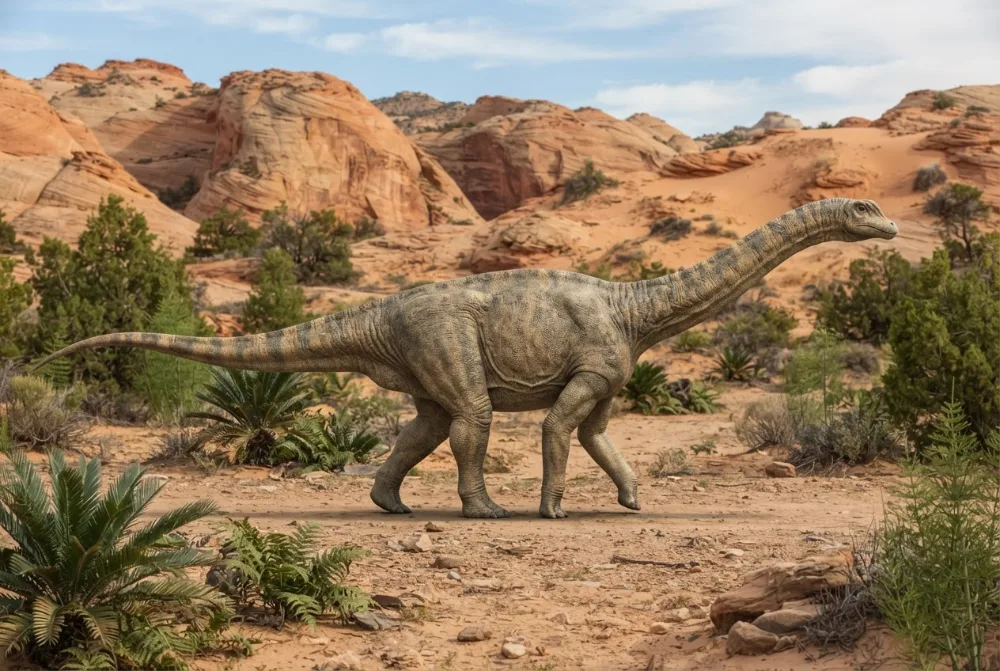
Seitaad was an early long-necked dinosaur that lived about 190 million years ago. It was a plant-eater that walked on two legs and could also use all fours. This dinosaur is one of the most complete fossils ever found in the Navajo Sandstone of Utah.31
E phetse neng?
E ne e le kgolo hakae?
E ne e le telele hakae?
E ne e phahame hakae?
E ne e le boima hakae?
 telele jwaloka dintja tse 4 ho tloha nkong ho isa mohatleng🍌telele jwaloka dibanana tse 25 di behilwe ka mola🍉boima jwaloka mahapu a 18🧸boima jwaloka bana ba kereshe ba 5🎒boima jwaloka bana ba sekolo ba 3🏃e ne e ka matha dimitara tse 100 ka metsotswana e 8.8 (motho ya lebelo ka ho fetisisa o hloka 9,6)
Seitaad e ne e le kgolo hakae ha e bapiswa le WENA?
Ke dipalo feela ho browser ya hao. Ha ho letho le bolokwang kapa le romelwang kae kapa kae.
E ne e le lebelo hakae?


Dintlha tse monate
Seitaad's name comes from a Navajo legend about a sand monster that buried its victims in dunes.1
The only known fossil of Seitaad was found at the base of a collapsed sand dune, which may have buried the animal after it died.1
Seitaad is one of the few early sauropodomorph dinosaurs known from North America.1
The species name ruessi honors Everett Ruess, a young artist and explorer who disappeared in southern Utah in 1934.1
Seitaad had a plate-like bone on its shoulder blade that helped support its arm.1
This dinosaur lived during the Early Jurassic period, when the climate was warm and deserts covered much of the area.1
Dipotso tse botswang haholo ka Seitaad
?How big was Seitaad?
About 3 to 4.5 metres long and 1 metre tall at the hips. It weighed around 70 to 90 kilograms, about the size of a large human.2
?What did Seitaad eat?
Seitaad ate plants. It had leaf-shaped teeth and a small head, just like its later giant relatives the sauropods.2
?Could Seitaad walk on two legs?
Yes, Seitaad could walk on two legs or on all fours. It had a long neck and tail, and a large curved claw on its thumb.2
?When did Seitaad live?
Seitaad lived during the Early Jurassic Period, about 183 to 190 million years ago. That is millions of years before the famous giant sauropods like Diplodocus.2
Bakeng sa ditsebi tsa didinosaure
- Lebitso la saense
- Seitaad
- E rehilwe ke
- Sertich and Loewen 20103
- Sehlopha
- Melala e melelele
- Lelapa / leloko
- Sauropodiformes3
- Tlhophiso
- Sauropodomorpha3
- Dilemo tsa mafika
- dilemo tse dimilione tse 193 ho isa ho 175 (Pliensbachian / Toarcian)3
- Dibopeho tsa mafika
- Navajo Sandstone3
- Dinaha
- Amerika3
- Direkoto tsa difosili
- 1 ho The Paleobiology Database3
- Ho sibollwa
- Seitaad was named by scientists Joseph Sertich and Michael Loewen in 2010. The partial skeleton was found in the Navajo Sandstone of southern Utah, near a cliff dwelling called Eagle's Nest.31
- E sa ntse e phehwa kgang
- Scientists are not sure exactly how Seitaad is related to other early sauropodomorphs, because its fossils do not give a clear family tree.1
Moo dintlha di tswang teng
- pone.0009789 1..17 (journals.plos.org)
- New Dinosaur from Utah’s Red Rocks – UNews Archive (archive.unews.utah.edu)
- Seitaad in The Paleobiology Database (CC BY 4.0): dilemo, dibaka, dibopeho tsa mafika, tlhophiso.
Ntlha e nngwe le e nngwe leqepheng lena e na le nomoro e supang mohlodi wa yona. Haeba re fositse ho hong, re kopa tshwarelo, re balatedi ba didinosaure, ha re koranta ya saense. Re bolelle ho [email protected] mme re tla e lokisa.
 Rex o lapile! Dino Wiki ke projeke ya ntate bakeng sa mora wa hae ya ratang didinosaure, ke mahala, ha ho dipapatso, ha ho disebedi. Batho ba baholo ba ka fepa Rex seneke ho thusa hore e dule e le inthaneteng.Fepa Rex
 Brachiosaurus
 Diplodocus
 Brontosaurus
 Argentinosaurus
 Camarasaurus
 Morosaurus
 Dilophosaurus
 Stenopterygius
 Dorygnathus
 Scutellosaurus
 Sinosaurus
 Temnodontosaurus