 Kwisi: O dinosaure efe?
 Ntwa ya didinosaure
 Peiso ya didinosaure
 Dipapadi tse nyane tsa didinosaure
 Albamo ya ditikara
 Manane a TOP a didinosaure
 Nkgethele!
E phetse neng?

E ne e le kgolo hakae?
E ne e le telele hakae?
E ne e phahame hakae?
E ne e le boima hakae?
 e batla e le boima jwaloka katse ya lapeng🍌boima jwaloka dibanana tse 29🪑e nyane hoo e ka tsamayang ka tlasa setulo🏃e ne e ka matha dimitara tse 100 ka metsotswana e 12 (motho ya lebelo ka ho fetisisa o hloka 9,6)
Shuvuuia e ne e le kgolo hakae ha e bapiswa le WENA?
Ke dipalo feela ho browser ya hao. Ha ho letho le bolokwang kapa le romelwang kae kapa kae.
E ne e le lebelo hakae?


Dintlha tse monate
Shuvuuia is known from two beautifully preserved skulls, which are the first skulls ever found for its group, the Alvarezsauridae.2
Its lower jaw was not locked to the skull, so its mouth could open very wide to catch larger prey.1
Shuvuuia lived in the Late Cretaceous period, about 75 to 81 million years ago, in what is now the Gobi Desert of Mongolia.1
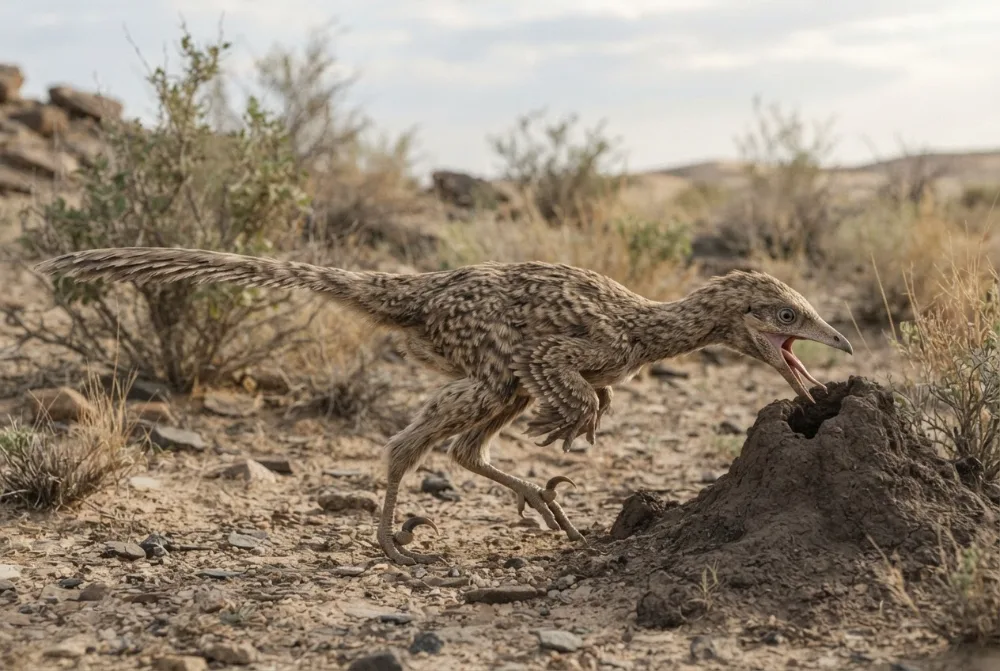
Scientists think Shuvuuia may have eaten termites, because its skull and jaw look like those of modern animals that eat insects.1
The name Shuvuuia means 'bird' in Mongolian, because its skull shows features that link it to birds.1
Dipotso tse botswang haholo ka Shuvuuia
?How big was Shuvuuia?
Shuvuuia was very small, about 1 metre (3.3 feet) long and weighed around 3.5 kilograms (7.7 pounds). It is one of the smallest known non-avian dinosaurs.4
?Did Shuvuuia have feathers?
Yes, scientists think Shuvuuia had a coat of feathers. Fossils show tiny tube-like structures that contain the same proteins found in modern bird feathers.4
?What did Shuvuuia eat?
Shuvuuia probably ate insects and small animals. It may have used its strong arms to dig into insect nests and its flexible jaw to catch prey like termites or small mammals.41
?Could Shuvuuia see in the dark?
Some scientists think Shuvuuia had excellent night vision and hearing, like an owl, and could hunt in complete darkness. However, a 2025 study disagreed and said its hearing was more like a chicken's.4
Bakeng sa ditsebi tsa didinosaure
- Lebitso la saense
- Shuvuuia
- E rehilwe ke
- Chiappe et al. 19985
- Sehlopha
- Didinosaure tse makatsang tse nang le mafofa
- Lelapa / leloko
- Alvarezsauridae5
- Tlhophiso
- Theropoda > Alvarezsauridae5
- Dilemo tsa mafika
- dilemo tse dimilione tse 84 ho isa ho 72 (Campanian)5
- Dibopeho tsa mafika
- Djadokhta5
- Dinaha
- Mongolia5
- Direkoto tsa difosili
- 3 ho The Paleobiology Database5
- Ho sibollwa
- Shuvuuia was named by Luis Chiappe, Mark Norell, and James Clark in 1998. The first fossils were found at Ukhaa Tolgod in Mongolia.25
- E sa ntse e phehwa kgang
- Scientists are still debating whether Shuvuuia was more closely related to birds or to other dinosaurs like therizinosaurs and oviraptorosaurs.2
Moo dintlha di tswang teng
- Shuvuuia | Natural History Museum (nhm.ac.uk)
- The skull of a relative of the stem-group bird Mononykus | Nature (nature.com)
- Shuvuuia Fact Sheet - Enchanted Learning (enchantedlearning.com)
- Shuvuuia (en.wikipedia.org)
- Shuvuuia in The Paleobiology Database (CC BY 4.0): dilemo, dibaka, dibopeho tsa mafika, tlhophiso.
Ntlha e nngwe le e nngwe leqepheng lena e na le nomoro e supang mohlodi wa yona. Haeba re fositse ho hong, re kopa tshwarelo, re balatedi ba didinosaure, ha re koranta ya saense. Re bolelle ho [email protected] mme re tla e lokisa.
 Rex o lapile! Dino Wiki ke projeke ya ntate bakeng sa mora wa hae ya ratang didinosaure, ke mahala, ha ho dipapatso, ha ho disebedi. Batho ba baholo ba ka fepa Rex seneke ho thusa hore e dule e le inthaneteng.Fepa Rex
Tse ding tsa sehlopha se le seng: Didinosaure tse makatsang tse nang le mafofa
 TherizinosaurusDidinosaure tse makatsang tse nang le mafofa
 OviraptorDidinosaure tse makatsang tse nang le mafofa
 ChirostenotesDidinosaure tse makatsang tse nang le mafofa
 CitipesDidinosaure tse makatsang tse nang le mafofa
 LeptorhynchosDidinosaure tse makatsang tse nang le mafofa
 AvimimusDidinosaure tse makatsang tse nang le mafofa
 Tyrannosaurus
 Triceratops
 Velociraptor
 Spinosaurus
 Ankylosaurus
 Parasaurolophus