 Kwisi: O dinosaure efe?
 Ntwa ya didinosaure
 Peiso ya didinosaure
 Dipapadi tse nyane tsa didinosaure
 Albamo ya ditikara
 Manane a TOP a didinosaure
 Nkgethele!
Tazoudasaurus
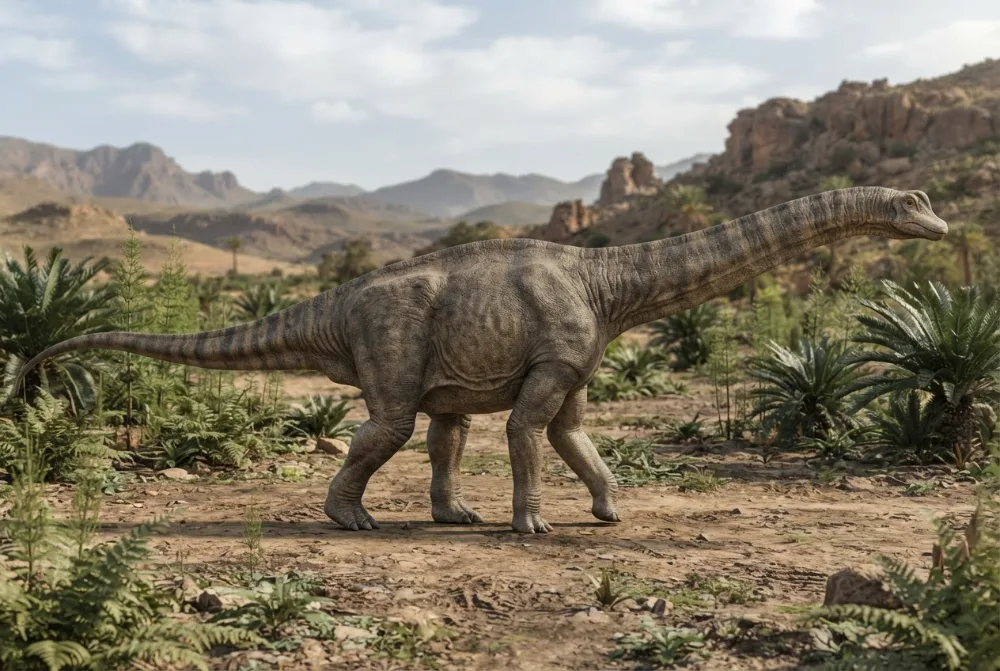
Tazoudasaurus was an early, medium-sized sauropod that lived in what is now Morocco about 183 million years ago. It had a long neck and tail, walked on four legs, and ate plants. Several skeletons have been found together, suggesting these dinosaurs may have lived in herds.13
E phetse neng?
E ne e le kgolo hakae?
E ne e le telele hakae?
E ne e phahame hakae?
kakanyo
E ne e le boima hakae?
 telele jwaloka dikoloi tse 3 tse pakilweng ka mola🍌telele jwaloka dibanana tse 78 di behilwe ka mola
 boima jwaloka ditlou tse 1.5🍉boima jwaloka mahapu a 1600🎒boima jwaloka ditlelase tse feletseng tse 10 tsa bana ba sekolo🐻❄️boima jwaloka dibere tse tshweu tse 18🏃e ne e ka matha dimitara tse 100 ka metsotswana e 22 (motho ya lebelo ka ho fetisisa o hloka 9,6)
Tazoudasaurus e ne e le kgolo hakae ha e bapiswa le WENA?
Ke dipalo feela ho browser ya hao. Ha ho letho le bolokwang kapa le romelwang kae kapa kae.
E ne e le lebelo hakae?


Dintlha tse monate
Tazoudasaurus is one of the most complete early sauropods ever found. Scientists have discovered bones from at least ten different individuals, including both adults and juveniles.1
Its neck was flexible, with long vertebrae that lacked true pleurocoels (air pockets). In contrast, its back and tail vertebrae were more rigid.1
Tazoudasaurus lived alongside the early theropod Berberosaurus, a meat-eating dinosaur. Their fossils were found together in the same bone bed.12
The name Tazoudasaurus comes from the village of Tazouda near where the fossils were discovered. The species name naimi means 'slender' in the Berber language.1
Tazoudasaurus had a primitive lower jaw that was not U-shaped like in later sauropods. Its teeth had small bumps called denticles, similar to those of earlier prosauropods.1
The environment where Tazoudasaurus lived was a river floodplain with sand-filled channels and abundant ferns, cycads, and conifers. The climate had both wet and dry seasons.1
Dipotso tse botswang haholo ka Tazoudasaurus
?How big was Tazoudasaurus?
Tazoudasaurus was a small sauropod, about 11 to 14 metres (36 to 46 feet) long. It weighed around 7 to 8 tonnes.1
?What did Tazoudasaurus eat?
Tazoudasaurus ate plants. Its teeth had small bumps called denticles and V-shaped wear marks, which show it chewed its food.1
?Did Tazoudasaurus live in herds?
Yes, scientists think Tazoudasaurus lived in herds. Several skeletons of adults, juveniles and subadults were found together, suggesting gregarious behaviour.12
?When did Tazoudasaurus live?
Tazoudasaurus lived during the late Early Jurassic, about 183 to 174 million years ago. Its fossils come from the Toarcian stage of the Azilal Formation in Morocco.1
Bakeng sa ditsebi tsa didinosaure
- Lebitso la saense
- Tazoudasaurus
- E rehilwe ke
- Allain et al. 20043
- Sehlopha
- Melala e melelele
- Lelapa / leloko
- Gravisauria3
- Tlhophiso
- Sauropodomorpha > Sauropoda3
- Dilemo tsa mafika
- dilemo tse dimilione tse 193 ho isa ho 175 (Pliensbachian / Toarcian)3
- Dinaha
- Moroko3
- Direkoto tsa difosili
- 2 ho The Paleobiology Database3
- Ho sibollwa
- Tazoudasaurus was named in 2004 by Ronan Allain and colleagues. The fossils were found in the High Atlas Mountains of Morocco, in a series of red rock layers called the Toundoute Continental Series.13
- E sa ntse e phehwa kgang
- Scientists are not sure exactly how long Tazoudasaurus could grow. Earlier estimates gave a length of about 10 to 11 metres, but more recent ones suggest up to 13 to 14 metres.1
Moo dintlha di tswang teng
- Tazoudasaurus (en.wikipedia.org)
- Anatomy and phylogenetic relationships of Tazoudasaurus naimi (Dinosauria, Sauropoda) from the late Early Jurassic of Morocco (sciencepress.mnhn.fr)
- Tazoudasaurus in The Paleobiology Database (CC BY 4.0): dilemo, dibaka, dibopeho tsa mafika, tlhophiso.
Ntlha e nngwe le e nngwe leqepheng lena e na le nomoro e supang mohlodi wa yona. Haeba re fositse ho hong, re kopa tshwarelo, re balatedi ba didinosaure, ha re koranta ya saense. Re bolelle ho [email protected] mme re tla e lokisa.
 Rex o lapile! Dino Wiki ke projeke ya ntate bakeng sa mora wa hae ya ratang didinosaure, ke mahala, ha ho dipapatso, ha ho disebedi. Batho ba baholo ba ka fepa Rex seneke ho thusa hore e dule e le inthaneteng.Fepa Rex
 Brachiosaurus
 Diplodocus
 Brontosaurus
 Argentinosaurus
 Camarasaurus
 Morosaurus
 Dilophosaurus
 Stenopterygius
 Dorygnathus
 Scutellosaurus
 Sinosaurus
 Temnodontosaurus