 Kwisi: O dinosaure efe?
 Ntwa ya didinosaure
 Peiso ya didinosaure
 Dipapadi tse nyane tsa didinosaure
 Albamo ya ditikara
 Manane a TOP a didinosaure
 Nkgethele!
Xingxiulong
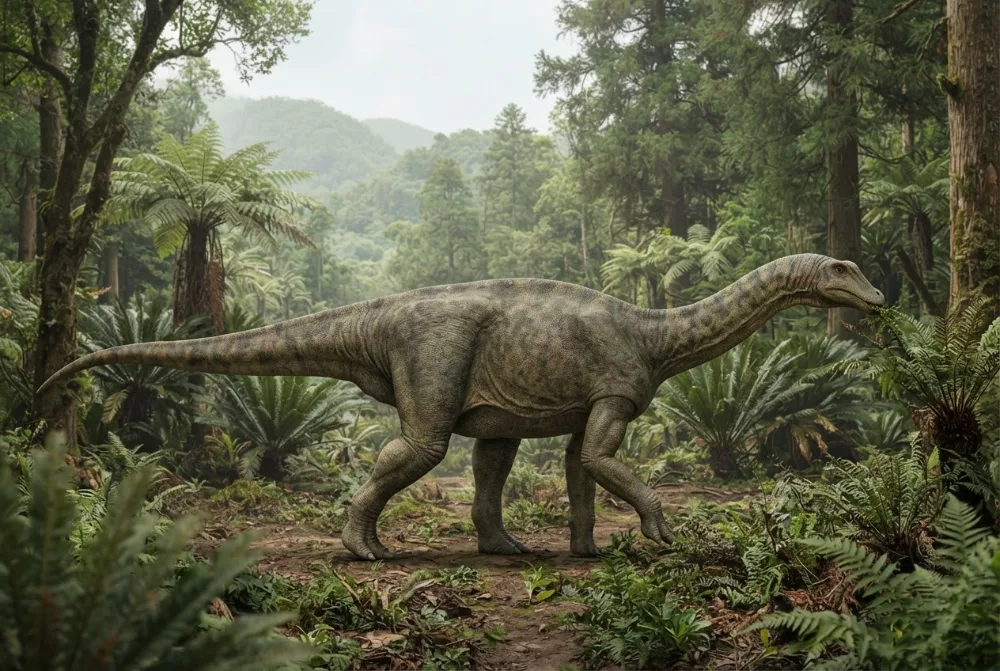
Xingxiulong was a long-necked plant-eater that lived in China during the Early Jurassic. It walked on two legs and had a strong, heavy body like a small sauropod. Three skeletons were found buried together, including two adults and a teenager.21
E phetse neng?
E ne e le kgolo hakae?
E ne e le telele hakae?
E ne e phahame hakae?
 telele jwaloka dintja tse 5 ho tloha nkong ho isa mohatleng🍌telele jwaloka dibanana tse 28 di behilwe ka mola🏃e ne e ka matha dimitara tse 100 ka metsotswana e 10 (motho ya lebelo ka ho fetisisa o hloka 9,6)
Xingxiulong e ne e le kgolo hakae ha e bapiswa le WENA?
Ke dipalo feela ho browser ya hao. Ha ho letho le bolokwang kapa le romelwang kae kapa kae.
E ne e le lebelo hakae?


Dintlha tse monate
Xingxiulong had four vertebrae in its sacrum (hip region), which is a feature usually seen in true sauropods.21
Its pubis (hip bone) had a very long top plate, about 40% of the total length of the bone.2
Xingxiulong was bipedal, meaning it walked on two legs, unlike later sauropods that used all four legs.1
The three skeletons were found together in purple silty mudstone from the Shawan Member of the Lufeng Formation.21
One skeleton was about 14% smaller than the others and had unfused vertebrae, showing it was a subadult.21
Xingxiulong is one of the oldest and most primitive members of the group Sauropodiformes, which includes all sauropods.2
Dipotso tse botswang haholo ka Xingxiulong
?How big was Xingxiulong?
About 4 to 5 metres (13 to 16 ft) long and 1 to 1.5 metres (3.3 to 4.9 ft) tall at the hip for the first species. A second species was larger, at 8 to 10 metres (26 to 33 ft) long.12
?Did Xingxiulong walk on two legs?
Yes, it was bipedal. Unlike later sauropods that used all four legs, Xingxiulong walked on two legs.12
?What did Xingxiulong eat?
It was a plant-eater. Its strong, heavy body and large gut helped it digest tough plants.1
Bakeng sa ditsebi tsa didinosaure
- Lebitso la saense
- Xingxiulong
- E rehilwe ke
- Wang et al. 20173
- Sehlopha
- Melala e melelele
- Lelapa / leloko
- Sauropodiformes3
- Tlhophiso
- Sauropodomorpha3
- Dilemo tsa mafika
- dilemo tse dimilione tse 201 ho isa ho 175 (Hettangian / Toarcian)3
- Dibopeho tsa mafika
- Lufeng3
- Dinaha
- Tjhaena3
- Direkoto tsa difosili
- 2 ho The Paleobiology Database3
- Ho sibollwa
- Xingxiulong was named in 2017 by Wang, You, and Wang. The fossils were dug up in 2013 near Sankeshu Village in Lufeng County, China.21
- E sa ntse e phehwa kgang
- Scientists are not sure whether Xingxiulong was more closely related to Jingshanosaurus or to other sauropodiformes.1
Moo dintlha di tswang teng
- Xingxiulong (en.wikipedia.org)
- A new basal sauropodiform dinosaur from the Lower Jurassic of Yunnan Province, China | Scientific Reports (nature.com)
- Xingxiulong in The Paleobiology Database (CC BY 4.0): dilemo, dibaka, dibopeho tsa mafika, tlhophiso.
Ntlha e nngwe le e nngwe leqepheng lena e na le nomoro e supang mohlodi wa yona. Haeba re fositse ho hong, re kopa tshwarelo, re balatedi ba didinosaure, ha re koranta ya saense. Re bolelle ho [email protected] mme re tla e lokisa.
 Rex o lapile! Dino Wiki ke projeke ya ntate bakeng sa mora wa hae ya ratang didinosaure, ke mahala, ha ho dipapatso, ha ho disebedi. Batho ba baholo ba ka fepa Rex seneke ho thusa hore e dule e le inthaneteng.Fepa Rex
 Brachiosaurus
 Diplodocus
 Brontosaurus
 Argentinosaurus
 Camarasaurus
 Morosaurus
 Dilophosaurus
 Stenopterygius
 Dorygnathus
 Scutellosaurus
 Sinosaurus
 Temnodontosaurus