 Kwisi: O dinosaure efe?
 Ntwa ya didinosaure
 Peiso ya didinosaure
 Dipapadi tse nyane tsa didinosaure
 Albamo ya ditikara
 Manane a TOP a didinosaure
 Nkgethele!
E phetse neng?

E ne e le kgolo hakae?
E ne e le telele hakae?
E ne e phahame hakae?
 telele jwaloka dikoloi tse 3 tse pakilweng ka mola🍌telele jwaloka dibanana tse 72 di behilwe ka mola🏃e ne e ka matha dimitara tse 100 ka metsotswana e 20 (motho ya lebelo ka ho fetisisa o hloka 9,6)
Yunnanosaurus e ne e le kgolo hakae ha e bapiswa le WENA?
Ke dipalo feela ho browser ya hao. Ha ho letho le bolokwang kapa le romelwang kae kapa kae.
E ne e le lebelo hakae?


Dintlha tse monate
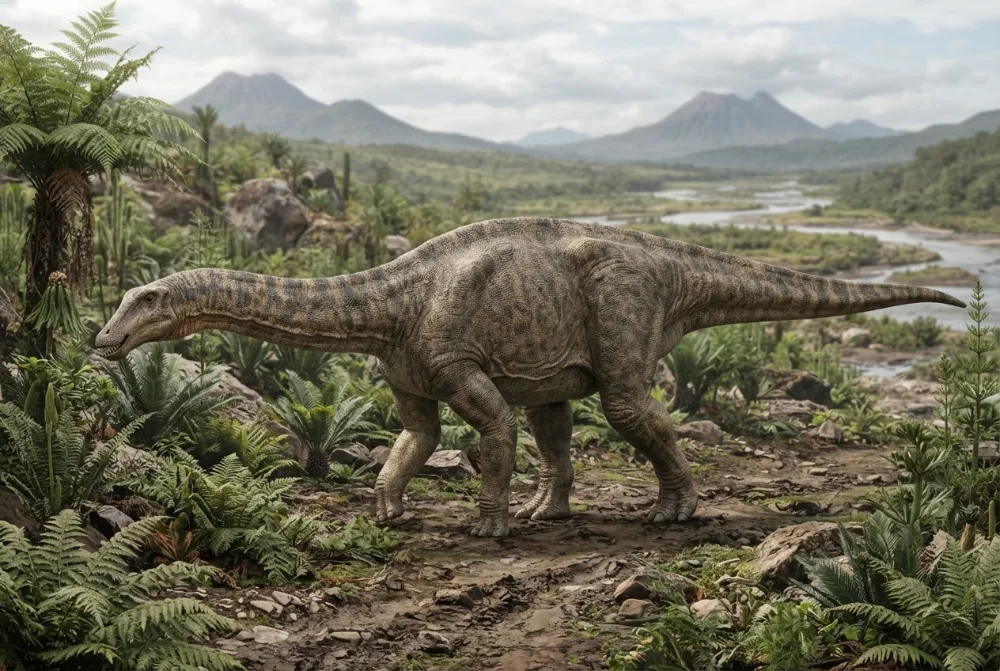
Yunnanosaurus had more than sixty spoon-shaped teeth that were self-sharpening because they wore against each other as the animal fed.1
Its teeth were advanced for an early sauropodomorph and looked like those of later giant sauropods, but scientists think this similarity evolved separately.1
The largest species, Yunnanosaurus youngi, reached about 13 metres (42 feet) long, as big as a school bus.1
The first fossils were discovered by Chinese paleontologist Yang Zhongjian (also known as C. C. Young) in the early 1940s.1
Yunnanosaurus lived between about 201 and 183 million years ago, during the Early Jurassic Period.12
It could walk on two legs or on all fours, making it a versatile mover through its ancient environment.1
Dipotso tse botswang haholo ka Yunnanosaurus
?How big was Yunnanosaurus?
The smallest species, Y. huangi, was about 7 metres (23 feet) long, while the largest, Y. youngi, reached about 13 metres (43 feet) long, roughly the size of a school bus.13
?What did Yunnanosaurus eat?
It was a herbivore that ate plants. Its spoon-shaped teeth were self-sharpening, and it fed on softer, less fibrous plants than later giant sauropods.13
?When did Yunnanosaurus live?
Yunnanosaurus lived during the Early Jurassic Period, about 201 to 183 million years ago.13
?Where was Yunnanosaurus found?
Its fossils were found in Yunnan Province, China. The first skeletons were discovered in the Lufeng Formation.1
?Did Yunnanosaurus have feathers?
No known fossils show feathers on Yunnanosaurus. It is not related to feathered dinosaurs like birds.1
?Could Yunnanosaurus walk on two legs?
Yes, it could walk on two legs or on all fours. It was a versatile mover that could switch between bipedal and quadrupedal walking.1
Mosenyi wa ditshomo
Tshomo: Yunnanosaurus is often called a prosauropod, meaning it was a direct ancestor of sauropods.
Nnete: Scientists now place Yunnanosaurus in a group called Sauropodiformes, which is closer to true sauropods but not a direct ancestor.1
Bakeng sa ditsebi tsa didinosaure
- Lebitso la saense
- Yunnanosaurus
- E rehilwe ke
- Young 19404
- Sehlopha
- Melala e melelele
- Lelapa / leloko
- Sauropodiformes4
- Tlhophiso
- Sauropodomorpha4
- Dilemo tsa mafika
- dilemo tse dimilione tse 201 ho isa ho 184 (Hettangian / Pliensbachian)4
- Dibopeho tsa mafika
- Lufeng, Fengjiahe4
- Dinaha
- Tjhaena4
- Direkoto tsa difosili
- 17 ho The Paleobiology Database4
- Ho sibollwa
- Chinese paleontologist C. C. Young (Yang Zhongjian) named Yunnanosaurus in 1942 after finding many skeletons in Yunnan, China. The type species is Yunnanosaurus huangi.1
- E sa ntse e phehwa kgang
- Scientists are not sure whether Yunnanosaurus robustus is a separate species or just a larger individual of Yunnanosaurus huangi.1
Moo dintlha di tswang teng
- Yunnanosaurus (en.wikipedia.org)
- PBDB Taxon (paleobiodb.org)
- Yunnanosaurus | Natural History Museum (nhm.ac.uk)
- Yunnanosaurus in The Paleobiology Database (CC BY 4.0): dilemo, dibaka, dibopeho tsa mafika, tlhophiso.
Ntlha e nngwe le e nngwe leqepheng lena e na le nomoro e supang mohlodi wa yona. Haeba re fositse ho hong, re kopa tshwarelo, re balatedi ba didinosaure, ha re koranta ya saense. Re bolelle ho [email protected] mme re tla e lokisa.
 Rex o lapile! Dino Wiki ke projeke ya ntate bakeng sa mora wa hae ya ratang didinosaure, ke mahala, ha ho dipapatso, ha ho disebedi. Batho ba baholo ba ka fepa Rex seneke ho thusa hore e dule e le inthaneteng.Fepa Rex
 Brachiosaurus
 Diplodocus
 Brontosaurus
 Argentinosaurus
 Camarasaurus
 Morosaurus
 Dilophosaurus
 Stenopterygius
 Dorygnathus
 Scutellosaurus
 Sinosaurus
 Temnodontosaurus