 Kwisi: O dinosaure efe?
 Ntwa ya didinosaure
 Peiso ya didinosaure
 Dipapadi tse nyane tsa didinosaure
 Albamo ya ditikara
 Manane a TOP a didinosaure
 Nkgethele!
Zhengheornis
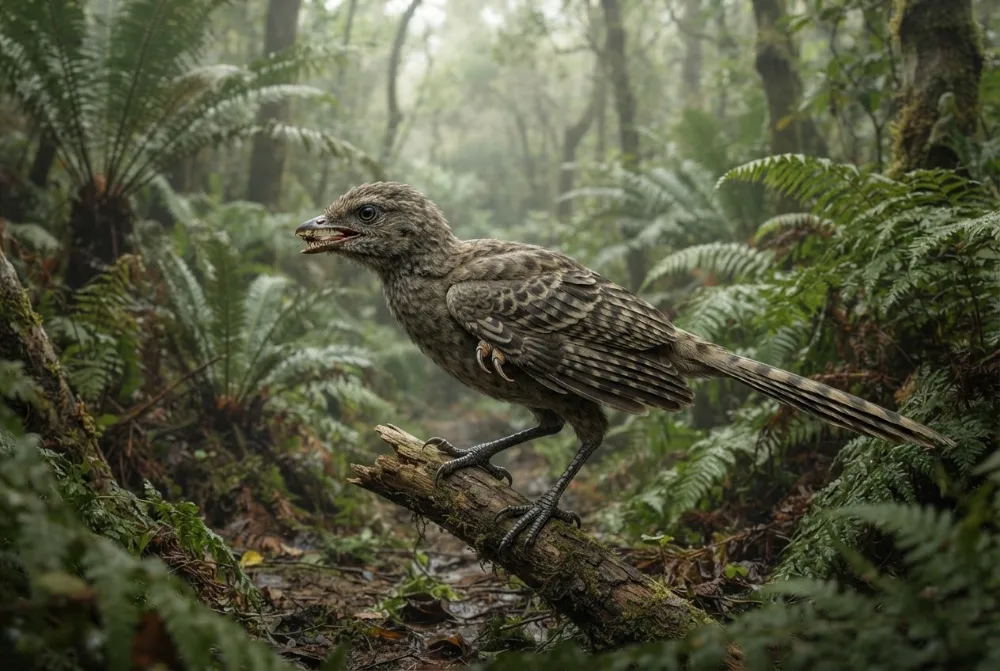
Zhengheornis was a tiny bird-like dinosaur that lived about 150 million years ago in what is now China. It had a short tail made of 15 bones, but no pygostyle, which is the fused tailbone modern birds have. This little creature helps scientists understand how bird tails evolved step by step.21
E phetse neng?
E ne e le kgolo hakae?
E ne e le boima hakae?
Zhengheornis e ne e le kgolo hakae ha e bapiswa le WENA?
Ke dipalo feela ho browser ya hao. Ha ho letho le bolokwang kapa le romelwang kae kapa kae.
E ne e le lebelo hakae?


Dintlha tse monate
Zhengheornis is one of the smallest known early bird relatives, weighing only about as much as a modern robin (74 to 163 grams).2
Its tail had 15 short vertebrae but no pygostyle, showing that tail shortening happened before the bones fused together in bird evolution.2
The name 'buyu' means 'unexpected' in Mandarin, because scientists were surprised by its unusual tail and pelvis.1
Zhengheornis lived alongside other early birds like Fujianvenator and Baminornis in the Zhenghe Fauna of Late Jurassic China.2
Scientists think Zhengheornis was not especially good at climbing trees or walking on the ground, unlike some of its relatives.2
The only known fossil was found in 2024 and includes bones, feather traces, and parts of the arms, legs, and pelvis.1
Dipotso tse botswang haholo ka Zhengheornis
?How big was Zhengheornis?
Zhengheornis was incredibly tiny, weighing only about 74 to 163 grams, similar to a modern robin. It is one of the smallest known long-tailed early bird relatives.34
?When did Zhengheornis live?
Zhengheornis lived during the Early Cretaceous period, about 120 to 130 million years ago, in what is now China.13
Bakeng sa ditsebi tsa didinosaure
- Lebitso la saense
- Zhengheornis
- E rehilwe ke
- Wang et al. 20265
- Sehlopha
- Dinonyana tsa pele
- Lelapa / leloko
- Avialae5
- Tlhophiso
- Theropoda > Avialae5
- Dilemo tsa mafika
- dilemo tse dimilione tse 152 ho isa ho 145 (Kimmeridgian / Tithonian)5
- Dibopeho tsa mafika
- Nanyuan5
- Dinaha
- Tjhaena5
- Direkoto tsa difosili
- 1 ho The Paleobiology Database5
- Ho sibollwa
- Zhengheornis was discovered in 2024 during fieldwork in Fujian Province, China, and named by Min Wang and colleagues in 2026.1
- E sa ntse e phehwa kgang
- Scientists are still debating exactly where Zhengheornis fits on the family tree of early birds, though most agree it is one of the earliest avialans.2
Moo dintlha di tswang teng
- Zhengheornis (en.wikipedia.org)
- Jurassic avialan reveals stepwise evolution of bony tail in birds (dinodata.de)
- China Jurassic Pocket-Sized Bird Fills a Puzzle of the Evolution of Bird Tail_Headline_Institute of Vertebrate Paleontology and Paleoanthropology, Chinese Academy of Sciences (english.ivpp.cas.cn)
- China Jurassic Pocket-Sized Bird Fills a Puzzle of the Evolution of Bird Tail_Research Progress_Institute of Vertebrate Paleontology and Paleoanthropology, Chinese Academy of Sciences (english.ivpp.cas.cn)
- Zhengheornis in The Paleobiology Database (CC BY 4.0): dilemo, dibaka, dibopeho tsa mafika, tlhophiso.
Ntlha e nngwe le e nngwe leqepheng lena e na le nomoro e supang mohlodi wa yona. Haeba re fositse ho hong, re kopa tshwarelo, re balatedi ba didinosaure, ha re koranta ya saense. Re bolelle ho [email protected] mme re tla e lokisa.
 Rex o lapile! Dino Wiki ke projeke ya ntate bakeng sa mora wa hae ya ratang didinosaure, ke mahala, ha ho dipapatso, ha ho disebedi. Batho ba baholo ba ka fepa Rex seneke ho thusa hore e dule e le inthaneteng.Fepa Rex
 Archaeopteryx
 Hesperornis
 Ichthyornis
 Baptornis
 Jurapteryx
 Gobipteryx
 Brachiosaurus
 Diplodocus
 Allosaurus
 Brontosaurus
 Compsognathus
 Camarasaurus