 O dino efe? Kwisi
 Ntwa ya didino
 Peiso ya didino
 Metshamekwana ya didino
 Alebamo ya disetikara
 Manane a TOP a didino
 Ngakgamatsa!
E tshetse leng?

E ne e le kgolo go le kae?
E ne e le telele go le kae?
E ne e le kwa godimo go le kae?
kakanyo
E ne e le bokete go le kae?
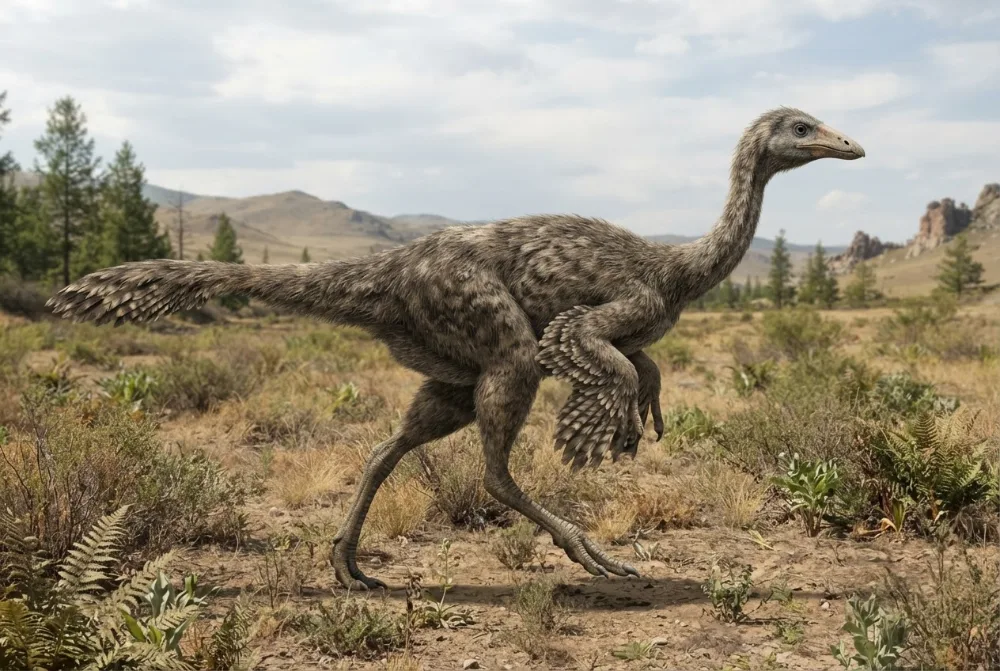
 telele jaaka dintšwa di le 5 go tswa kwa nkong go ya kwa mogatleng🍌telele jaaka dibanana di le 26 di latelana🍉bokete jaaka magapu a le 20🧸bokete jaaka bana ba kreše ba le 5🎒bokete jaaka bana ba sekolo ba le 3🏃e ne e ka taboga dimetara di le 100 mo metsotswaneng e le 5.5 (motho yo o bonako go gaisa o tlhoka 9,6)
Garudimimus e ne e le kgolo go le kae fa e bapisiwa le WENA?
Ke dipalo fela mo sebatling sa gago. Ga go sepe se se bolokwang kgotsa se se romelwang gope.
E ne e le bonako go le kae?


Dintlha tse di monate
Garudimimus had four toes on each foot, but the first toe was very small. Most later ornithomimids had only three toes.1
Scientists once thought Garudimimus had a horn on its skull. Later they realized it was just a crushed bone.1
Garudimimus was not built for fast running. Its leg muscles were not as strong as those of speedier ornithomimids.1
The only known skeleton of Garudimimus is almost complete and still has its bones connected.1
Garudimimus lived alongside turtles, crocodile relatives, and other dinosaurs in a warm, semi-arid floodplain.1
The name Garudimimus comes from Garuda, a mythical bird-like creature in Mongolian Buddhism.1
Dipotso tse di botswang thata ka ga Garudimimus
?How big was Garudimimus?
About 3.5 metres (11.5 feet) long and weighed around 77 to 98 kilograms (170 to 216 pounds).1
?What did Garudimimus eat?
It was an omnivore or herbivore, eating plants and maybe small animals. It had a toothless beak and a weak bite.1
?Could Garudimimus run fast?
Yes, it was likely a fast runner. Its long legs and anatomy suggest it was built for speed, similar to other ornithomimosaurs.1
?Did Garudimimus have feathers?
Scientists think it probably had feathers, like many other ornithomimosaurs, but no direct feather impressions have been found on the only known skeleton.1
?When did Garudimimus live?
It lived during the Late Cretaceous period, about 99 to 89 million years ago.2
?Where was Garudimimus found?
In the Gobi Desert of Mongolia, at a place called Bayshin Tsav in the Bayan Shireh Formation.1
Mothubi wa ditlhamane
Tlhamane: Garudimimus was a fast runner like an ostrich.
Boammaaruri: Garudimimus had short, stocky legs and weak leg muscles, so it was not a fast runner.1
Ya baitseanape ba didino
- Leina la saense
- Garudimimus
- Leina le neilwe ke
- Barsbold 19813
- Setlhopha
- Didino tsa mpshe
- Lelapa / clade
- Deinocheiridae3
- Thulaganyo
- Theropoda > Ornithomimosauria3
- Bogolo jwa matlapa
- 94 go ya go 84 dimilione tsa dingwaga (Turonian / Santonian)3
- Dibopego tsa matlapa
- Baynshire3
- Dinaga
- Mongolia3
- Direkoto tsa difosili
- 1 mo The Paleobiology Database3
- Go fitlhelwa
- A Soviet-Mongolian expedition found the skeleton in the Gobi Desert in 1981. Mongolian paleontologist Rinchen Barsbold named it Garudimimus brevipes that same year.1
- Go sa ntse go ganetsanwa
- Scientists are not sure if Garudimimus belongs in the family Deinocheiridae or in its own family, Garudimimidae.1
Kwa dintlha di tswang teng
- Garudimimus (en.wikipedia.org)
- Garudimimus | Natural History Museum (nhm.ac.uk)
- Garudimimus in The Paleobiology Database (CC BY 4.0): dingwaga, mafelo, dibopego tsa matlapa, thulaganyo.
Ntlha nngwe le nngwe mo tsebeng eno e na le nomoro e e supang motswedi wa yona. Fa re dirile phoso, maitshwarelo, re barati ba didino, ga re lokwalodikgang lwa saense. Re bolelele kwa [email protected] mme re tla e baakanya.
 Rex o tshwerwe ke tlala! Dino Wiki ke porojeke ya rre e a e diretseng morwawe yo o ratang didino, ke mahala, ga e na dipapatso e bile ga e na dilatedi. Batho ba bagolo ba ka fepa Rex senyamo go thusa gore e nne mo inthaneteng.Fepa Rex
 Gallimimus
 Ornithomimus
 Struthiomimus
 Deinocheirus
 Dromiceiomimus
 Archaeornithomimus
 Tyrannosaurus
 Triceratops
 Velociraptor
 Spinosaurus
 Ankylosaurus
 Parasaurolophus