 Ban dino nga? Kiis
 Xeexu dino
 Rawante dino
 Fo yu ndaw yu dino
 Albomu sitikeer
 Limu TOP yu dino
 Bett ma!
Altirhinus
Altirhinus was a big, plant-eating dinosaur that walked on two legs but could also drop to all fours to munch on low plants. It had a tall bump on its snout that gave it its name, and a wide mouth like a duck's bill for scooping up food.1
Kañ la dundoon?
Naka la réyoon?
Naka la guddoon?
Naka la kawewoon?
jortu
Naka la diisoon?
 gudd ni 8 xaj, bakkan ba geen🍌gudd ni 44 banaana yu ñu topp-toppale🍉diis ni 220 xaal🧸diis ni 58 xale yu maternel🎒diis ni 34 xale yu lekkool🐻❄️diis ni 2,5 uurs yu weex🏃mënoon na daw 100 meetar ci 11 segond (nit ki gën a gaaw dafay soxla 9,6)
Naka la Altirhinus réyoon, bu ñu ko méngalee ak YAW?
Ay kalkil rekk ci sa navigatëer. Dara du ñu denc, dara du ñu yónne fenn.
Naka la gaawoon?


Xibaar yu neex
Altirhinus had a thumb spike like a sharp nail, which it might have used for defense or to break open seeds.1
Its fifth finger could move a bit like a thumb, helping it grab food while eating.1
The tall arch on its snout was made by the nasal bones, and scientists think it might have been used for cooling, smelling, or showing off to other Altirhinus.1
Altirhinus lived about 125 to 100 million years ago, during the Early Cretaceous Period.1
Fossils of several Altirhinus of different ages were found together, including a nearly complete skull and a set of 34 tail bones.1
Altirhinus is a close relative of the duck-billed dinosaurs called hadrosaurids, but it lived a bit earlier.1
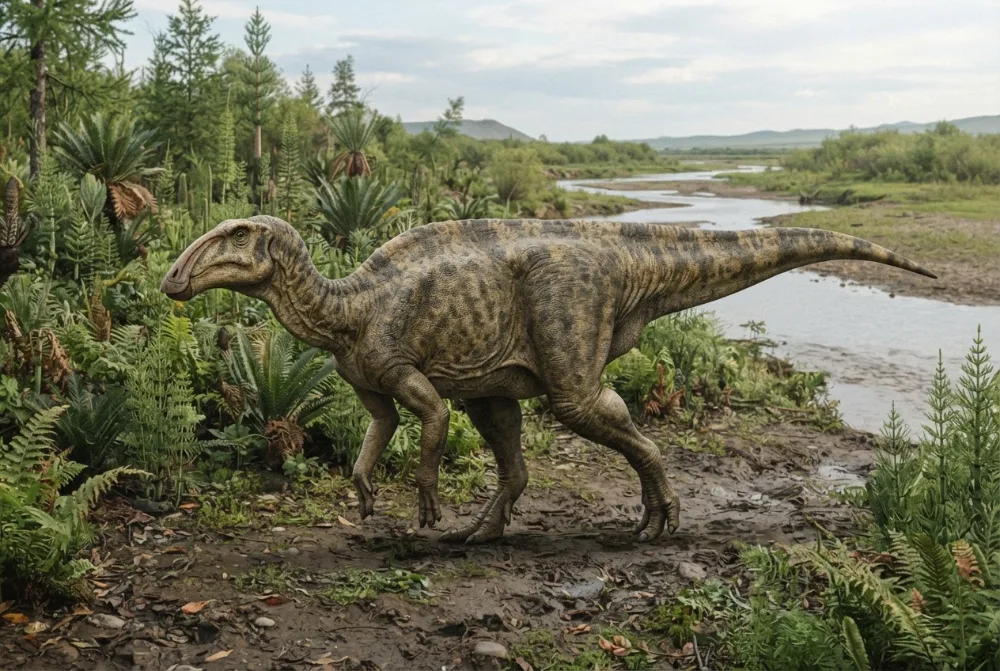
Laaj yi ñu gën a laaj ci Altirhinus
?How big was Altirhinus?
About 6.5 to 8 metres long and weighed around 1.1 tonnes.1
?What did Altirhinus eat?
It was a plant-eater. It used its wide beak to crop plants and its cheek teeth to chew them, just like cows do today.1
?Why did Altirhinus have a bump on its nose?
Scientists aren't sure. It might have been used for cooling, smelling, making sounds, or showing off to other Altirhinus, like a peacock's tail.1
?When did Altirhinus live?
It lived during the Early Cretaceous Period, about 125 to 100 million years ago.1
Ku tas léeb yu dul dëgg
Léeb: Altirhinus is the same as Iguanodon orientalis.
Dëgg: Altirhinus was originally thought to be Iguanodon orientalis, but scientists later realized the old fossils were too broken to tell, and the new ones were a different dinosaur.1
Ngir ñi xam dino lool
- Turu xam-xam
- Altirhinus
- Ku ko tudde
- Norman 19982
- Kurél
- Dino yu lekk gàncax te am gémmiñu picc
- Njaboot / klad
- Neoiguanodontia2
- Klasifikasiyoŋ
- Ornithischia > Ornithopoda > Iguanodontia2
- Màggaayu doj yi
- 110 ba 100 milyoŋ at (Albian)2
- Formasiyoŋi doj
- Khuren Dukh2
- Réew yi
- Mongoli2
- Fosil yu ñu gis
- 1 ci The Paleobiology Database2
- Gisees
- Altirhinus was named by British paleontologist David B. Norman in 1998, based on fossils found in 1981 by a Soviet-Mongolian team led by Sergei Kurzanov.1
- Ñu ngi koy werante ba tey
- Scientists are not sure what the tall arch on Altirhinus's snout was for. It might have helped with cooling, smelling, making sounds, or attracting mates.1
Fa xibaar yi jóge
- Altirhinus (en.wikipedia.org)
- Altirhinus in The Paleobiology Database (CC BY 4.0): at, béréb yi, formasiyoŋi doj, klasifikasiyoŋ.
Bépp xibaar ci xët wii am na lim bu wone fa mu jóge. Su nu juumee, baal nu, nun ñu bëgg dino lanu, du ab sërnaalu xam-xam. Wax nu ko ci [email protected] nu defar ko.
 Rex xiif na! Dino Wiki, mbiru ab baay la ngir doomam ju góor ju bëgg dinosoor, ci neen te amul kaamuñaate, amul tracker. Mag ñi mën nañu jox Rex tuuti ñam ngir dimbali ko mu des ci internet.Dundal Rex
 Iguanodon
 Tenontosaurus
 Thescelosaurus
 Zalmoxes
 Camptosaurus
 Rhabdodon
 Stegosaurus
 Archaeopteryx
 Giganotosaurus
 Microraptor
 Deinonychus
 Baryonyx