 Ban dino nga? Kiis
 Xeexu dino
 Rawante dino
 Fo yu ndaw yu dino
 Albomu sitikeer
 Limu TOP yu dino
 Bett ma!
Anurognathus
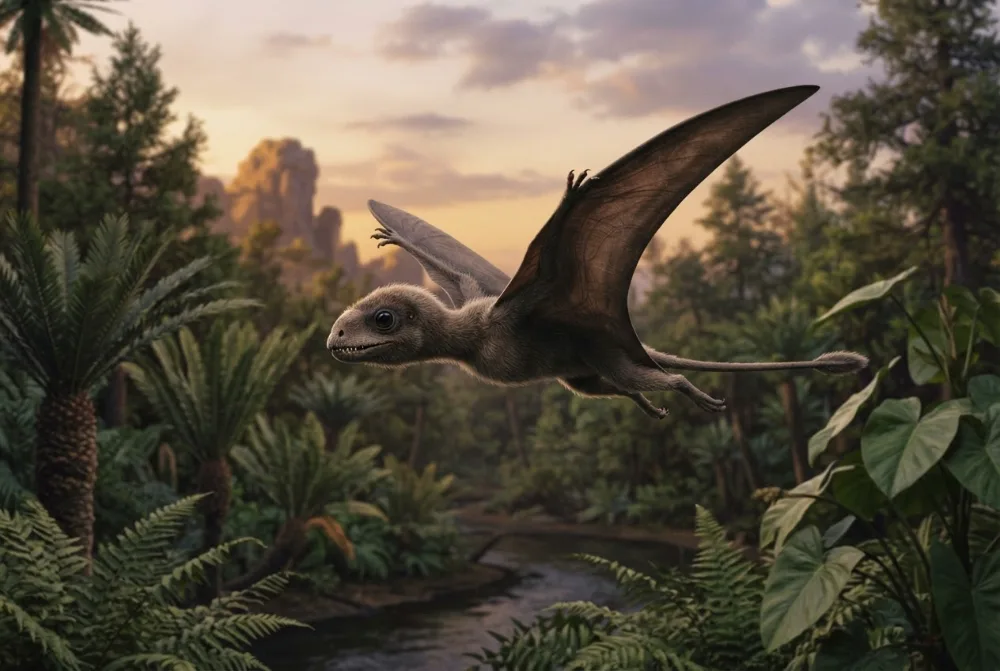
Anurognathus was a tiny pterosaur that lived in the Late Jurassic. It had a very short, wide head and big eyes, like a little flying frog. It probably hunted insects at dusk.12
Kañ la dundoon?
Naka la réyoon?
Naka la guddoon?
Naka la diisoon?
Naka la Anurognathus réyoon, bu ñu ko méngalee ak YAW?
Ay kalkil rekk ci sa navigatëer. Dara du ñu denc, dara du ñu yónne fenn.
Naka la gaawoon?


Xibaar yu neex
Anurognathus had a very short tail, unlike most early pterosaurs. This made it more maneuverable when hunting insects.1
Its skull was wider than it was long, and its eyes were huge. This helped it see well in dim light.12
Anurognathus weighed only about 40 grams (1.4 ounces), as light as a small bird.1
Scientists think Anurognathus had bristles around its mouth, like a fringe, to help catch insects.12
Only two fossils of Anurognathus have been found, both in Germany. One is a juvenile.1
Laaj yi ñu gën a laaj ci Anurognathus
?How big was Anurognathus?
Anurognathus was tiny, with a wingspan of about 35 cm (14 in) and a weight of only 40 grams (1.4 oz), as light as a small bird.1
?What did Anurognathus eat?
It ate insects. Its pin-like teeth and small mouth were perfect for catching tiny bugs about 11 mm long.1
?Could Anurognathus fly?
Yes, it was a pterosaur and could fly. It had short, broad wings and probably flew slowly and maneuvered well to catch insects at dusk.1
?Did Anurognathus have feathers?
No, it did not have feathers. It had a fuzzy coat of hair-like fibers called pycnofibers, and possibly bristles around its mouth.1
?When did Anurognathus live?
Anurognathus lived during the Late Jurassic period, about 150 to 148 million years ago.1
?Why did Anurognathus have big eyes?
Its huge eyes helped it see well in dim light, so it could hunt insects at dusk or in the dark.1
?Is Anurognathus a dinosaur?
No, Anurognathus is a pterosaur, a flying reptile that is not a dinosaur.1
?How many fossils of Anurognathus have been found?
Only two fossils have been found, both in Germany. One is a juvenile, and the other is a subadult.1
Ku tas léeb yu dul dëgg
Léeb: Some people think Anurognathus was a dinosaur.
Dëgg: Anurognathus was a pterosaur, a flying reptile that is not a dinosaur.4
Ngir ñi xam dino lool
- Turu xam-xam
- Anurognathus
- Ku ko tudde
- Döderlein 19234
- Kurél
- Reptil yuy naaw
- Njaboot / klad
- Anurognathidae4
- Klasifikasiyoŋ
- Pterosauria4
- Màggaayu doj yi
- 149 ba 145 milyoŋ at (Tithonian)4
- Formasiyoŋi doj
- Solnhofener Plattenkalk4
- Réew yi
- Almaañ4
- Fosil yu ñu gis
- 1 ci The Paleobiology Database4
- Gisees
- Anurognathus was named by Ludwig Döderlein in 1923. He bought the first fossil from a collector in 1922. It was found in the Solnhofen limestone of Germany.1
- Ñu ngi koy werante ba tey
- Scientists still debate whether Anurognathus was a fast flyer that surprised its prey, or a slow, maneuverable hunter like a nightjar.1
Fa xibaar yi jóge
- Anurognathus (en.wikipedia.org)
- A second specimen of the pterosaurAnurognathus ammoni | PalZ | Springer Nature Link (link.springer.com)
- PaleoCodex :: Anurognathus (paleocodex.com)
- Anurognathus in The Paleobiology Database (CC BY 4.0): at, béréb yi, formasiyoŋi doj, klasifikasiyoŋ.
Bépp xibaar ci xët wii am na lim bu wone fa mu jóge. Su nu juumee, baal nu, nun ñu bëgg dino lanu, du ab sërnaalu xam-xam. Wax nu ko ci [email protected] nu defar ko.
 Rex xiif na! Dino Wiki, mbiru ab baay la ngir doomam ju góor ju bëgg dinosoor, ci neen te amul kaamuñaate, amul tracker. Mag ñi mën nañu jox Rex tuuti ñam ngir dimbali ko mu des ci internet.Dundal Rex
 Pteranodon
 Quetzalcoatlus
 Dorygnathus
 Rhamphorhynchus
 Anhanguera
 Pterodactylus
 Brachiosaurus
 Diplodocus
 Allosaurus
 Brontosaurus
 Compsognathus
 Camarasaurus