 Ban dino nga? Kiis
 Xeexu dino
 Rawante dino
 Fo yu ndaw yu dino
 Albomu sitikeer
 Limu TOP yu dino
 Bett ma!
Balaenognathus
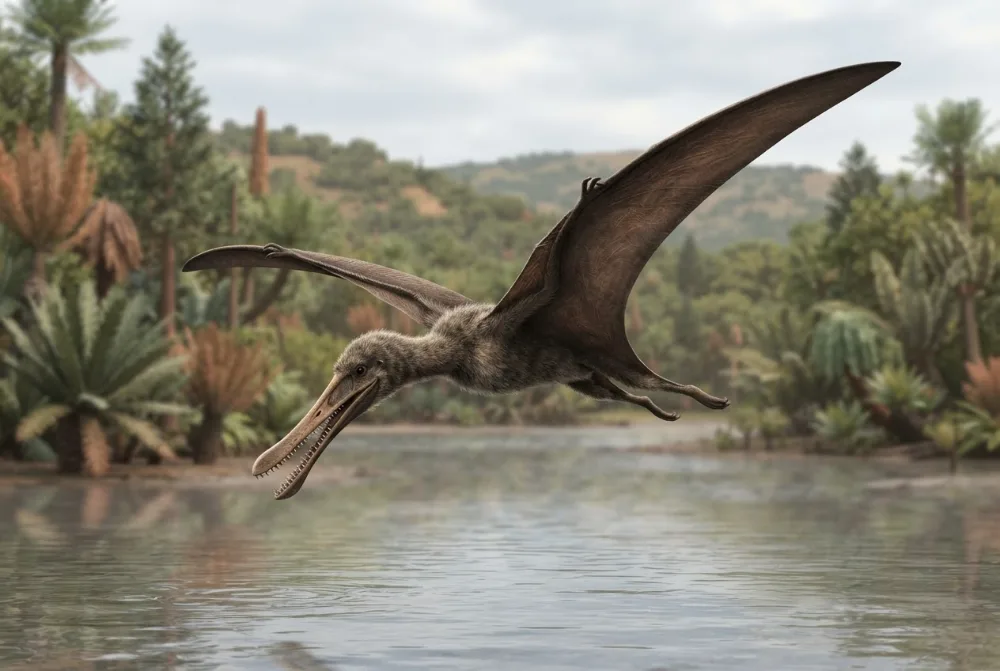
Balaenognathus was a flying reptile that lived about 150 million years ago. It had a strange, spoon-shaped snout with hundreds of tiny hooked teeth. It used its beak like a strainer to scoop up tiny shrimp from the water, just like a modern flamingo.12
Kañ la dundoon?
Naka la réyoon?
Naka la guddoon?
 gudd ni 2 muusu kër, bakkan ba geen🍌gudd ni 6 banaana yu ñu topp-toppale⚽mënoon na naaw ci kaw teraŋ futbal bépp ci 9,9 segond
Naka la Balaenognathus réyoon, bu ñu ko méngalee ak YAW?
Ay kalkil rekk ci sa navigatëer. Dara du ñu denc, dara du ñu yónne fenn.
Naka la gaawoon?


Xibaar yu neex
Balaenognathus had at least 480 teeth, more than most other pterosaurs.1
The tips of its teeth had tiny hooks, which have never been seen in any other pterosaur. These hooks helped trap shrimp so they couldn't escape.12
The front of its snout was shaped like a spatula and had no teeth, so water could flow in easily.1
Its upper jaw was more curved than its lower jaw, so its mouth stayed slightly open at the front even when closed.1
The fossil was found by accident in a quarry in Germany, inside a block of stone that also contained bones of a crocodile-like animal.12
Balaenognathus lived during the Late Jurassic period, about 152 to 149 million years ago.3
It had long legs, which helped it wade through shallow seas while feeding.2
Laaj yi ñu gën a laaj ci Balaenognathus
?What did Balaenognathus eat?
It ate tiny shrimp and other small plankton. It used its spoon-shaped beak and hundreds of tiny hooked teeth to strain them out of the water.12
?How big was Balaenognathus?
It was a medium-sized pterosaur with a wingspan of 1.17 metres (3.8 feet). Its body was about 1 metre long.5
Ngir ñi xam dino lool
- Turu xam-xam
- Balaenognathus
- Ku ko tudde
- Martill et al. 20236
- Kurél
- Reptil yuy naaw
- Njaboot / klad
- Ctenochasmatidae6
- Klasifikasiyoŋ
- Pterosauria > Pterodactyloidea6
- Màggaayu doj yi
- 152 ba 149 milyoŋ at (Kimmeridgian)6
- Réew yi
- Almaañ6
- Fosil yu ñu gis
- 1 ci The Paleobiology Database6
- Gisees
- Balaenognathus was named by David Martill and colleagues in 2023. The only known fossil was found in September 2011 in a quarry near Wattendorf, Bavaria, Germany, by workers collecting a block of limestone.1
- Ñu ngi koy werante ba tey
- Scientists are not sure exactly how Balaenognathus used its hooked teeth and spatula-like snout to filter food, but they think it may have pumped water in and out by moving its long neck.1
Fa xibaar yi jóge
- A new pterodactyloid pterosaur with a unique filter-feeding apparatus from the Late Jurassic of Germany | PalZ | Springer Nature Link (link.springer.com)
- Bizarre filter-feeding pterosaur described from Germany | Natural History Museum (nhm.ac.uk)
- PBDB Taxon (paleobiodb.org)
- Balaenognathus (en.m.wikipedia.org)
- Balaenognathus (Wikipedia) (Wikipedia)
- Balaenognathus in The Paleobiology Database (CC BY 4.0): at, béréb yi, formasiyoŋi doj, klasifikasiyoŋ.
Bépp xibaar ci xët wii am na lim bu wone fa mu jóge. Su nu juumee, baal nu, nun ñu bëgg dino lanu, du ab sërnaalu xam-xam. Wax nu ko ci [email protected] nu defar ko.
 Rex xiif na! Dino Wiki, mbiru ab baay la ngir doomam ju góor ju bëgg dinosoor, ci neen te amul kaamuñaate, amul tracker. Mag ñi mën nañu jox Rex tuuti ñam ngir dimbali ko mu des ci internet.Dundal Rex
 Pteranodon
 Quetzalcoatlus
 Dorygnathus
 Rhamphorhynchus
 Anhanguera
 Pterodactylus
 Brachiosaurus
 Diplodocus
 Allosaurus
 Brontosaurus
 Compsognathus
 Camarasaurus