 Ban dino nga? Kiis
 Xeexu dino
 Rawante dino
 Fo yu ndaw yu dino
 Albomu sitikeer
 Limu TOP yu dino
 Bett ma!
Baminornis
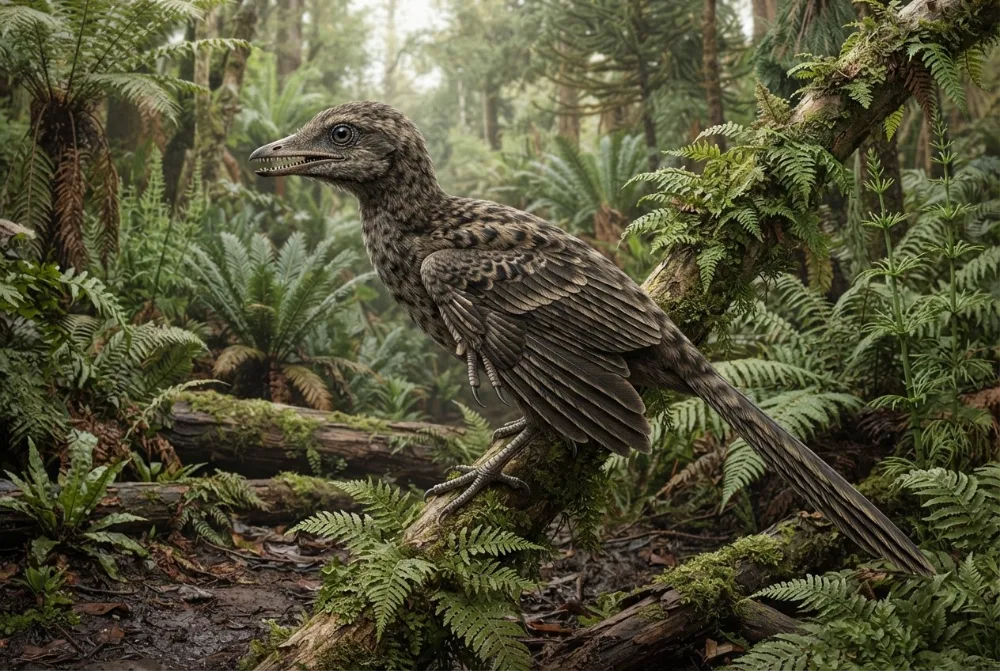
Baminornis was a tiny, early bird that lived about 150 million years ago in what is now China. It had a short tail with a fused bone called a pygostyle, making it one of the oldest short-tailed birds ever found. This little creature could probably fly better than its older cousin Archaeopteryx.21
Kañ la dundoon?
Naka la réyoon?
Naka la diisoon?
Naka la Baminornis réyoon, bu ñu ko méngalee ak YAW?
Ay kalkil rekk ci sa navigatëer. Dara du ñu denc, dara du ñu yónne fenn.
Naka la gaawoon?


Xibaar yu neex
Baminornis had a fused tail bone called a pygostyle, which is a feature of modern birds and was very rare among Jurassic birds.21
It lived around 150 million years ago, during the Late Jurassic period, in a swampy environment.1
Baminornis was very small, weighing only about 130 to 300 grams, similar to a modern robin or sparrow.1
Its shoulder bones were not fused together, which may have helped it fly better than Archaeopteryx.1
The fossil of Baminornis was found in the Zhenghe Fauna, a site that also contained turtles, fish, and other early birds.1
Some scientists think the pygostyle of Baminornis might actually be part of its hip bone, not a tail bone, so its tail length is still debated.1
Laaj yi ñu gën a laaj ci Baminornis
?Was Baminornis a dinosaur?
Yes, Baminornis is a type of bird-like dinosaur called an avialan. It is part of the dinosaur group Theropoda.1
?How big was Baminornis?
Baminornis was very small, weighing about 130 to 300 grams. That is similar to a modern robin or sparrow.1
?Did Baminornis have a short tail?
Scientists disagree. The first study said it had a short tail with a fused pygostyle, but later research suggests that bone might be part of the hip, so its tail length is still debated.1
?Could Baminornis fly?
Yes, Baminornis could probably fly better than its older cousin Archaeopteryx. Its shoulder bones were unfused, which may have helped its flight.1
Ngir ñi xam dino lool
- Turu xam-xam
- Baminornis
- Ku ko tudde
- Chen et al. 20254
- Kurél
- Picc yu jëkk yi
- Njaboot / klad
- Avialae4
- Klasifikasiyoŋ
- Theropoda > Avialae4
- Màggaayu doj yi
- 152 ba 145 milyoŋ at (Kimmeridgian / Tithonian)4
- Formasiyoŋi doj
- Nanyuan4
- Réew yi
- Siin4
- Fosil yu ñu gis
- 1 ci The Paleobiology Database4
- Gisees
- Baminornis was named in 2025 by Chen and colleagues based on a partial skeleton found near Yangyuan Village in Zhenghe County, Fujian Province, China.1
- Ñu ngi koy werante ba tey
- Scientists are not sure whether the short tail of Baminornis evolved just once or multiple times in early birds.1
Fa xibaar yi jóge
- Baminornis (en.wikipedia.org)
- Earliest short-tailed bird from the Late Jurassic of China | Nature (nature.com)
- PBDB Taxon (paleobiodb.org)
- Baminornis in The Paleobiology Database (CC BY 4.0): at, béréb yi, formasiyoŋi doj, klasifikasiyoŋ.
Bépp xibaar ci xët wii am na lim bu wone fa mu jóge. Su nu juumee, baal nu, nun ñu bëgg dino lanu, du ab sërnaalu xam-xam. Wax nu ko ci [email protected] nu defar ko.
 Rex xiif na! Dino Wiki, mbiru ab baay la ngir doomam ju góor ju bëgg dinosoor, ci neen te amul kaamuñaate, amul tracker. Mag ñi mën nañu jox Rex tuuti ñam ngir dimbali ko mu des ci internet.Dundal Rex
 Archaeopteryx
 Hesperornis
 Ichthyornis
 Baptornis
 Jurapteryx
 Gobipteryx
 Brachiosaurus
 Diplodocus
 Allosaurus
 Brontosaurus
 Compsognathus
 Camarasaurus