 Ban dino nga? Kiis
 Xeexu dino
 Rawante dino
 Fo yu ndaw yu dino
 Albomu sitikeer
 Limu TOP yu dino
 Bett ma!
Banguela
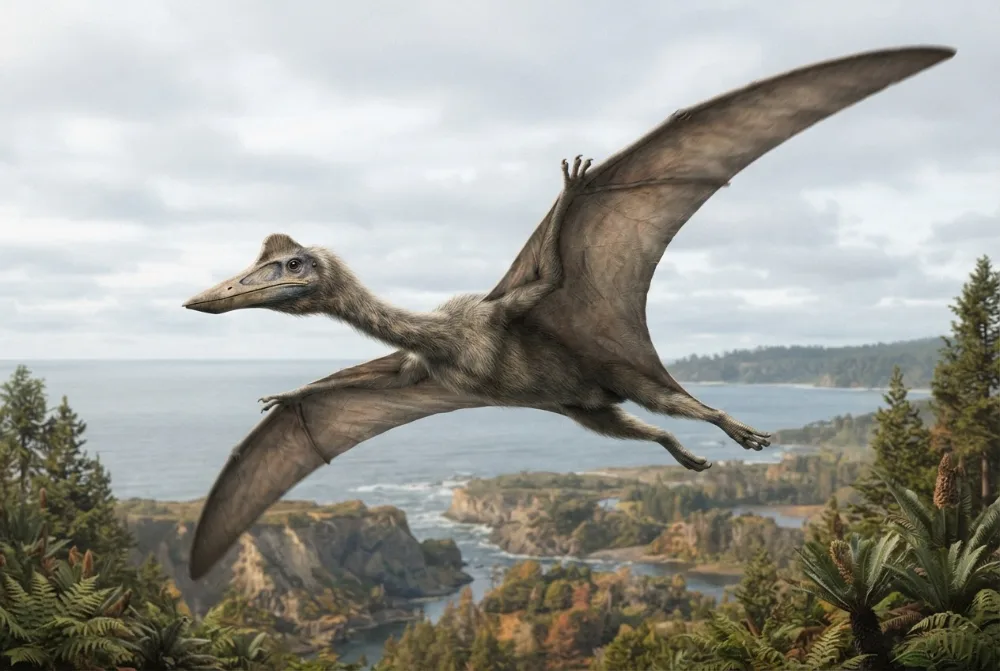
Banguela was a flying reptile that lived about 115 million years ago. It had no teeth, so it probably scooped up fish with its beak. It was not a dinosaur, but a pterosaur, a cousin of dinosaurs.14
Kañ la dundoon?
Naka la réyoon?
Naka la ay laafam yaatuwoon?
 laaf yu yaatu ni 2 welo ci benn rëdd⚽mënoon na naaw ci kaw teraŋ futbal bépp ci 6,2 segond
Naka la Banguela réyoon, bu ñu ko méngalee ak YAW?
Ay kalkil rekk ci sa navigatëer. Dara du ñu denc, dara du ñu yónne fenn.
Naka la gaawoon?


Xibaar yu neex
Banguela's lower jaw, called a symphysis, was about 27 centimeters (10.7 inches) long and curved upward. The front edges were sharp, but it had no teeth or tooth sockets.1
Its skull was about 61 centimeters (2 feet) long, and its wingspan was over 3.7 meters (12 feet).1
Banguela is one of the few pterosaurs that completely lost its teeth. Scientists think tooth loss happened at least four separate times among pterosaurs.1
The fossil was first thought to belong to another pterosaur called Thalassodromeus, but in 2015 scientists gave it its own name, Banguela.1
Banguela's toothless beak might have had a horny covering, like a bird's beak, which helped it catch slippery fish.1
Laaj yi ñu gën a laaj ci Banguela
?How big was Banguela?
Its skull was about 61 centimeters (24 inches) long and its wingspan was over 3.7 meters (12 feet). It weighed about as much as a small dog or a large goose.13
?Did Banguela have teeth?
No, Banguela had no teeth or tooth sockets. Its name means 'toothless one' in Portuguese.13
?What did Banguela eat?
It probably ate fish, scooping them up with its toothless beak. Its sharp jaw tips were not good for holding food, so it likely swallowed fish whole.3
?Is Banguela a dinosaur?
No, Banguela is a pterosaur, a flying reptile that lived alongside dinosaurs but is not a dinosaur itself.1
Ku tas léeb yu dul dëgg
Léeb: Some people think Banguela was a dinosaur because it lived with dinosaurs.
Dëgg: Banguela was a pterosaur, a flying reptile, not a dinosaur. Pterosaurs are a separate group of reptiles.1
Ngir ñi xam dino lool
- Turu xam-xam
- Banguela
- Ku ko tudde
- Headden and Campos 20144
- Kurél
- Reptil yuy naaw
- Njaboot / klad
- Dsungaripteridae4
- Klasifikasiyoŋ
- Pterosauria > Pterodactyloidea4
- Màggaayu doj yi
- 120 ba 113 milyoŋ at (Aptian)4
- Formasiyoŋi doj
- Romualdo4
- Réew yi
- Beresil4
- Fosil yu ñu gis
- 1 ci The Paleobiology Database4
- Gisees
- A Swiss collector named Urs Oberli bought a jaw fragment from Brazil. In 2005, scientists first described it as Thalassodromeus, but in 2015, Jaime Headden and Hebert Campos named it Banguela oberlii, honoring Oberli.1
- Ñu ngi koy werante ba tey
- Scientists disagree about Banguela's family. Some say it belongs to Dsungaripteridae, others think it is a species of Thalassodromeus, and some place it in Chaoyangopteridae.1
Fa xibaar yi jóge
- Banguela (en.wikipedia.org)
- PBDB Taxon (paleobiodb.org)
- Meet Banguela | The Bite Stuff (qilong.wordpress.com)
- Banguela in The Paleobiology Database (CC BY 4.0): at, béréb yi, formasiyoŋi doj, klasifikasiyoŋ.
Bépp xibaar ci xët wii am na lim bu wone fa mu jóge. Su nu juumee, baal nu, nun ñu bëgg dino lanu, du ab sërnaalu xam-xam. Wax nu ko ci [email protected] nu defar ko.
 Rex xiif na! Dino Wiki, mbiru ab baay la ngir doomam ju góor ju bëgg dinosoor, ci neen te amul kaamuñaate, amul tracker. Mag ñi mën nañu jox Rex tuuti ñam ngir dimbali ko mu des ci internet.Dundal Rex
 Pteranodon
 Quetzalcoatlus
 Dorygnathus
 Rhamphorhynchus
 Anhanguera
 Pterodactylus
 Stegosaurus
 Iguanodon
 Archaeopteryx
 Giganotosaurus
 Microraptor
 Deinonychus