 Ban dino nga? Kiis
 Xeexu dino
 Rawante dino
 Fo yu ndaw yu dino
 Albomu sitikeer
 Limu TOP yu dino
 Bett ma!
Bohaiornis
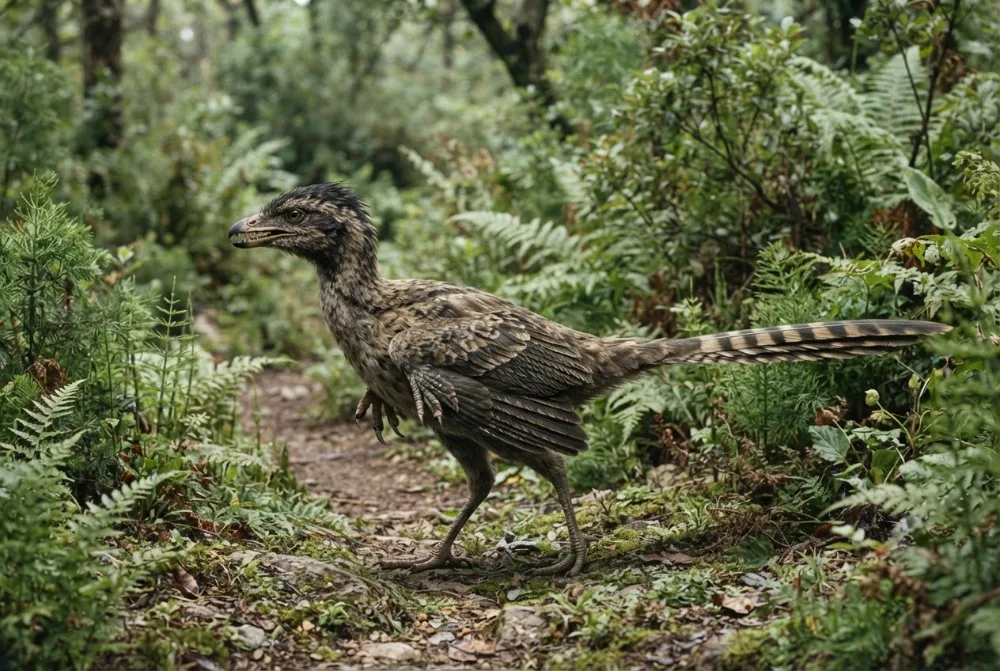
Bohaiornis was a feathered dinosaur that lived about 120 million years ago in what is now China. It was a bird-like predator with sharp teeth and long tail feathers. Scientists found a nearly complete skeleton that shows it was a fast, ground-dwelling hunter.15
Kañ la dundoon?
Naka la réyoon?
Naka la diisoon?
Naka la Bohaiornis réyoon, bu ñu ko méngalee ak YAW?
Ay kalkil rekk ci sa navigatëer. Dara du ñu denc, dara du ñu yónne fenn.
Naka la gaawoon?


Xibaar yu neex
Bohaiornis had two long, ribbon-like feathers on its tail, not a fan of short feathers like many other birds.1
It was much larger than its close relative Eoenantiornis, which lived a bit earlier.1
The first skeleton found was almost complete, with all its bones still connected.2
Scientists once thought it had stones in its belly to help grind food, but those turned out to be mineral lumps that formed after death.1
Bohaiornis had a broad snout, which is unusual for early birds that ate meat.1
It lived during the Early Cretaceous, about 120 million years ago.1
Laaj yi ñu gën a laaj ci Bohaiornis
?How big was Bohaiornis?
Scientists do not give an exact size, but it was much larger than its close relative Eoenantiornis, and a second, even larger specimen has been found.14
?What did Bohaiornis eat?
It was probably a meat-eater, maybe a raptorial predator. Scientists once thought it had stomach stones to help grind food, but those turned out to be mineral lumps that formed after death.14
?Did Bohaiornis have feathers?
Yes. The first skeleton found had two long, ribbon-like feathers attached to its tail.1
?When did Bohaiornis live?
It lived during the Early Cretaceous, about 120 million years ago, in what is now China.1
Ku tas léeb yu dul dëgg
Léeb: People might think Bohaiornis ate plants because it had stones in its stomach.
Dëgg: The stones were actually mineral concretions that formed after the animal died, and Bohaiornis was a meat-eater.1
Ngir ñi xam dino lool
- Turu xam-xam
- Bohaiornis
- Ku ko tudde
- Hu et al. 20115
- Kurél
- Picc yu jëkk yi
- Njaboot / klad
- Bohaiornithidae5
- Klasifikasiyoŋ
- Theropoda > Avialae5
- Màggaayu doj yi
- 121 ba 113 milyoŋ at (Aptian)5
- Formasiyoŋi doj
- Jiufotang5
- Réew yi
- Siin5
- Fosil yu ñu gis
- 2 ci The Paleobiology Database5
- Gisees
- Bohaiornis was named by Dongyu Hu, Li Li, Lianhaim Hou, and Xing Xu in 2011. They described a nearly complete skeleton from the Yixian Formation in China.21
- Ñu ngi koy werante ba tey
- Scientists still debate what exactly Bohaiornis ate, because its stomach contents are not clear.1
Fa xibaar yi jóge
- Bohaiornis (en.wikipedia.org)
- A new enantiornithine bird from the Lower Cretaceous of western L...: Ingenta Connect (ingentaconnect.com)
- Synthetic analysis of trophic diversity and evolution in Enantiornithes with new insights from Bohaiornithidae (pmc.ncbi.nlm.nih.gov)
- A new specimen of large-bodied basal Enantiornithine Bohaiornis from the Early Cretaceous of China and the inference of feeding ecology in Mesozoic birds | Journal of Paleontology | Cambridge Core (cambridge.org)
- Bohaiornis in The Paleobiology Database (CC BY 4.0): at, béréb yi, formasiyoŋi doj, klasifikasiyoŋ.
Bépp xibaar ci xët wii am na lim bu wone fa mu jóge. Su nu juumee, baal nu, nun ñu bëgg dino lanu, du ab sërnaalu xam-xam. Wax nu ko ci [email protected] nu defar ko.
 Rex xiif na! Dino Wiki, mbiru ab baay la ngir doomam ju góor ju bëgg dinosoor, ci neen te amul kaamuñaate, amul tracker. Mag ñi mën nañu jox Rex tuuti ñam ngir dimbali ko mu des ci internet.Dundal Rex
 Archaeopteryx
 Hesperornis
 Ichthyornis
 Baptornis
 Jurapteryx
 Gobipteryx
 Stegosaurus
 Iguanodon
 Giganotosaurus
 Microraptor
 Deinonychus
 Baryonyx