 Ban dino nga? Kiis
 Xeexu dino
 Rawante dino
 Fo yu ndaw yu dino
 Albomu sitikeer
 Limu TOP yu dino
 Bett ma!
Cariocecus
Cariocecus was a medium-sized plant-eating dinosaur that lived in what is now Portugal. It had a bony brow over its eye that made it look like an eagle, and its upper jaw bones were fused together to help it chew tough plants.1
Kañ la dundoon?
Naka la réyoon?
Naka la guddoon?
Naka la kawewoon?
jortu
Naka la diisoon?
 gudd ni 7 xaj, bakkan ba geen🍌gudd ni 39 banaana yu ñu topp-toppale🍉diis ni 120 xaal🧸diis ni 32 xale yu maternel🎒diis ni 19 xale yu lekkool🏃mënoon na daw 100 meetar ci 9,7 segond (nit ki gën a gaaw dafay soxla 9,6)
Naka la Cariocecus réyoon, bu ñu ko méngalee ak YAW?
Ay kalkil rekk ci sa navigatëer. Dara du ñu denc, dara du ñu yónne fenn.
Naka la gaawoon?


Xibaar yu neex
Cariocecus is the first iguanodontian skull ever found in Portugal.1
The skull of Cariocecus was about 45 centimetres (18 inches) long, and the animal was not fully grown when it died.2
Its maxilla and jugal bones were completely fused together, which is unique among all ornithopods.1
Cariocecus had a large bony brow over its eye that may have protected it from sun glare and injury.1
Scientists used micro-CT scanning to study the inside of the skull, including the brain and inner ear.2
Cariocecus lived alongside the spinosaurid Iberospinus and other dinosaurs in a shallow coastal environment.1
The fossil was discovered in 2016 by Pedro Marrecas and was named in 2025.1
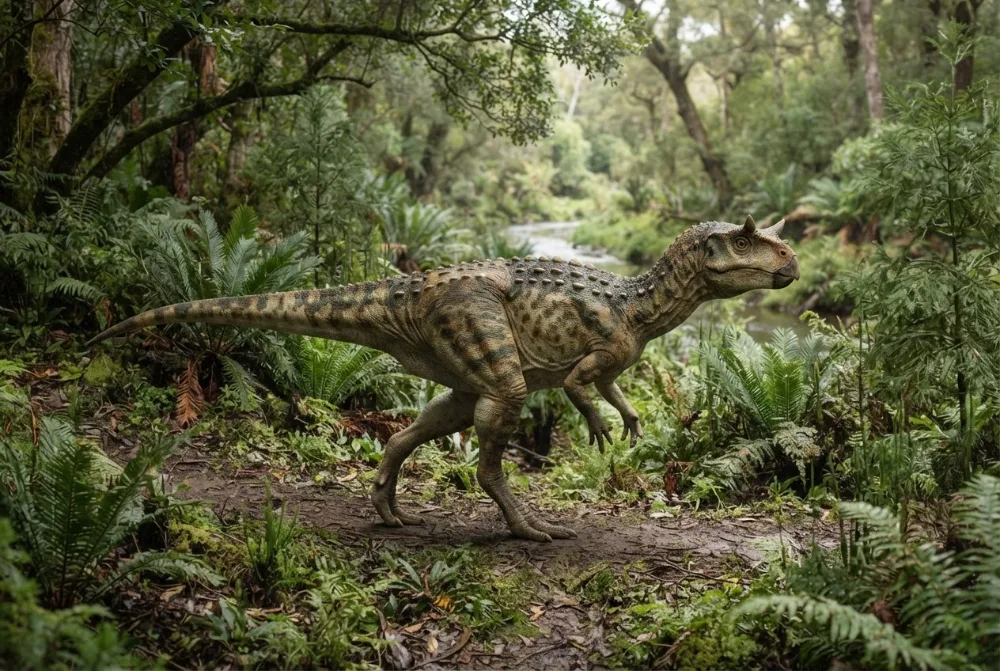
Ngir ñi xam dino lool
- Turu xam-xam
- Cariocecus
- Ku ko tudde
- Bertozzo et al. 20254
- Kurél
- Dino yu lekk gàncax te am gémmiñu picc
- Njaboot / klad
- Hadrosauroidea4
- Klasifikasiyoŋ
- Ornithischia > Ornithopoda > Iguanodontia4
- Màggaayu doj yi
- 126 ba 121 milyoŋ at (Barremian)4
- Formasiyoŋi doj
- Papo Seco4
- Réew yi
- Portigaal4
- Fosil yu ñu gis
- 1 ci The Paleobiology Database4
- Gisees
- The only known skull was found in 2016 by Pedro Marrecas in a limestone outcrop in Portugal. It was named Cariocecus bocagei in 2025 by Filippo Bertozzo and colleagues.1
- Ñu ngi koy werante ba tey
- Scientists are not sure exactly how large Cariocecus grew, because the only known fossil is from a young individual.1
Fa xibaar yi jóge
- Cariocecus bocagei (en.wikipedia.org)
- Cariocecus bocagei, a new basal hadrosauroid from the Lower Cretaceous of Portugal: Journal of Systematic Palaeontology: Vol 23, No 1 (tandfonline.com)
- Cariocecus bocagei | Dinosaur Database by DinoAnimals.com (dinoanimals.com)
- Cariocecus in The Paleobiology Database (CC BY 4.0): at, béréb yi, formasiyoŋi doj, klasifikasiyoŋ.
Bépp xibaar ci xët wii am na lim bu wone fa mu jóge. Su nu juumee, baal nu, nun ñu bëgg dino lanu, du ab sërnaalu xam-xam. Wax nu ko ci [email protected] nu defar ko.
 Rex xiif na! Dino Wiki, mbiru ab baay la ngir doomam ju góor ju bëgg dinosoor, ci neen te amul kaamuñaate, amul tracker. Mag ñi mën nañu jox Rex tuuti ñam ngir dimbali ko mu des ci internet.Dundal Rex
 Iguanodon
 Tenontosaurus
 Thescelosaurus
 Zalmoxes
 Camptosaurus
 Rhabdodon
 Stegosaurus
 Archaeopteryx
 Giganotosaurus
 Microraptor
 Deinonychus
 Baryonyx