 Ban dino nga? Kiis
 Xeexu dino
 Rawante dino
 Fo yu ndaw yu dino
 Albomu sitikeer
 Limu TOP yu dino
 Bett ma!
Kañ la dundoon?

Naka la réyoon?
Naka la guddoon?
Naka la kawewoon?
jortu
Naka la diisoon?

 gudd ni 6 xaj, bakkan ba geen🍌gudd ni 33 banaana yu ñu topp-toppalediis ni 75 xaj🍉diis ni 300 xaal🧸diis ni 79 xale yu maternel🎒diis ni 47 xale yu lekkool🐻❄️diis ni 3 uurs yu weex🏃mënoon na daw 100 meetar ci 12 segond (nit ki gën a gaaw dafay soxla 9,6)
Naka la Cedrorestes réyoon, bu ñu ko méngalee ak YAW?
Ay kalkil rekk ci sa navigatëer. Dara du ñu denc, dara du ñu yónne fenn.
Naka la gaawoon?


Xibaar yu neex
Cedrorestes is known from only one partial skeleton, including hip bones, a thighbone, and ribs.1
Its hip bone had a tall blade like Iguanodon but also a special bony bump that is usually seen in hadrosaurids, the duck-billed dinosaurs.1
The fossil was found scattered in mudstone and showed damage from weathering or trampling before it was buried.1
Cedrorestes lived alongside other dinosaurs like the armored Gastonia, the big predator Utahraptor, and the sauropod Cedarosaurus.1
The species name crichtoni honors Michael Crichton, the author of Jurassic Park.1
Scientists think Cedrorestes could move on two legs or on all fours, like many other iguanodontian dinosaurs.1
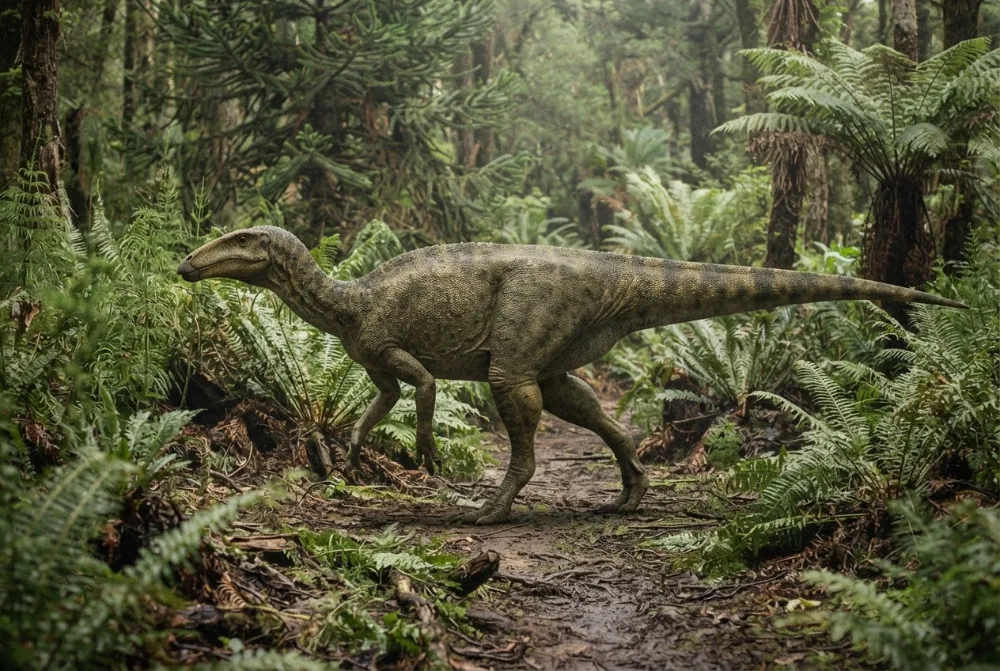
Laaj yi ñu gën a laaj ci Cedrorestes
?How big was Cedrorestes?
No one knows for sure because only a partial skeleton has been found. It was a large herbivore, but scientists need more fossils to estimate its size.1
?What did Cedrorestes eat?
It was a plant-eater. It had a beak for munching plants and could walk on two legs or on all fours to reach different kinds of vegetation.1
?Was Cedrorestes a dinosaur?
Yes, it was a dinosaur. It belonged to the group Iguanodontia, which are plant-eating ornithischian dinosaurs.1
?When did Cedrorestes live?
It lived during the Early Cretaceous Period, about 137 to 132 million years ago, in what is now Utah, USA.1
Ngir ñi xam dino lool
- Turu xam-xam
- Cedrorestes
- Ku ko tudde
- Gilpin et al. 20074
- Kurél
- Dino yu lekk gàncax te am gémmiñu picc
- Njaboot / klad
- Hadrosauroidea4
- Klasifikasiyoŋ
- Ornithischia > Ornithopoda > Iguanodontia4
- Màggaayu doj yi
- 137 ba 133 milyoŋ at (Valanginian)4
- Formasiyoŋi doj
- Cedar Mountain4
- Réew yi
- Amerig4
- Fosil yu ñu gis
- 1 ci The Paleobiology Database4
- Gisees
- The fossil was found in 2001 near the top of the Yellow Cat Member in Utah. David Gilpin and colleagues named it Cedrorestes crichtoni in 2007.1
- Ñu ngi koy werante ba tey
- Scientists are not sure whether Cedrorestes was an early hadrosaurid or a close relative of hadrosaurids, because the skeleton is incomplete.1
Fa xibaar yi jóge
- Cedrorestes (en.wikipedia.org)
- Cedrorestes Gilpin et al. 2007 - Encyclopedia of Life (eol.org)
- Cedrorestes crichtoni (es.wikipedia.org)
- Cedrorestes in The Paleobiology Database (CC BY 4.0): at, béréb yi, formasiyoŋi doj, klasifikasiyoŋ.
Bépp xibaar ci xët wii am na lim bu wone fa mu jóge. Su nu juumee, baal nu, nun ñu bëgg dino lanu, du ab sërnaalu xam-xam. Wax nu ko ci [email protected] nu defar ko.
 Rex xiif na! Dino Wiki, mbiru ab baay la ngir doomam ju góor ju bëgg dinosoor, ci neen te amul kaamuñaate, amul tracker. Mag ñi mën nañu jox Rex tuuti ñam ngir dimbali ko mu des ci internet.Dundal Rex
 Iguanodon
 Tenontosaurus
 Thescelosaurus
 Zalmoxes
 Camptosaurus
 Rhabdodon
 Stegosaurus
 Archaeopteryx
 Giganotosaurus
 Microraptor
 Deinonychus
 Baryonyx