 Ban dino nga? Kiis
 Xeexu dino
 Rawante dino
 Fo yu ndaw yu dino
 Albomu sitikeer
 Limu TOP yu dino
 Bett ma!
Comptonatus
Comptonatus was a big, plant-eating dinosaur that lived on the Isle of Wight in England about 125 million years ago. It had a beak and walked on two legs, munching on ferns and cycads. Its skeleton is the most complete iguanodontian dinosaur found in the Wealden Group in a hundred years!61
Kañ la dundoon?
Naka la réyoon?
Naka la guddoon?
Naka la kawewoon?
jortu
Naka la diisoon?
 gudd ni 6 xaj, bakkan ba geen🍌gudd ni 34 banaana yu ñu topp-toppale🍉diis ni 210 xaal🧸diis ni 55 xale yu maternel🎒diis ni 33 xale yu lekkool🐻❄️diis ni 2,5 uurs yu weex🏃mënoon na daw 100 meetar ci 11 segond (nit ki gën a gaaw dafay soxla 9,6)
Naka la Comptonatus réyoon, bu ñu ko méngalee ak YAW?
Ay kalkil rekk ci sa navigatëer. Dara du ñu denc, dara du ñu yónne fenn.
Naka la gaawoon?


Xibaar yu neex
Comptonatus was named in 2024, making it one of the newest dinosaur species.6
Its name means 'the Compton thunderer' because it was found at Compton Bay and was a large animal.1
The skeleton was discovered in 2013 by fossil collector Nick Chase, and it took over a decade to study and name.1
Comptonatus had a straight lower jaw bone (dentary) and a very wide prepubic blade, which are unique features.1
It lived alongside other dinosaurs like Mantellisaurus, Brighstoneus, and Iguanodon in the same area.1
The fossils were found in a plant debris bed that also contained fish scales, crocodile teeth, and conifer trunks.1
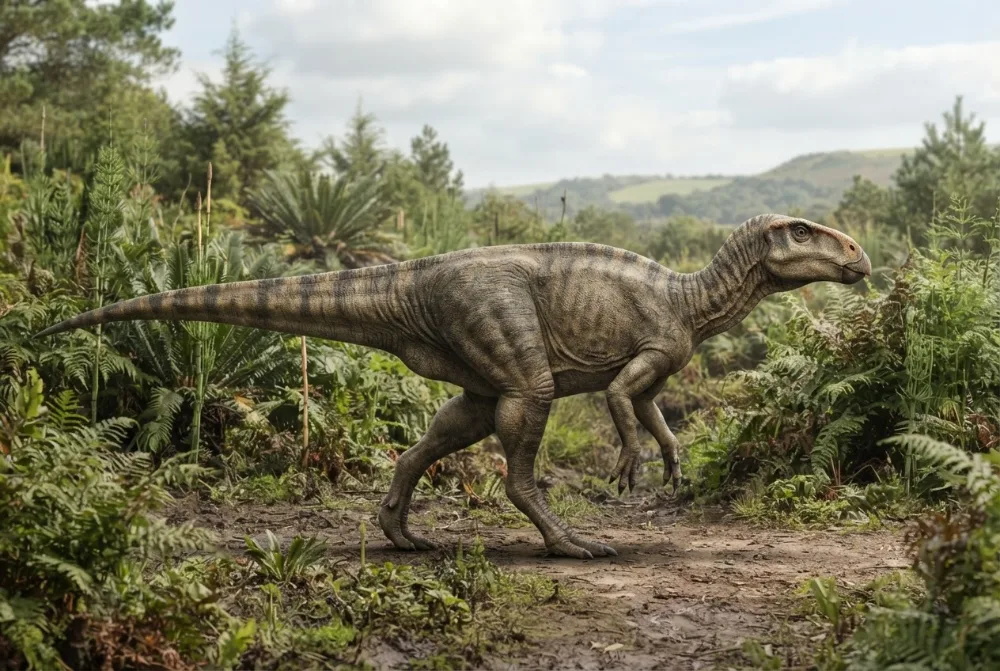
Laaj yi ñu gën a laaj ci Comptonatus
?How big was Comptonatus?
About 4 metres (13 feet) long. That is roughly the length of a small car.4
?What did Comptonatus eat?
It was a herbivore, eating plants like conifers, cycads and tree-ferns that grew in its environment.4
?Did Comptonatus have any special features?
Yes, it had a straight lower jaw bone and a very wide prepubic blade. It also had large thumb spikes that may have been used for defense or fighting.41
?When did Comptonatus live?
It lived during the early Cretaceous period, about 125 million years ago.5
Ngir ñi xam dino lool
- Turu xam-xam
- Comptonatus
- Ku ko tudde
- Lockwood et al. 20246
- Kurél
- Dino yu lekk gàncax te am gémmiñu picc
- Njaboot / klad
- Hadrosauriformes6
- Klasifikasiyoŋ
- Ornithischia > Ornithopoda > Iguanodontia6
- Màggaayu doj yi
- 126 ba 121 milyoŋ at (Barremian)6
- Formasiyoŋi doj
- Wessex6
- Réew yi
- Angalteer6
- Fosil yu ñu gis
- 1 ci The Paleobiology Database6
- Gisees
- Comptonatus chasei was discovered in 2013 by Nick Chase on National Trust land at Compton Bay, Isle of Wight. It was named by Jeremy Lockwood, David Martill, and Susannah Maidment in 2024.1
- Ñu ngi koy werante ba tey
- Scientists are still debating exactly how Comptonatus is related to other iguanodontian dinosaurs, because it has a mix of features seen in different groups.1
Fa xibaar yi jóge
- Full article: Comptonatus chasei, a new iguanodontian dinosaur from the Lower Cretaceous Wessex Formation of the Isle of Wight, southern England (tandfonline.com)
- Comptonatus chasei | Dinosaur Database by DinoAnimals.com (dinoanimals.com)
- The most complete UK dinosaur in a century found on the Isle of Wight | Natural History Museum (nhm.ac.uk)
- Comptonatus, an iguanodontian dinosaur from the Isle of Wight - DinoWight (dinowight.org.uk)
- Comptonatus (en.wikipedia.org)
- Comptonatus in The Paleobiology Database (CC BY 4.0): at, béréb yi, formasiyoŋi doj, klasifikasiyoŋ.
Bépp xibaar ci xët wii am na lim bu wone fa mu jóge. Su nu juumee, baal nu, nun ñu bëgg dino lanu, du ab sërnaalu xam-xam. Wax nu ko ci [email protected] nu defar ko.
 Rex xiif na! Dino Wiki, mbiru ab baay la ngir doomam ju góor ju bëgg dinosoor, ci neen te amul kaamuñaate, amul tracker. Mag ñi mën nañu jox Rex tuuti ñam ngir dimbali ko mu des ci internet.Dundal Rex
 Iguanodon
 Tenontosaurus
 Thescelosaurus
 Zalmoxes
 Camptosaurus
 Rhabdodon
 Stegosaurus
 Archaeopteryx
 Giganotosaurus
 Microraptor
 Deinonychus
 Baryonyx