 Ban dino nga? Kiis
 Xeexu dino
 Rawante dino
 Fo yu ndaw yu dino
 Albomu sitikeer
 Limu TOP yu dino
 Bett ma!
Dearc
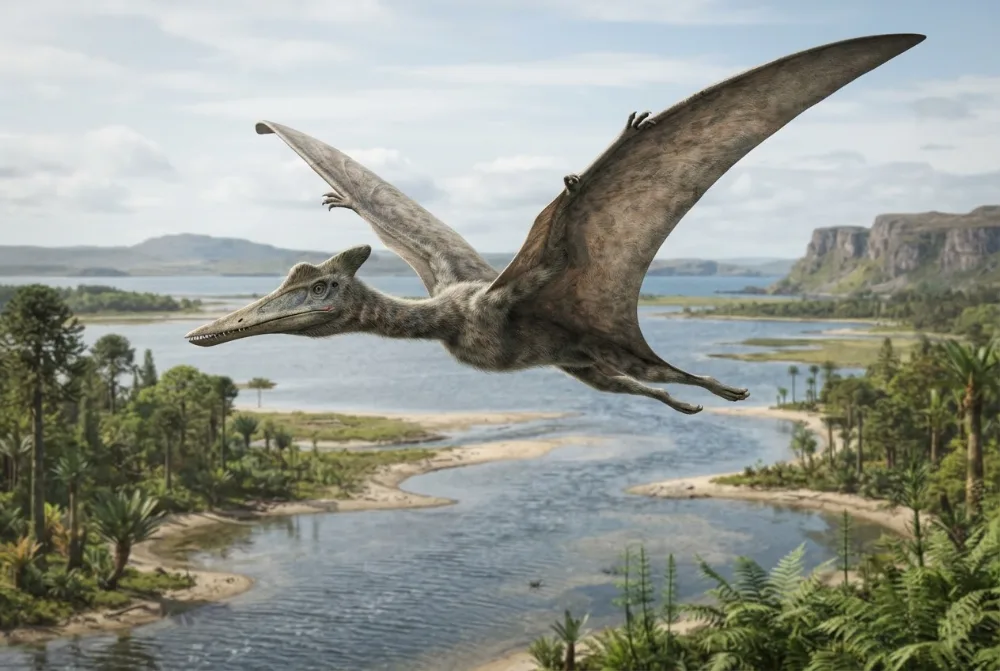
Dearc was a flying reptile that lived in the Middle Jurassic, about 167 million years ago. It was one of the biggest flying animals of its time, with wings as wide as a small car! It soared over the lagoons of what is now Scotland.1
Kañ la dundoon?
Naka la réyoon?
Naka la ay laafam yaatuwoon?
 laaf yu yaatu ni 1,5 welo ci benn rëdd⚽mënoon na naaw ci kaw teraŋ futbal bépp ci 7,3 segond
Naka la Dearc réyoon, bu ñu ko méngalee ak YAW?
Ay kalkil rekk ci sa navigatëer. Dara du ñu denc, dara du ñu yónne fenn.
Naka la gaawoon?


Xibaar yu neex
Dearc was not fully grown when it died. It was a juvenile or subadult, still actively growing, so adults might have been even bigger.13
Its wingspan was about 2.5 to 3 metres (8 to 10 feet), as wide as a wandering albatross, the largest flying bird today.1
Before Dearc was discovered, scientists thought pterosaurs stayed small until the Cretaceous period. Dearc shows they got big much earlier.13
The fossil was found at Brothers' Point on the Isle of Skye in 2017, during a National Geographic-funded field trip.1
Its name comes from Scottish Gaelic and means both 'winged reptile' and 'reptile from Skye', because Skye is called the 'winged isle'.1
Dearc had a long, low skull and a slender upper arm bone, which helped it fly.1
Laaj yi ñu gën a laaj ci Dearc
?How big was Dearc?
Dearc had a wingspan of about 2.5 to 3 metres, as wide as a wandering albatross, the largest flying bird today. It was not fully grown when it died, so adults might have been even bigger.34
?When did Dearc live?
Dearc lived in the Middle Jurassic, about 167 million years ago.3
?Where was Dearc found?
The fossil was found at Brothers' Point on the Isle of Skye in Scotland in 2017.3
?What did Dearc eat?
Dearc had two types of teeth: long fangs at the front and peg-like teeth further back, which suggests it ate fish or other small animals.3
?Is Dearc a dinosaur?
No, Dearc is a pterosaur, a flying reptile, not a dinosaur.3
Ngir ñi xam dino lool
- Turu xam-xam
- Dearc
- Ku ko tudde
- Jagielska et al. 20226
- Kurél
- Reptil yuy naaw
- Njaboot / klad
- Rhamphorhynchidae6
- Klasifikasiyoŋ
- Pterosauria > Rhamphorhynchidae6
- Màggaayu doj yi
- 168 ba 165 milyoŋ at (Bathonian)6
- Formasiyoŋi doj
- Lealt Shale6
- Réew yi
- Angalteer6
- Fosil yu ñu gis
- 1 ci The Paleobiology Database6
- Gisees
- The first Dearc fossil was discovered on May 23, 2017, at Brothers' Point on the Isle of Skye, Scotland, by a team led by Stephen Brusatte. It was named Dearc sgiathanach by Jagielska and colleagues in 2022.1
- Ñu ngi koy werante ba tey
- Scientists are not sure exactly how big Dearc could grow, because the only known fossil is from a young animal that was still growing.1
Fa xibaar yi jóge
- A skeleton from the Middle Jurassic of Scotland illuminates an earlier origin of large pterosaurs: Current Biology (cell.com)
- PBDB Taxon (paleobiodb.org)
- Dearc (en.wikipedia.org)
- Report A skeleton from the Middle Jurassic of Scotland illuminates an earlier origin of large pterosaurs (sciencedirect.com)
- Jurassic Dearc | Nature Ecology & Evolution (nature.com)
- Dearc in The Paleobiology Database (CC BY 4.0): at, béréb yi, formasiyoŋi doj, klasifikasiyoŋ.
Bépp xibaar ci xët wii am na lim bu wone fa mu jóge. Su nu juumee, baal nu, nun ñu bëgg dino lanu, du ab sërnaalu xam-xam. Wax nu ko ci [email protected] nu defar ko.
 Rex xiif na! Dino Wiki, mbiru ab baay la ngir doomam ju góor ju bëgg dinosoor, ci neen te amul kaamuñaate, amul tracker. Mag ñi mën nañu jox Rex tuuti ñam ngir dimbali ko mu des ci internet.Dundal Rex
 Pteranodon
 Quetzalcoatlus
 Dorygnathus
 Rhamphorhynchus
 Anhanguera
 Pterodactylus
 Ichthyosaurus
 Khudiakovia
 Ophthalmosaurus
 Peloneustes
 Gongbusaurus
 Shunosaurus