 Ban dino nga? Kiis
 Xeexu dino
 Rawante dino
 Fo yu ndaw yu dino
 Albomu sitikeer
 Limu TOP yu dino
 Bett ma!
Kañ la dundoon?

Naka la réyoon?
Naka la guddoon?
 gudd ni 5 muusu kër, bakkan ba geen🍌gudd ni 13 banaana yu ñu topp-toppale🏃mënoon na daw 100 meetar ci 8,8 segond (nit ki gën a gaaw dafay soxla 9,6)
Naka la Diluvicursor réyoon, bu ñu ko méngalee ak YAW?
Ay kalkil rekk ci sa navigatëer. Dara du ñu denc, dara du ñu yónne fenn.
Naka la gaawoon?


Xibaar yu neex
Diluvicursor's name means 'flood runner' because its body was found in a deep, fast-moving river deposit.1
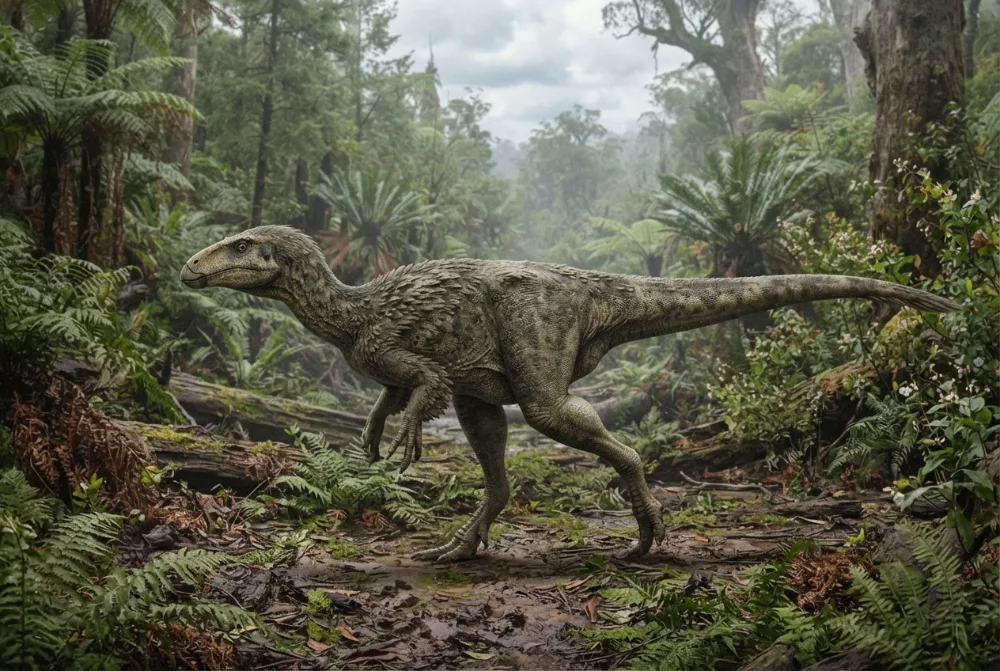
The only known skeleton is a juvenile that was about 1.2 metres long, about the size of a wild turkey.1
An adult Diluvicursor probably grew to at least 2.3 metres long, similar in size to a rhea.1
Its tail was short but very strong, with wide bones that suggest powerful muscles for running.2
Diluvicursor lived about 113 to 112 million years ago, during the Early Cretaceous period.1
The fossil was found in a log-filled scour in an ancient river, possibly caught on a tree stump.1
Scientists think Diluvicursor was closely related to other small ornithopods from South America and Antarctica.2
Laaj yi ñu gën a laaj ci Diluvicursor
?How big was Diluvicursor?
A young Diluvicursor was about 1.2 metres (3.9 ft) long, about the size of a wild turkey. An adult probably grew to at least 2.3 metres (7.5 ft) long, similar in size to a rhea.12
?What did Diluvicursor eat?
Diluvicursor was a plant-eater. Its diet probably included flowers, seeds, fruit, pine nuts, mosses, and lichens.1
?Could Diluvicursor run fast?
Yes, scientists think Diluvicursor was a good runner. Its short, strong tail had powerful muscles that helped it run quickly.13
?When did Diluvicursor live?
Diluvicursor lived about 113 to 112 million years ago, during the Early Cretaceous period.1
Ngir ñi xam dino lool
- Turu xam-xam
- Diluvicursor
- Ku ko tudde
- Herne et al. 20184
- Kurél
- Dino yu lekk gàncax te am gémmiñu picc
- Njaboot / klad
- Elasmaria4
- Klasifikasiyoŋ
- Ornithischia > Ornithopoda > Iguanodontia4
- Màggaayu doj yi
- 113 ba 110 milyoŋ at (Albian)4
- Formasiyoŋi doj
- Eumeralla4
- Réew yi
- Ostarali4
- Fosil yu ñu gis
- 1 ci The Paleobiology Database4
- Gisees
- The fossils were discovered in 2005 at a beach near Cape Otway, Victoria, Australia. Scientists named it Diluvicursor pickeringi in 2018, honoring David A. Pickering.1
- Ñu ngi koy werante ba tey
- Scientists are not sure if Diluvicursor is the same as other small ornithopods from the same area, like Atlascopcosaurus or Leaellynasaura, because their fossils don't overlap.1
Fa xibaar yi jóge
- Diluvicursor (en.wikipedia.org)
- A new small-bodied ornithopod (Dinosauria, Ornithischia) from a deep, high-energy Early Cretaceous river of the Australian, Antarctic rift system (pmc.ncbi.nlm.nih.gov)
- Turkey-sized dinosaur discovered in ancient log-jam - News - The University of Queensland (news.uq.edu.au)
- Diluvicursor in The Paleobiology Database (CC BY 4.0): at, béréb yi, formasiyoŋi doj, klasifikasiyoŋ.
Bépp xibaar ci xët wii am na lim bu wone fa mu jóge. Su nu juumee, baal nu, nun ñu bëgg dino lanu, du ab sërnaalu xam-xam. Wax nu ko ci [email protected] nu defar ko.
 Rex xiif na! Dino Wiki, mbiru ab baay la ngir doomam ju góor ju bëgg dinosoor, ci neen te amul kaamuñaate, amul tracker. Mag ñi mën nañu jox Rex tuuti ñam ngir dimbali ko mu des ci internet.Dundal Rex
 Iguanodon
 Tenontosaurus
 Thescelosaurus
 Zalmoxes
 Camptosaurus
 Rhabdodon
 Stegosaurus
 Archaeopteryx
 Giganotosaurus
 Microraptor
 Deinonychus
 Baryonyx