 Ban dino nga? Kiis
 Xeexu dino
 Rawante dino
 Fo yu ndaw yu dino
 Albomu sitikeer
 Limu TOP yu dino
 Bett ma!
Dunhuangia
Dunhuangia was a bird that lived during the Early Cretaceous, about 121 to 113 million years ago. It was a medium-sized enantiornithine bird, a group that was very common during the time of dinosaurs. Dunhuangia had special bones in its chest that made it different from other birds.21
Kañ la dundoon?
Naka la gaawoon?


Xibaar yu neex
Dunhuangia is only the second enantiornithine bird species ever named from the Changma Basin in China.1
Its fossil includes parts of the forelimbs, shoulder girdle, and breastbone, but the skull is missing.3
The end of its breastbone had a deep notch with two side projections, a feature that helps scientists tell it apart from other enantiornithine birds.1
Dunhuangia lived alongside many other animals, including fish, salamanders, turtles, and other birds like Gansus.1
The Changma Basin where Dunhuangia was found is one of the few places where more advanced ornithuromorph birds outnumbered enantiornithines like Dunhuangia.1
Scientists think Dunhuangia was a ground-dwelling bird that could fly actively.2
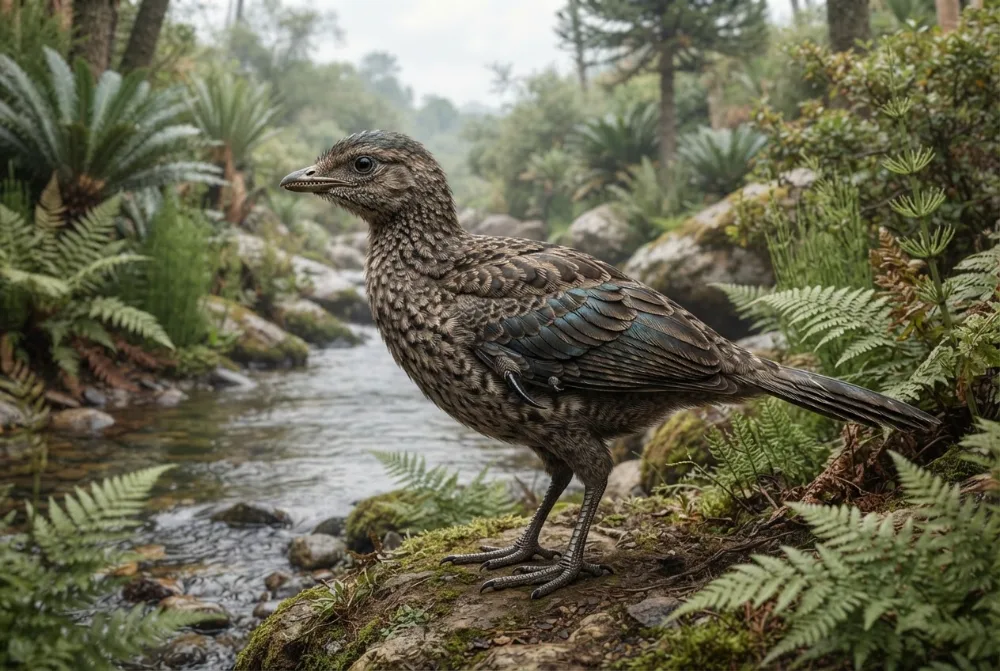
Ngir ñi xam dino lool
- Turu xam-xam
- Dunhuangia
- Ku ko tudde
- Wang et al. 20154
- Kurél
- Picc yu jëkk yi
- Njaboot / klad
- Enantiornithes4
- Klasifikasiyoŋ
- Theropoda > Avialae4
- Màggaayu doj yi
- 121 ba 113 milyoŋ at (Aptian)4
- Formasiyoŋi doj
- Xiagou4
- Réew yi
- Siin4
- Fosil yu ñu gis
- 1 ci The Paleobiology Database4
- Gisees
- Dunhuangia was named and described in 2015 by Wang Min, Li Daqing, Jingmai Kathleen O'Connor, Zhou Zhonghe, and You Hailu. The species name cuii honors Cui Guihai, who prepared many bird fossils from the Changma Basin.31
- Ñu ngi koy werante ba tey
- Scientists are still debating whether the Changma avifauna represents a transitional stage in the dominance of ornithuromorph birds over enantiornithines like Dunhuangia.1
Fa xibaar yi jóge
- Second species of enantiornithine bird from the Lower Cretaceous Changma Basin, northwestern China with implications for the taxonomic diversity of the Changma avifauna (sciencedirect.com)
- PBDB Taxon (paleobiodb.org)
- Dunhuangia (en.wikipedia.org)
- Dunhuangia in The Paleobiology Database (CC BY 4.0): at, béréb yi, formasiyoŋi doj, klasifikasiyoŋ.
Bépp xibaar ci xët wii am na lim bu wone fa mu jóge. Su nu juumee, baal nu, nun ñu bëgg dino lanu, du ab sërnaalu xam-xam. Wax nu ko ci [email protected] nu defar ko.
 Rex xiif na! Dino Wiki, mbiru ab baay la ngir doomam ju góor ju bëgg dinosoor, ci neen te amul kaamuñaate, amul tracker. Mag ñi mën nañu jox Rex tuuti ñam ngir dimbali ko mu des ci internet.Dundal Rex
 Archaeopteryx
 Hesperornis
 Ichthyornis
 Baptornis
 Jurapteryx
 Gobipteryx
 Stegosaurus
 Iguanodon
 Giganotosaurus
 Microraptor
 Deinonychus
 Baryonyx