 Ban dino nga? Kiis
 Xeexu dino
 Rawante dino
 Fo yu ndaw yu dino
 Albomu sitikeer
 Limu TOP yu dino
 Bett ma!
Kañ la dundoon?

Naka la réyoon?
Naka la guddoon?
Naka la diisoon?
Naka la Eoalulavis réyoon, bu ñu ko méngalee ak YAW?
Ay kalkil rekk ci sa navigatëer. Dara du ñu denc, dara du ñu yónne fenn.
Naka la gaawoon?


Xibaar yu neex
Eoalulavis was about the size of a European goldfinch, weighing only about 45 grams (1.6 ounces).1
Its wingspan, including feathers, was only about 26 centimeters (10 inches), similar to a modern kingfisher.1
The name Eoalulavis means 'dawn alula bird' because it is one of the earliest birds known to have an alula, or 'bastard wing'.1
Scientists found the remains of its last meal inside the fossil: concentrated pieces of crustacean shells.1
Eoalulavis had a very thin, spear-shaped breastbone, unlike the wide breastbones of most early birds.1
It likely flew in a bounding style, flapping hard then tucking its wings to dive, like modern songbirds and woodpeckers.1
The fossil was preserved with feathers and soft tissues because it was buried quickly in a lake with special conditions.1
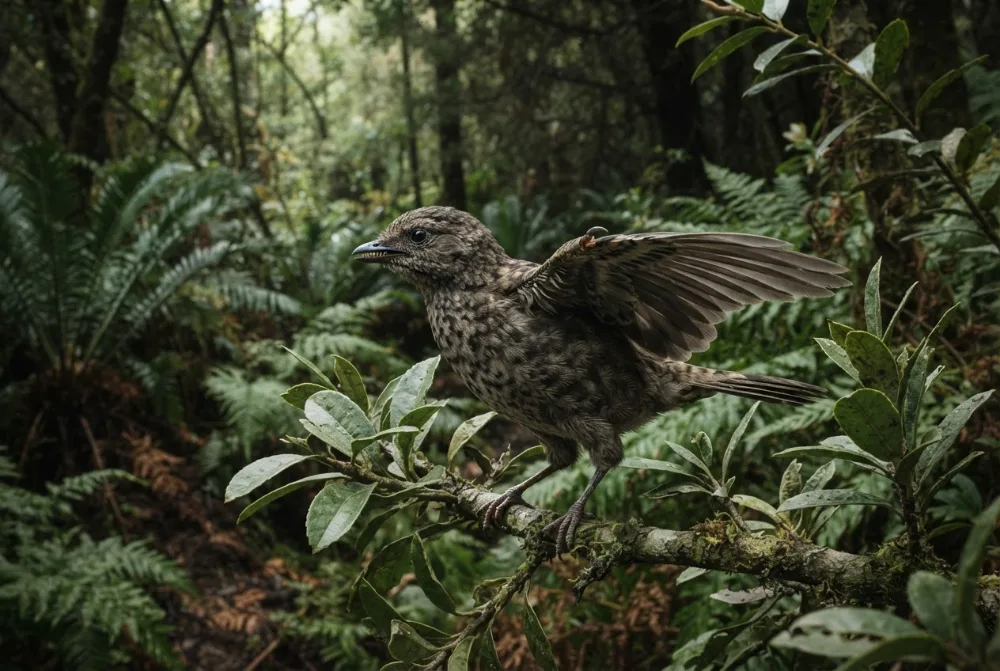
Laaj yi ñu gën a laaj ci Eoalulavis
?What did Eoalulavis eat?
It ate small crustaceans. Scientists found pieces of crustacean shells in its fossilized belly, its last meal.1
?How big was Eoalulavis?
It was tiny, about the size of a European goldfinch. It weighed about 45 grams and had a wingspan of about 26 centimeters.1
?Could Eoalulavis fly well?
Yes, it was a good flier. It had an alula for slow, sharp turns and likely used bounding flight, flapping hard then diving with wings folded, like modern songbirds.1
?Is Eoalulavis a dinosaur?
Yes, it is a bird, and birds are a type of dinosaur called avialan dinosaurs. It lived about 125 million years ago.1
Ngir ñi xam dino lool
- Turu xam-xam
- Eoalulavis
- Ku ko tudde
- Sanz et al. 19962
- Kurél
- Picc yu jëkk yi
- Njaboot / klad
- Enantiornithes2
- Klasifikasiyoŋ
- Theropoda > Avialae2
- Màggaayu doj yi
- 126 ba 121 milyoŋ at (Barremian)2
- Formasiyoŋi doj
- La Huérguina2
- Réew yi
- Españ2
- Fosil yu ñu gis
- 1 ci The Paleobiology Database2
- Gisees
- Eoalulavis was named in 1996 by Sanz and colleagues based on a single fossil skeleton found at Las Hoyas in Spain.12
- Ñu ngi koy werante ba tey
- Scientists are not sure what its hind legs looked like because no leg bones have been found.1
Fa xibaar yi jóge
- Eoalulavis (en.wikipedia.org)
- Eoalulavis in The Paleobiology Database (CC BY 4.0): at, béréb yi, formasiyoŋi doj, klasifikasiyoŋ.
Bépp xibaar ci xët wii am na lim bu wone fa mu jóge. Su nu juumee, baal nu, nun ñu bëgg dino lanu, du ab sërnaalu xam-xam. Wax nu ko ci [email protected] nu defar ko.
 Rex xiif na! Dino Wiki, mbiru ab baay la ngir doomam ju góor ju bëgg dinosoor, ci neen te amul kaamuñaate, amul tracker. Mag ñi mën nañu jox Rex tuuti ñam ngir dimbali ko mu des ci internet.Dundal Rex
 Archaeopteryx
 Hesperornis
 Ichthyornis
 Baptornis
 Jurapteryx
 Gobipteryx
 Stegosaurus
 Iguanodon
 Giganotosaurus
 Microraptor
 Deinonychus
 Baryonyx